

Roughly 376 billion emails are sent and received globally every day. A meaningful share of those are transactional – password resets, order confirmations, shipping alerts – emails users actually expect and open.
For developers and dev-led teams responsible for sending them, choosing the right SMTP service is one of those quiet infrastructure decisions with an outsized failure cost; pick wrong and you’re debugging bounce rates at 11pm.
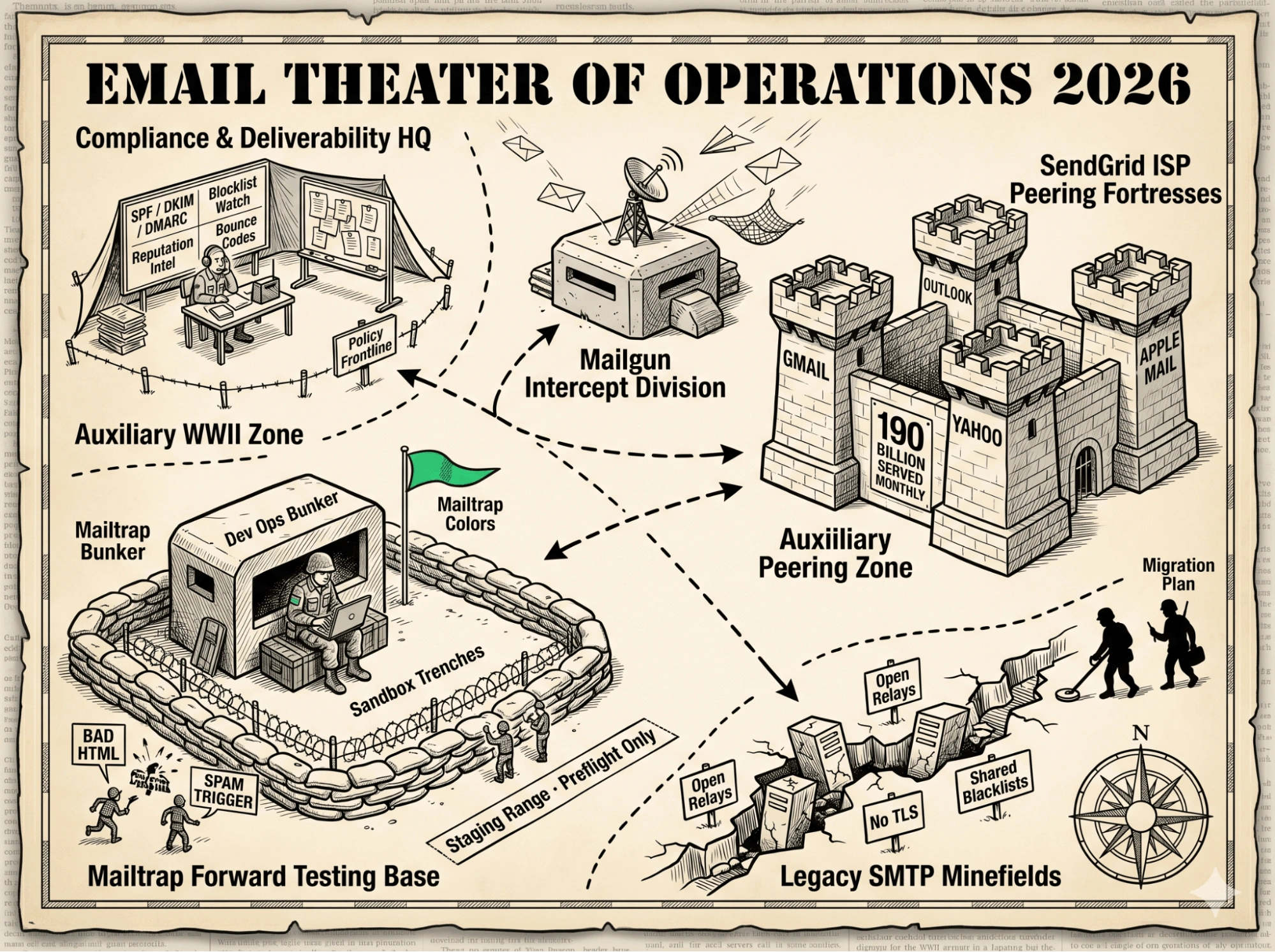
Mailtrap, SendGrid, and Mailgun cover the most common ground in the transactional email space – each is a capable email sending service, but none is the objectively correct answer for every team.
To help you make an informed choice, this comparison breaks down:
- Pricing
- Features
- Developer experience
- Security
Mailtrap vs SendGrid vs Mailgun: Which SMTP Service Is Best?
Three tools, three different philosophies.
- Choose Mailtrap if you’re a dev team that wants 99.99% uptime SLA, high deliverability, separate email streams, and 24/7 deliverability support.
- Choose SendGrid if you’re sending at enterprise scale (millions per month), or run dedicated marketing campaigns that require a purpose-built campaign product with full audience management.
- Choose Mailgun if your app handles inbound email programmatically, you need advanced list validation built into your workflow, or send-time optimization matters more than price.
There’s no safe default here. These tools are built for different problems.
Quick comparison
| Feature | Mailtrap | SendGrid | Mailgun |
| SMTP relay | Yes | Yes | Yes |
| REST API | Yes | Yes | Yes |
| Free tier | 4,000 emails/mo | 100 emails/day | 100 emails/day |
| SDK languages | 7 | 7 | Limited official |
| Email testing sandbox | Built-in (50 free test emails) | Paid add-on | Paid add-on |
| Inbound email parsing | Coming soon | No | Yes |
| Dedicated IP | Business+ ($85/mo) | Pro+ ($89.95/mo) | Scale ($90/mo) |
| SAML SSO | Enterprise | Pro+ | Scale+ |
| Email campaigns | Available on all plans | Dedicated product | Analytics-focused |
| Compliance certs | SOC 2, SOC 3, ISO, GDPR | GDPR, ISO, SOC 2 Type 2 | ISO, CSA, GDPR |
| Ecosystem | Standalone | Twilio | Sinch |
SMTP Providers Pricing Comparison

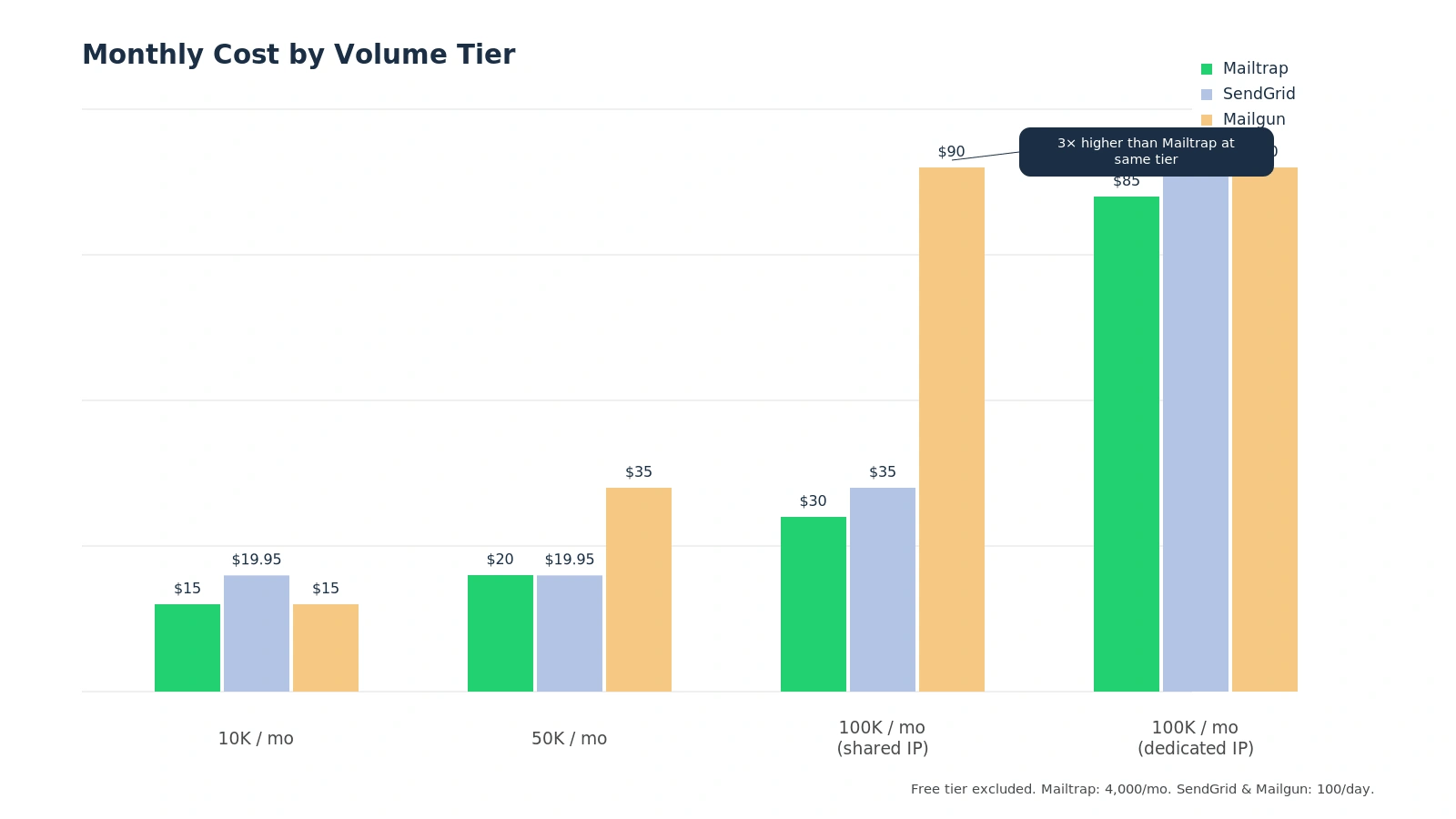
Pricing is where the differences become concrete fast. Here’s how Mailtrap, SendGrid, and Mailgun pricing stack up across common volume tiers.
| Volume | Mailtrap | SendGrid | Mailgun |
| Free tier | 4,000/mo | 100/day | 100/day |
| 10,000/mo | $15 | $19.95 | $15 |
| 50,000/mo | $20 | $19.95 | $35 |
| 100,000/mo (shared IP) | $30 | ~$35 | $90 |
| 100,000/mo (dedicated IP) | $85 | $89.95 | $90 + $59/IP |
| Overage per 1,000 | $0.55 – $1.00 | $0.90–$1.30 | $1.10–$1.80 |
The numbers tell a clear story at the extremes.
Mailtrap’s free tier is the most generous of the three by a significant margin – 4,000 emails per month versus 100 per day for both SendGrid and Mailgun. For development and early production, that gap matters.
At 50K emails/month, SendGrid edges out Mailtrap slightly on price ($19.95 vs $20). At 100K on shared infrastructure, Mailtrap pulls ahead at $30 versus SendGrid’s approximately $35 – and well ahead of Mailgun’s $90. Mailgun’s Scale plan is the only option at that volume; it bundles dedicated IPs by default, which partly explains the higher floor.
For dedicated IP plans, all three converge between $85 and $90 at 100K. Mailgun adds $59/IP for any additional addresses on top of that.
One Mailtrap limitation worth flagging: dedicated IP access starts at the Business tier ($85/month). Teams on the Basic plan ($30/month) are on shared IP infrastructure, with no upgrade path short of jumping to Business. For senders where IP reputation control matters, that’s a meaningful gap.
The situation is similar with SendGrid, a dedicated IP is included on Email API Pro plan $89.95. And you can purchase additional dedicated IPs at $30 per address.
Mailgun’s overage pricing is the steepest at lower tiers: $1.80 per 1,000 extra emails on the Basic plan, versus $1.00 for Mailtrap and around $1.30 for SendGrid Essentials. If your volume spikes over the ceiling regularly, Mailgun’s overages compound quickly.
Pricing verdict:
- Choose Mailtrap for the most generous free tier and best per-email cost for higher volumes – with the caveat that dedicated IPs require the $85/month Business plan
- Choose SendGrid at the 50K range for the lowest entry price, or when dedicated marketing teams need a full-featured campaign management product
- Choose Mailgun if 100K with dedicated IPs bundled suits your requirements, or Scale-tier features are non-negotiable
Mailtrap vs SendGrid vs Mailgun: Features Comparison
Price gets you in the door. Features determine whether you stay.
SMTP, Email API, and SDKs
All three platforms support both SMTP relay and a RESTful transactional email API. The integration method is not a differentiator, yet the differences show up in SDK depth and platform scope.
Mailtrap offers official SDKs in 7 languages – Python, PHP, Ruby, Node.js, Java, C#/.NET, Elixir. It also ships 25+ pre-built code snippets.
SendGrid covers 7 languages as well (Python, Node.js, Ruby, Go, PHP, Java, C#).
Email Marketing Features
Sometimes, developers need to set up sending marketing campaigns, so it won’t hurt to touch upon this topic as well.
SendGrid’s marketing campaigns product is purpose-built for dedicated marketing teams – audience segmentation, A/B testing, and detailed campaign reporting in one place.
Mailtrap also ships Email Campaigns on every plan, including free: drag-and-drop editor, contact segmentation, trigger-based automation, and scheduling. For dev-led teams with moderate campaign needs, Mailtrap’s bundled approach covers both in one subscription. For dedicated marketing teams running sophisticated campaigns at scale, SendGrid’s campaign product has more depth.
Mailgun focuses on the heavy-duty sending infrastructure and Templates API (allowing devs to store and version-control marketing templates via code), the front-end marketing features are handled by its sister brand, Mailjet. This gives you a specialized marketing interface with real-time collaboration and visual automation, backed by Mailgun’s enterprise-grade delivery network.
Deliverability and Analytics
Deliverability is the metric that matters most when something goes wrong.
SendGrid operates at the largest scale here – 190+ billion emails per month, with direct peering relationships with Gmail, Outlook, Yahoo, and Apple Mail. Those ISP relationships are established infrastructure; your emails aren’t negotiating their way into inboxes from scratch. Pro+ plans include dedicated IPs, and the platform’s published 1.9-second median delivery speed is the best-documented figure of the three.
Mailtrap Email API/SMTP service takes a different angle: its deliverability features are anchored by separate email streams and authentication. Also, there is an Email Sanbox where you can check how your emails perform using spam score analysis and HTML template support before you send the emails.
Mailgun takes the most active optimization approach of the three. Inbox placement testing, send-time optimization based on recipient behavior, and ESP throttling for high-volume senders (500K+/month) go beyond delivery confirmation into active improvement. Email validation is built into every plan tier – useful for keeping list quality high before bounce rates become a reputational problem.
On analytics, all three track delivery, open, click, and bounce rates with webhook notifications. Log retention is the key variable: Mailtrap Basic retains 5 days, SendGrid Essentials retains 3 days, Mailgun Foundation retains 5 days. Longer retention (15–30 days) requires higher-tier plans across all three.
Setup and Developer Experience
Getting to your first sent email is where developer experience lives or dies.
Mailtrap has the most compact onboarding path. The setup-to-send typically takes 5 minutes. If you’re using AI IDEs like Cursor or AI dev agents like Claude Code, Mailtrap provides an official MCP server and curated skills. And if you’re looking for one-click integrations with Supabase or Vercel: there are, with many more modern dev tools covered.
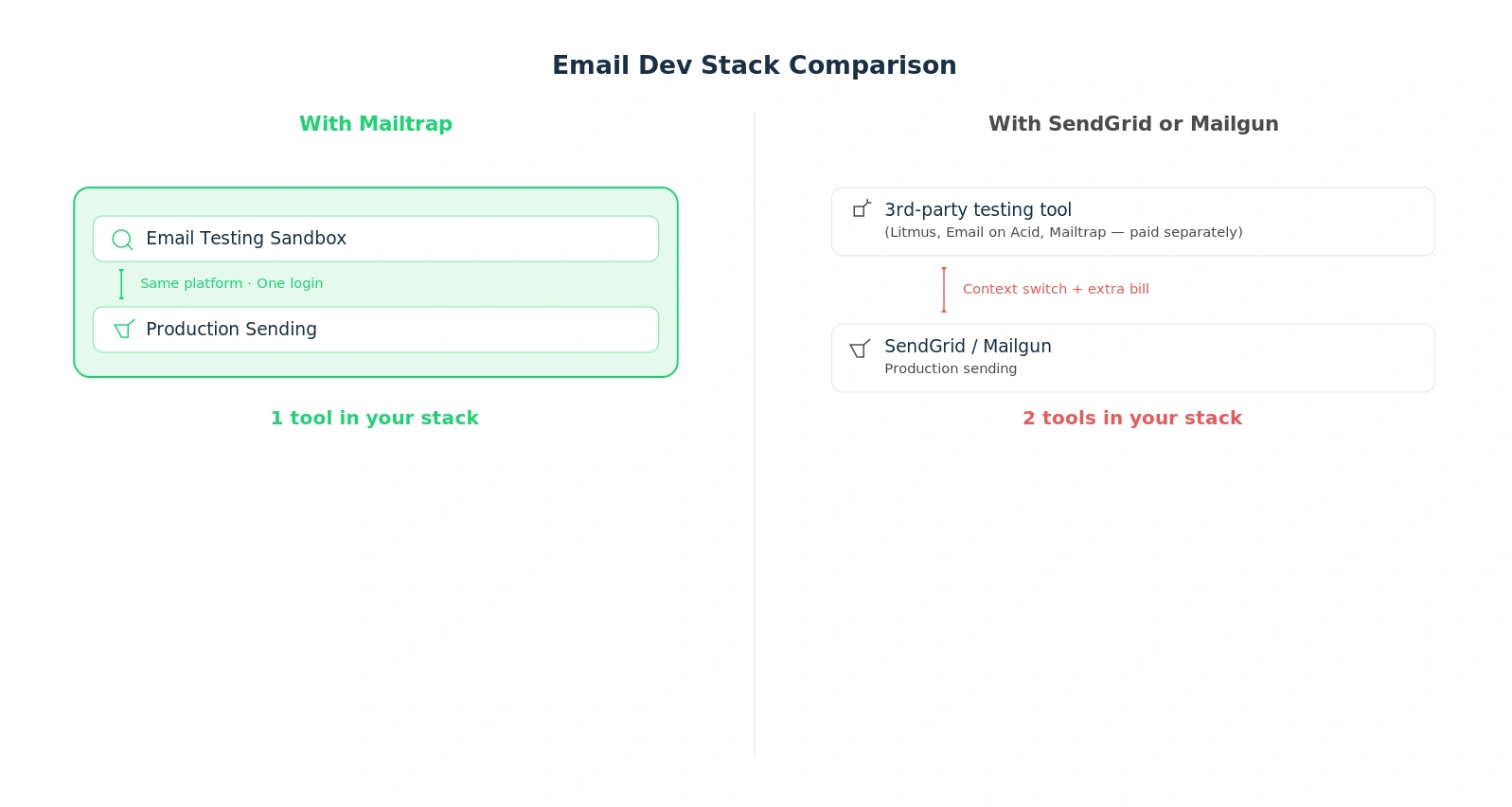
SendGrid’s setup takes more configuration. The platform’s breadth – transactional sending, marketing campaigns, email validation, paid testing add-ons – is genuinely powerful, but it adds overhead for teams that only need transactional email. Email testing starts at $18/month as a paid add-on rather than being included. If you came for a simple SMTP relay and found yourself reading documentation on subuser management, you’re not alone.
Mailgun is API-first and delivers on that positioning. Documentation is thorough, the email parsing features are well-defined, and the HTML compatibility checker extends to ADA and EAA accessibility checking – a level of QA features the other two don’t match. SAML SSO arrives at the Scale tier ($90/month), a lower price of entry than SendGrid’s equivalent (Pro at $89.95/month) and significantly lower than Mailtrap’s Enterprise tier.
Security and Compliance
All three implement SPF, DKIM, and DMARC as the baseline authentication stack.
Mailtrap adds automatic monthly DKIM key rotation – reducing the operational overhead of key management without manual intervention. On the compliance side, Mailtrap holds SOC 2 Type 2, SOC 3, and ISO certifications alongside GDPR compliance – a posture that stands up in enterprise procurement reviews.
SendGrid (via Twilio) includes SOC 2 Type 2, and ISO certificates. In addition, it supports TLS encryption, threat detection, and sender reputation monitoring under Twilio’s broader enterprise compliance umbrella. GDPR coverage applies across the platform.
Mailgun holds SOC2 Type 2, ISO, and CSA (Cloud Security Alliance) certifications alongside GDPR compliance, with a Data Processing Agreement available on request.
The right choice depends on which specific standards your procurement or legal team requires. For instance, ISO and SOC 2 Type 2 is common in US enterprise reviews; and Mailgun’s CSA credential carries weight in cloud security contexts.
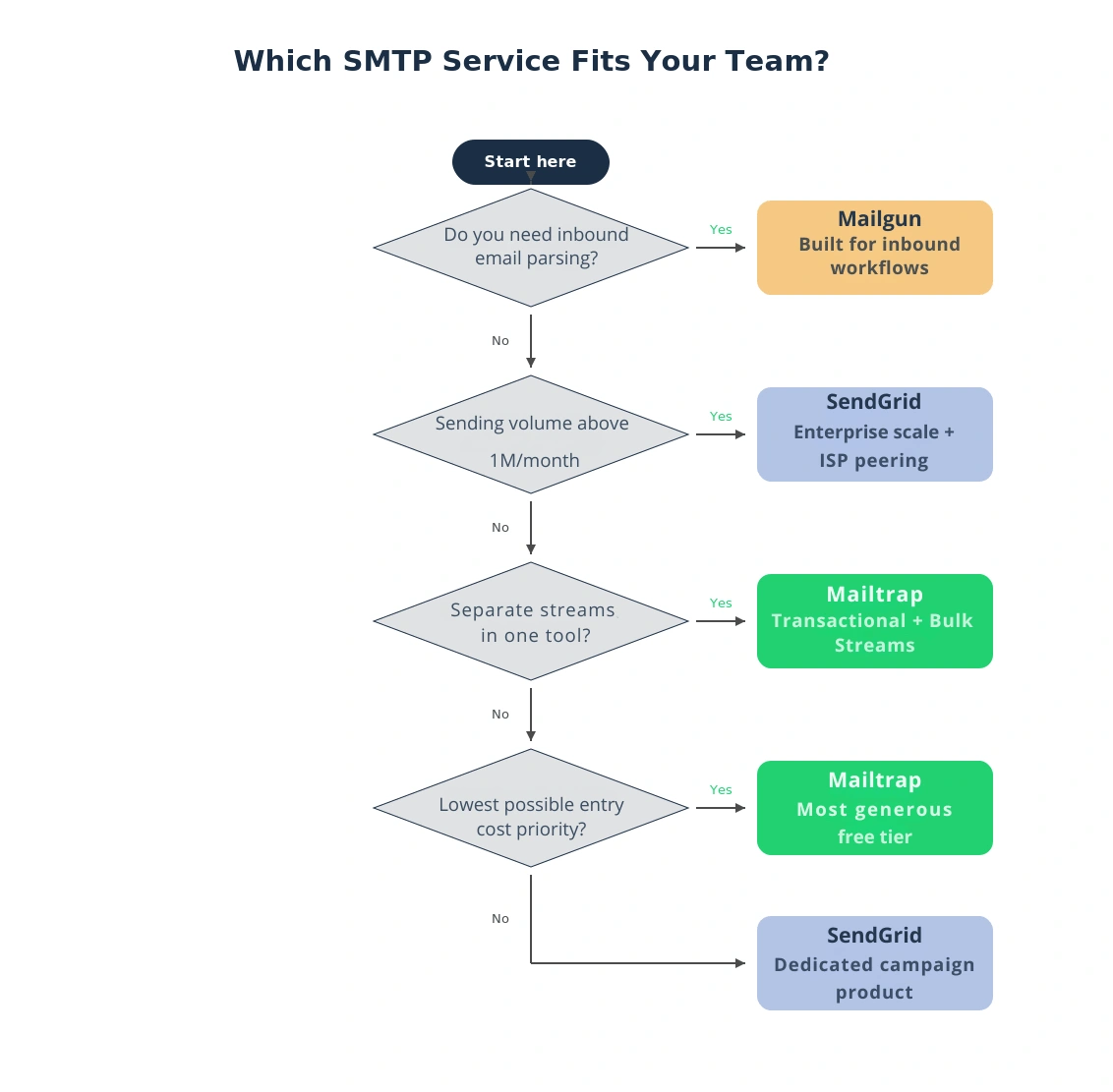
What SMTP Service – Mailtrap, SendGrid, or Mailgun – Is Right for Your Team?
Early-stage startup or small dev team: Mailtrap’s free tier (4,000 emails/month) and Basic plan pricing make it the easiest place to start without overcommitting. And you won’t be making compromises in deliverability and developer experience When you outgrow it, the path to higher tiers is straightforward.
Growth-stage product at 50K–500K/month: Mailtrap stays price-competitive across this range. This goes double for AI-native teams who need an email service that easily plugs into any ML tech stack. SendGrid makes sense if you’re already in the Twilio ecosystem and want to consolidate SMS and email under one provider. Mailgun fits when your product receives email as well as sends it.
High-volume sender at 1M+/month: SendGrid’s infrastructure at this scale is the most battle-tested. Direct ISP peering, a 99.99% uptime SLA, and dedicated deliverability consulting are meaningful at volume. Mailtrap’s Enterprise plan covers up to 2.5M+ emails; Mailgun scales to enterprise with custom agreements as well.
Regulated industry (fintech, healthcare, enterprise SaaS): SendGrid (SOC2, ISO,GDPR), Mailtrap (SOC 2 Type 2, SOC 3, ISO, GDPR) and Mailgun (ISO, CSA, GDPR with DPA) all carry documented third-party certifications. The right choice depends on which standards your procurement or legal team requires. As a reminder – SOC 2 Type 2 is the more common requirement in US enterprise contexts; CSA certification carries more weight in cloud security evaluations.
API-heavy or inbound email workflows: Mailgun is the clear choice. Inbound email parsing is a core feature, not an afterthought.
FAQ
Can I use these platforms for marketing email as well as transactional?
All three platforms support marketing campaigns alongside transactional email. Mailtrap includes Email Campaigns on every plan – from free through Enterprise – with a drag-and-drop editor, contact segmentation, automation, and scheduling. SendGrid has a dedicated marketing campaigns product with more depth for large-scale or dedicated marketing teams. Mailgun offers campaign analytics and a WYSIWYG template builder, though its positioning leans toward API-driven transactional use cases. For most dev-led teams, Mailtrap covers both transactional and campaign needs in one subscription. For dedicated marketing operations at scale, SendGrid’s standalone campaign product goes further.
Which has the best free tier?
Mailtrap, by a wide margin. Its free plan includes 4,000 emails per month plus a built-in testing sandbox. SendGrid and Mailgun both cap free sending at 100 emails per day with no built-in testing environment.
Do all three support dedicated IP addresses?
Yes. Mailtrap offers dedicated IPs starting at its Business plan ($85/month). SendGrid includes them on Pro plans ($89.95/month and above). Mailgun includes dedicated IP pools in the Scale plan ($90/month) and charges $59/IP for additional addresses.
How long are email logs available?
Log retention scales with plan tier on all three platforms. At entry-level paid plans: Mailtrap Basic and Mailgun Foundation both retain 5 days; SendGrid Essentials retains 3 days. Higher tiers extend retention to 15–30 days.
Which platform has the most SDK language support?
Mailtrap supports 8 programming languages with official SDKs. SendGrid supports 7. Mailgun has fewer officially maintained libraries but covers the major languages.
What if I need SAML SSO?
Mailgun and SendGrid both offer SAML SSO at their mid-tier plans ($90/month and $89.95/month respectively). Mailtrap reserves it for the Enterprise tier ($750/month). For SSO at the lowest cost entry point, Mailgun or SendGrid has the advantage.
Does the choice of SMTP service affect email deliverability?
Deliverability depends heavily on sender reputation, list hygiene, and authentication setup – factors within your control on any platform. At the infrastructure level, SendGrid’s scale and direct ISP peering is a documented advantage for high-volume senders. Mailtrap’s separate sending streams help mitigate deliverability problems, and you can use email sendbox to check emails before they affect sender reputation. Mailgun’s inbox placement testing actively diagnoses and helps improve placement over time. In a Mailtrap vs SendGrid vs Mailgun comparison on deliverability specifically, there’s no single winner – the right tool is the one that matches your volume, workflow, and how much active optimization you want built in.