
Quick Overview
Halloween email campaigns perform best when brands plan the schedule, the offers, the segments, and the measurement before October starts. Brands send six waves between early October and November 3, covering a teaser, the main offer, reminders, urgency, Halloween Day, and clearance. The theme matches the brand voice, layouts work on mobile, and colors keep strong contrast on dark backgrounds. Click-through rate, conversion rate, revenue per recipient, unsubscribe and complaint rates, deliverability, and A/B test results show what worked.
Why Halloween Email Marketing Matters
Halloween email marketing matters because it gives brands a dependable seasonal reason to reach the inbox before holiday shopping begins. Halloween gives brands an audience that is already spending, and email reaches that audience before the money leaves.
Shoppers spend heavily:
NRF projects $13.5 billion in 2026 spending, which maintains last year’s record of $13.1 billion.
Shoppers start early:
About half plan to begin in September or earlier, so a teaser in early October reaches people who are already shopping.
Shoppers want value:
79% expect higher prices, and 21% of early shoppers move early for promotions, so clear offers and bundles match the mood.
Email can drive real revenue:
Klaviyo data shows Halloween beating every federal holiday except BFCM, with top performers attributing over $1 million on average to Halloween email.
Halloween rehearses Black Friday:
Brands can collect data and test discount depth in October, then apply the winners in November.
Halloween builds the list:
Contests, loyalty perks, and reengagement emails strengthen the audience before the busiest weeks, and we see this in our own client work.
15 Halloween Email Campaign Ideas With Examples
Halloween email campaigns engage subscribers with enticing discounts, tailored product recommendations, limited sales, mystery offers, and holiday-themed guides.
1. Offer An Enticing Treat
Brands can choose the treat that fits their margins and audience. Discounts, free shipping, free setup, free trials, BOGO offers, and gifts all work as treats.
This Runway Rogue email places one clear treat at the center of the design. The BOGO 50 percent off eyeshadow offer appears in the hero, repeats beside two product images, and carries the code BOO each time.
How to adapt this idea:
- Service brands can offer free setup or an extended trial, while retailers often pair a percentage off with free shipping above a threshold.
- We place the offer in the hero and repeat the code at every button.
Key takeaways:
- A single specific offer outperforms a menu of small deals in our experience.
- Repeating code saves the reader from searching for it.
- Named audience, such as loyal subscribers, raises the perceived value of the same discount.
CTA: Shop BOGO 50% Off

2. Halloween Sale or Discount Email
A Halloween sale with a discount window can convert subscribers. Retailers can add gifts at two spending tiers to lift average order value.
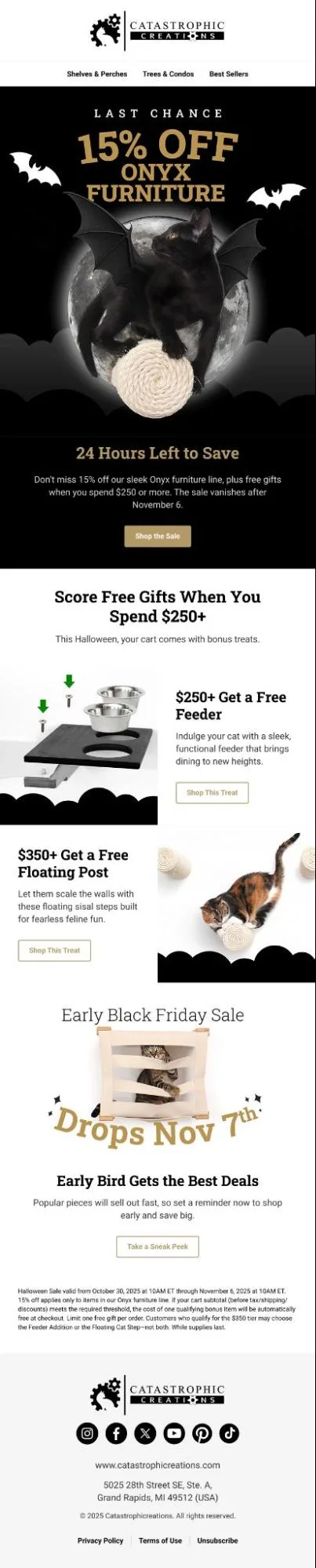
This Catastrophic Creations email combines a deadline with a tiered reward. The headline announces a last-chance 15 percent discount on Onyx furniture, and the next line states that 24 hours remain. Two gifts unlock at $250 and $350, encouraging larger carts.
How to adapt this idea:
- A closing teaser for an early Black Friday sale gives readers another reason to stay subscribed.
- A themed hero image, such as bats and a moon, carries the season without changing the product mix.
Key takeaways:
- Tiered gifts raise order value without deepening the discount.
- A visible end date makes urgency believable.
CTA: Shop the Sale
3. Halloween Teaser Email
Brands can send a teaser two to three weeks before Halloween. The email should preview the collection, announce the bundles or drops, and send readers to a landing page.
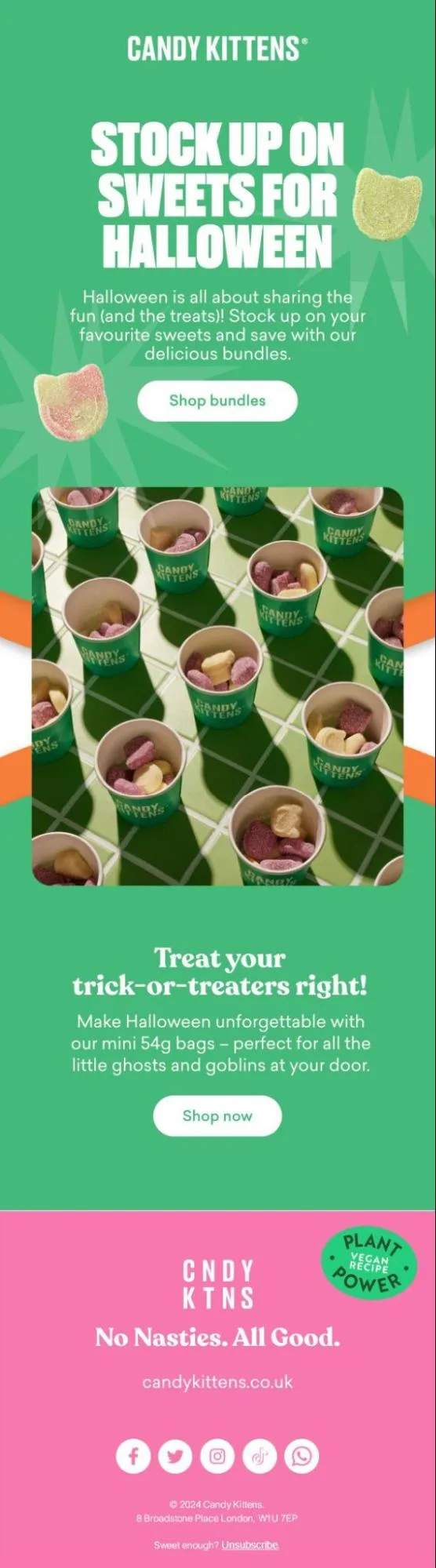
This Candy Kittens email opens the season early with a simple and playful message. The headline tells subscribers to stock up on sweets, and the first button leads to money-saving bundles. The email previews the range without leading with a heavy discount.
How to adapt this idea:
- Brands can add a text alert sign-up to build a stronger audience for the main offer.
- A short message with two buttons gives readers a quick path to browse.
Key takeaways:
- Teasers prepare the audience for the main offer.
- Brief copy and one strong photo keep the message easy to scan.
- A seasonal palette builds recognition before the discount arrives.
CTA: Shop now, Shop bundles
4. Countdown and Last Chance Halloween Email
Brands can add a countdown timer to the final week of the campaign and again to the final 48 hours of an offer.
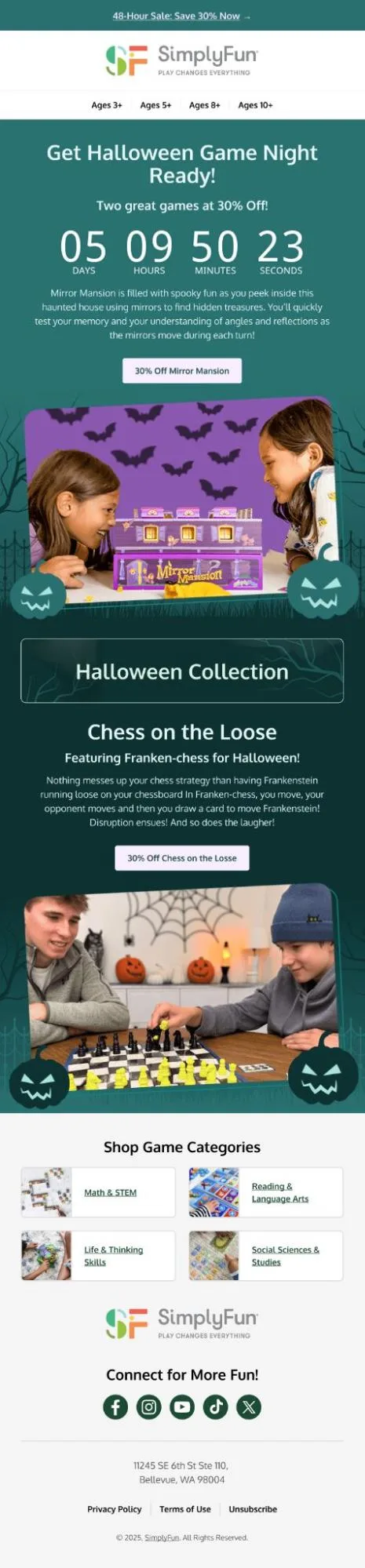
The Halloween email we designed for SimplyFun makes the deadline visible with a countdown timer. The top bar announces a 48-hour sale of 30 percent off, and the timer below the headline counts days, hours, minutes, and seconds. Two featured games, Mirror Mansion and Chess on the Loose, give readers a specific product to act on.
How to adapt this idea:
- A dynamic timer service updates the image at open time, so each subscriber sees the true time remaining.
- Marketers should match the timer to the real end of the offer.
- A last chance subject line and a matching top bar reinforce the deadline.
Key takeaways:
- A timer turns a deadline into a visual.
- Real deadlines build trust with subscribers.
- Product-specific buttons give readers a clearer next step.
CTA: 30% Off Mirror Mansion
5. Halloween-themed Product Email
Brands can revamp existing products with a seasonal theme or introduce Halloween-specific products.
Sok-It’s Halloween email presents a seasonal collection as a themed drop. The headline promises a magical drink, and the hero shows five sleeve designs on dark backgrounds. A top bar offers a 15 percent code for one day, which adds urgency.
How to adapt this idea:
- Brands can theme existing products with seasonal photography, names, and short descriptions.
- Marketers can group a limited drop into named styles so each subscriber finds a favorite.
- A one-day code or a drop framing creates urgency without a deep discount.
Key takeaways:
- Named styles let subscribers shop by personality.
- A drop framing creates scarcity without a deep discount.
- One strong visual direction keeps a long email cohesive.
CTA: Shop the Drop

6. Halloween Costume Inspiration Email
Halloween emails can share costume ideas that connect to the product, such as a food costume for a food brand. Apparel and beauty brands can show costume looks that use items from the catalog.
Our Halloween email for Graza entertains subscribers before it sells to them. The email opens with a spooky playlist for handing out candy and shares costume inspiration. A pumpkin seed recipe shows a practical use for the product, and a duo offer closes the message. The playful illustrations and voice stay consistent with the brand.
How to adapt this idea:
- Brands can pair each idea with a button that leads to a relevant page, such as a playlist, a how-to guide, or a product page.
- A single offer gives interested readers a path to purchase.
Key takeaways:
- Entertaining content earns attention that a banner cannot.
- Inspiration works best when each idea links to a next step.
- A closing offer turns goodwill into revenue.
CTA: Shop the Duo, Teach Me

7. Trick-Or-Treat Mystery Offer Email
Brands can run a trick-or-treat reveal in which each subscriber receives either a discount or a small bonus. A simple puzzle or reply prompt gives the reveal a reason to exist.
Threadheads’ email invites subscribers to play for a hidden reward. The reply requirement creates a two-way interaction, and replies also send a positive engagement signal to mailbox providers.
How to adapt this idea:
- Marketers can generate codes in tiers so every participant wins something.
- The landing page should confirm the reward quickly so the experience feels fair.
Key takeaways:
- Mystery offers raise curiosity and replies.
- Guaranteed rewards keep the tone friendly.
- A reply-based game strengthens sender reputation when the audience engages.
CTA: Shop Halloween

8. Food And Drinks Halloween Email
Food and drink brands can release a seasonal flavor, a limited blend, or a themed pack for Halloween.
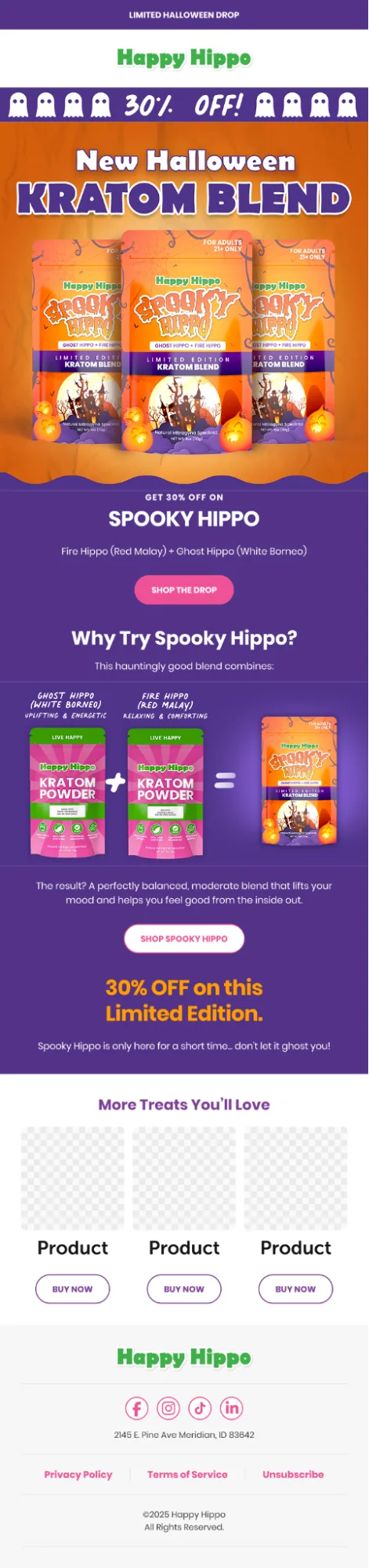
Happy Hippo email presents a limited-edition seasonal blend in their Halloween email. The line about short availability adds urgency, and 30% off entices subscribers.
How to adapt this idea:
A visual equation of ingredients explains a new product in seconds.
Key takeaways:
- Limited edition products justify urgency without extra discounts.
- Simple explainer visuals shorten the path to a decision.
CTA: Shop the Drop, Shop Spooky Hippo
9. Halloween Bundle Email
Halloween emails can bundle products around a single event, such as a party, a movie night, or a trick or treat evening.
InboxArmy built William Sonoma’s email by grouping products into easy themes. Sections for tabletop, bakeware, tools, and decor sit beside recipes from the test kitchen and a haunted happy hour. Building a Halloween board block turns separate products into one complete idea.
How to adapt this idea:
- A ready-made bundle with a small discount raises average order value.
- Adding recipes or styling tips to make the bundle feel useful.
- Each bundle should link to one landing page where the subscriber can add everything in a single step.
Key takeaways:
- Occasion-based bundles raise cart size.
- Helpful content makes the products feel curated.
- A short path from idea to cart improves conversion.
CTA: Shop All Halloween, Get All Recipes

10. Post-Halloween Clearance Email
A clearance email between November 1 and November 3 can clear out leftover seasonal inventory with deep discounts or mystery offers.
London Store’s Halloween email keeps it simple with a discount of 10 to 15 percent on apparel. There is a clear expiry for the discount code. Brand tiles for Asics, Edwin, Levi’s, Obey, and Santa Cruz give shoppers fast routes into the catalog.
How to adapt this idea:
- Lead with the discount range, state the end date, and show brand tiles for leftover stock. Replace the Halloween hero with a neutral seasonal close out message.
- A suppression rule for recent full price buyers protects goodwill.
Key takeaways:
- Clear expiry dates drive action.
- Brand tiles help shoppers filter quickly.
- Neutral creative lets the campaign flow into early holiday gifting.
CTA: Shop Now, View More

11. Mystery Discount Spin Email
Halloween emails can include spin-to-win wheels, mystery prizes, or interactive games to engage subscribers.
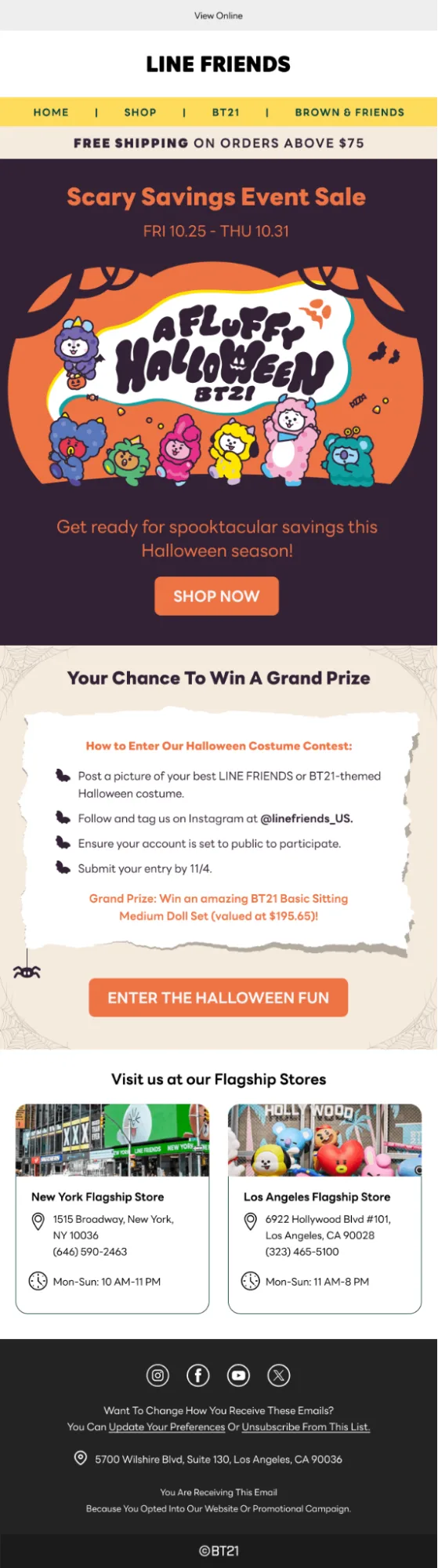
Our Line Friends’ email gamifies the holiday with a prize that feels worth chasing. The character artwork makes the whole message fun and recognizable.
How to adapt this idea:
- The wheel should offer several prizes, with a guaranteed small win for every participant.
- Brands can collect the email address and consent before the spin and send the prize code by email so the result lands in the inbox.
- Entry rules, an end date, and the prize value should appear near the button.
Key takeaways:
- Games raise clicks because readers want to see the result.
- A visible prize value signals a real reward.
- A code delivered by email creates a second touchpoint.
CTA: Enter the Halloween Fun
12. Halloween Gift Guide Email
Build a Halloween gift guide email around treats, decor, party supplies, or costumes, depending on the catalog.
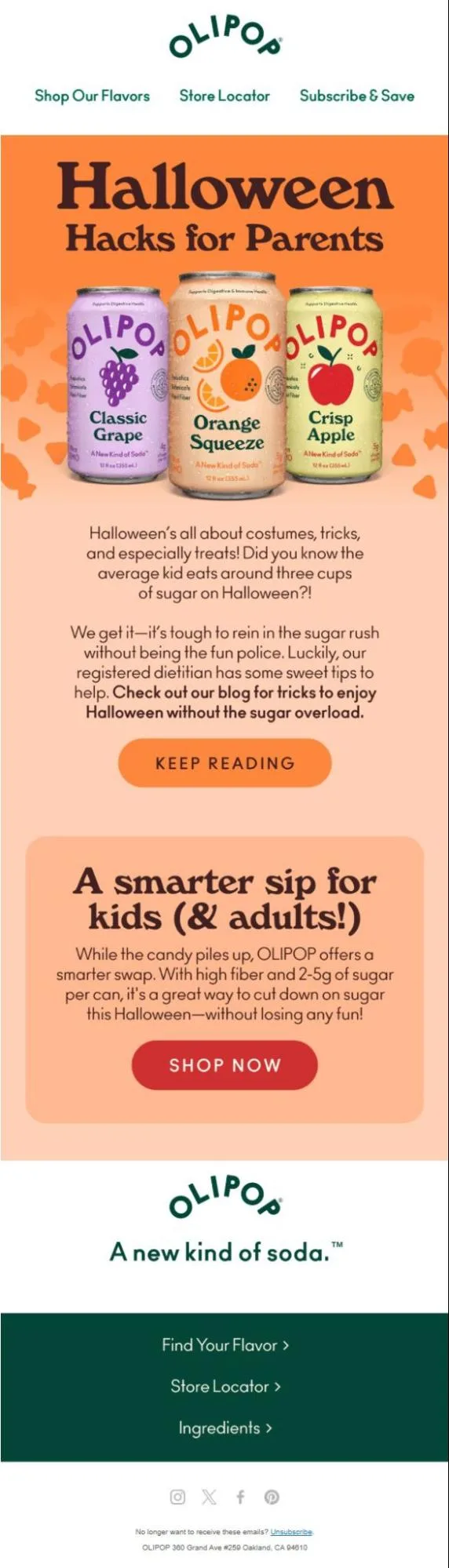
Olipop email solves a seasonal problem for parents before it mentions a product. A short statistic about candy intake frames the problem, and the first button sends readers to a blog post. The product pitch follows as a smarter swap, which lets the soda feel like part of the solution.
How to adapt this idea:
- A guide groups products by recipient, such as kids, hosts, or pet owners.
- Add expert tips to build trust, as this email does with a dietitian.
- Two buttons, one for the guide and one for the product, serve both browsers and buyers.
Key takeaways:
- Helpful content makes the sales message easier to accept.
- Expert voices build credibility. Grouping by recipient simplifies choices.
CTA: Keep Reading
13. Spooky Story Series
Halloween email campaigns can serialize a short story across three to five emails, with each email revealing a new character or chapter.
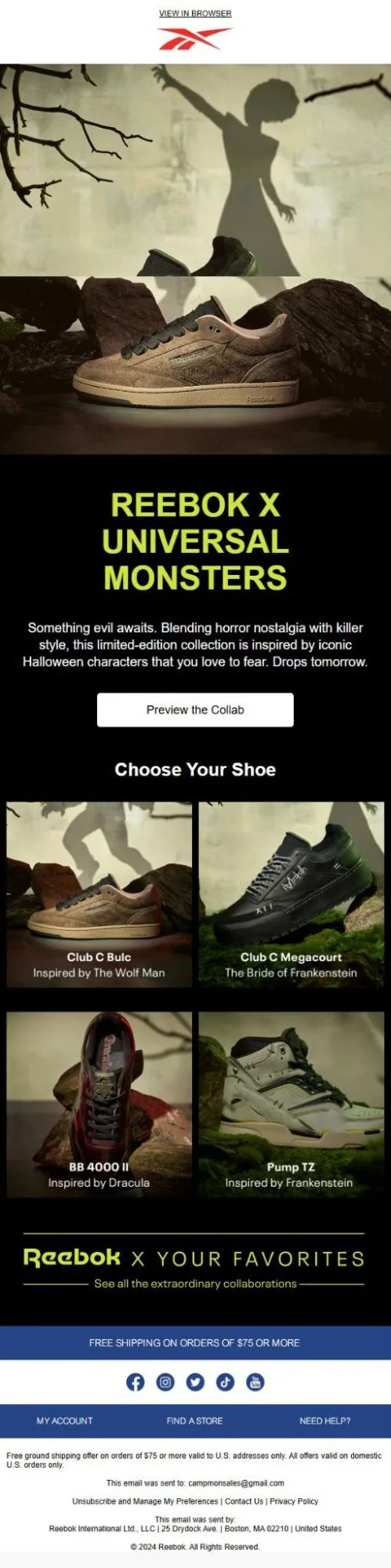
This Reebok email tells a story before it shows a shoe. The headline pairs the brand with Universal Monsters, and the copy teases that something evil awaits and that the collection drops tomorrow.
How to adapt this idea:
- The final installment can carry the offer or the launch.
- Give each chapter a consistent header so subscribers recognize the series.
- A preview button in early installments keeps readers engaged until the reveal.
Key takeaways:
- Serial content builds anticipation across sends.
- Character-driven storytelling gives each product a personality.
- A launch on the next day creates natural urgency.
CTA: Preview the Collab
14. User-Generated Content Halloween Email
Businesses can collect reviews, star ratings, and customer photos from past buyers and feature them in a seasonal email.
At InboxArmy, we let customers sell the product through their own words. The review block sits after a hero, which gives new buyers social proof at the moment of decision.
How to adapt this idea:
- Pull the strongest quotes about a Halloween product.
- Brands with a photo contest can invite subscribers to share costume pictures or decorated homes with a branded hashtag and feature the best entries in a follow-up send.
- Secure permission before reusing any customer quote or photo.
- A button directly below the reviews gives readers a clear next step.
Key takeaways:
- Customer voices carry more credibility than brand copy in our experience.
- Short quotes keep the block easy to scan on mobile.
- Star ratings signal quality at a glance.
- A simple permission process keeps user-generated content safe to reuse across future campaigns.
CTA: Order Now, Learn More

15. Loyalty Perks Email
Brands can send VIP members early access, bonus points, or free shipping during Halloween week.
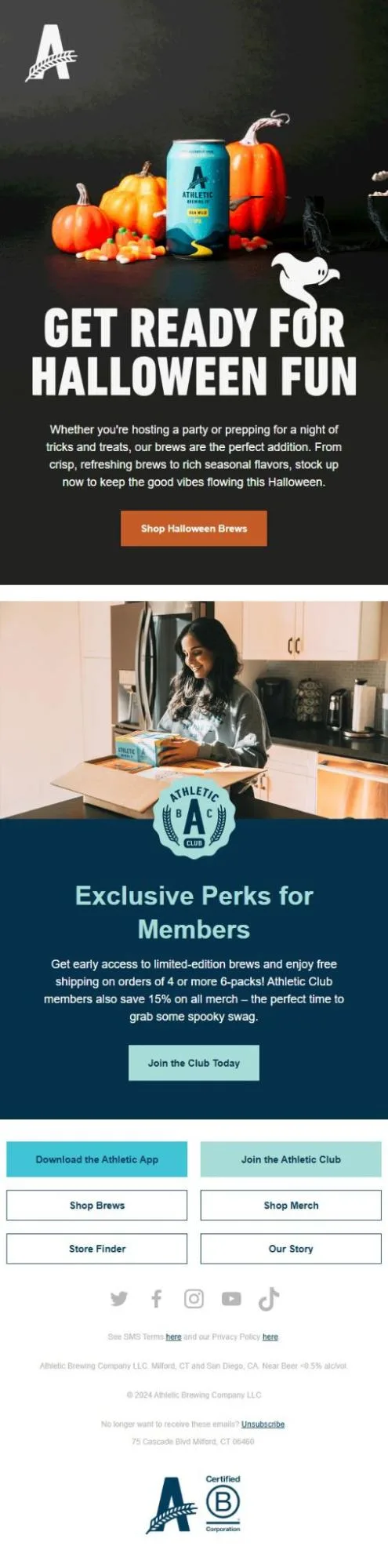
The Athletic Brewing email gives members a reason to feel recognized during the holiday. It lists member perks, including early access to limited edition brews, free shipping on orders of four or more six packs, and 15 percent off merch.
How to adapt this idea:
- A candy theme can frame perks as treats that drop into the member account, such as fun size points, treat tiers, or surprise bonuses.
- Offering similar perks for non-members, the same perks to encourage sign-ups.
Key takeaways:
- Loyalty perks reward existing customers and recruit new members in one email.
- Early access feels exclusive and costs little.
- Candy names make routine rewards feel seasonal.
CTA: Shop Halloween Brews, Join the Club Today
Best Time to Send Halloween Email
The best Halloween email schedule starts in early October and ends on November 3. We usually send six waves of email across that window, and each wave has one clear job.
- Early October (teaser): We send the first email with costume ideas, recipes, or a seasonal preview.
- Mid-October (main offer): Our second email launches the primary collection, discount, or event announcement.
- October 24 to 28 (reminders): Reminder Halloween emails build urgency around the main offer.
- Last week of October (urgency): We often send countdown reminders, low stock warnings, or flash sales.
- Halloween Day (October 31): A low-pressure trick-or-treat thank you or a bonus email.
- November 1 to 3 (clearance): We transition customers into post-Halloween clearance or early holiday gifting.
Note: Halloween 2026 falls on a Saturday, so the weekend sends should stay light and fun.
Halloween Email Subject Lines and Preview Text
Halloween emails require catchy, intentional, and scroll-stopping subject lines and preview text to improve engagement. InboxArmy offers free Subject Line Generator and Subject Line Tester tools to make the process simple and effective.
Halloween Sale Subject Lines
Haunt Your Home with Savings 71%
Spooky deals on home essentials you won’t want to miss.
Creepy Good Deals Just for You 72%
Enjoy frighteningly low prices on seasonal favorites.
Last Chance Halloween Subject Lines
Last Chance to Make Your Halloween Spooktacular 73%
Don’t miss out on exclusive deals ending tonight. Shop now before it’s too late!
Your Final Chance for Halloween Bargains 77%
Shop now to save big on Halloween costumes, decorations, and more.
Halloween Subject Lines for B2B and SaaS
Halloween Offer: Transform Your Business Strategy 77%
Limited-time discounts on innovative SaaS platforms to elevate your operations.
Hauntingly Good Features You Can’t Miss 75%
Upgrade your SaaS tools with features designed to impress and improve.
5 Copy-and-Paste Halloween Email Templates
Sale Email
Product Promotion Email
Mystery Offer Email
Last-Chance Halloween Email
Post-Halloween Clearance Email
How to Segment and Automate Your Halloween Campaign
Segmentation sends each audience the offer that fits its history with the brand, and automation extends the campaign without extra manual work. We build both before October so the calendar runs smoothly.
New subscribers and engaged prospects
- New subscribers receive a themed welcome treat, such as a first order discount.
- Engaged prospects who click often receive the teaser and the main offer before other segments.
Previous customers and repeat purchasers
Repeat purchasers receive product picks based on past orders and bundles that complement earlier purchases.
- A small bonus for a second or third order encourages loyalty.
- Recent buyers skip clearance reminders for items they already bought.
VIP and loyalty members
- VIP members receive early access, bonus points, or exclusive drops.
- Each perk should match the real rules of the loyalty program.
Inactive subscribers
- Inactive subscribers receive a playful reengagement message, such as a ghost that misses them.
- A stronger incentive often earns the click from this group.
- A sunset rule removes subscribers who ignore the series, which protects list health.
Automated reminders and follow-up emails
- A reminder to openers who did not click recovered missed attention.
- A cart reminder with a themed header recovers abandoned orders.
- A thank-you email after purchase builds goodwill.
Suppression rules and frequency management
Recent purchasers and recent complainants belong on the suppression list for the final urgency sends.
- A frequency cap of one to two emails per day keeps the inbox friendly in the final week.
- Engaged subscribers tolerate more sends than inactive subscribers.
Halloween Email Design and Deliverability Best Practices
Strong Halloween emails pair a brand-matched theme with accessible design and clean list practices.
-
Match the Halloween Theme to Your Brand
The theme follows the brand’s voice and palette. A luxury brand can use a dark and elegant look, while a toy brand can use bright and silly illustrations. The Candy Kittens and Reebok emails show two very different executions of the same holiday.
-
Use Mobile-Friendly Layouts and Accessible Design
Single-column layouts and large buttons suit phone readers. Strong color contrast, alt text, and readable font sizes make the email accessible. Dark Halloween backgrounds need extra attention to contrast.
-
Use Seasonal Visuals, GIFs, and Product Photography
A GIF should show the key message in its first frame, because some email clients display only that frame. Product photos should stay sharp and uncluttered. Marketers should compress every image so the email loads quickly.
-
Share Non-Sales Content:
Spooky playlists give subscribers a reason to open without purchase pressure.
DIY decorations and recipes add practical value to the email.
Team costume photos add a human touch.
-
Use Interactive Content Where It Adds Value
Countdown timers, reveals, and quizzes work when they support the offer.
Each interactive element needs a static fallback for email clients that block scripts.
Marketers should test every element across the major clients.
-
Maintain Email Deliverability and List Hygiene
Brands remove bounced addresses and suppress long inactive subscribers.
Our marketing team warms up sending volume before the main push. We ensure authentication records such as SPF, DKIM, and DMARC are in place before October. Image-heavy emails need balanced text so spam filters read the message correctly.
How to Measure Halloween Email Campaign Performance
Halloween email performance is best measured with a small set of metrics tied to revenue and list health.
Click-through rate:
This metric shows whether the creative and the offer earned attention.
Conversion rate:
This metric shows how many clicks became orders, and a low rate with high clicks points to a landing page or offer problem.
Revenue per recipient:
This metric combines conversion and order value, and it compares campaigns of different sizes fairly.
Unsubscribe and spam complaint rates:
These rates reveal whether frequency or relevance went too far.
Deliverability and list engagement:
Inbox placement and engagement trends show whether the list stays healthy, and brands should compare November engagement against September.
A/B testing subject lines, offers, and CTAs:
Testing turns each send into a lesson, and our marketers change one variable at a time.
Halloween Email Campaign Mistakes to Avoid
The most common Halloween email mistakes involve volume, relevance, and trust.
- Sending too many emails: Too many sends fatigue subscribers, and a planned calendar with frequency caps prevents the problem.
- Using irrelevant seasonal messaging: A forced theme confuses readers, so a light tie to the brand voice works better.
- Neglecting segmentation: One offer for every audience ignores each subscriber’s history, and tailored messages respect it.
- Relying on discounts alone: Constant discounts train subscribers to wait for sales, so stories, content, and perks add value without cutting the price.
- Creating false urgency or scarcity: A deadline that resets damages trust, and real end dates protect credibility.
- Ignoring mobile users: Desktop-only layouts lose a large share of readers, and responsive layouts solve the problem.
- Overusing emojis and puns: Too many emojis make an email look like spam, and one or two touches carry the theme.
- Forgetting post-Halloween follow-up: Skipping November wastes the campaign’s momentum, and a clearance or gifting email captures shoppers who missed the deadline.
FAQs
How many Halloween emails should I send?
We recommend three to five Halloween emails for most brands. We send a teaser in early October, a main offer in mid-October, a countdown in the last week, and a clearance email on November 1. Engaged subscribers tolerate a daily cadence in the final week, while inactive subscribers receive only the main offer and the countdown.
Should I send Halloween emails if my products have nothing to do with Halloween?
Yes, you should send them when you connect the theme to your brand’s voice. Seasonal themes give subscribers a fresh reason to open an email. Our B2B and SaaS clients usually pair a playful subject line with their regular content, and that approach keeps the tone light without forcing a pun into the product.
Can I use emojis in Halloween email subject lines?
Yes, you can use one or two emojis in a subject line. Heavy emoji use raises spam filter risk, and some email clients render them inconsistently. We A/B test every Halloween subject line with and without an emoji, and the winner guides the rest of the campaign.
How do I grow my email list before Halloween?
You can grow your list with a costume contest, a giveaway, or a trick-or-treat popup that reveals a discount. A gated Halloween gift guide also attracts new sign-ups. We pair each of these sources with a welcome email so the new subscribers hear from your brand within minutes.
Should I add a Halloween theme to my automated emails?
Yes, you should add a light theme to your highest traffic automations. The welcome series and abandoned cart flows reach the most people, so we swap in a seasonal header and subject line there. The flow logic stays the same, and we revert the creative on November 1.
Should I segment my list for Halloween emails?
Yes, you should segment, because each audience responds to a different offer. New subscribers receive a welcome treat, repeat buyers receive product picks based on past orders, and VIP members receive early access. Inactive subscribers receive a reengagement message, and we suppress anyone who already purchased from the final urgency emails.
What should I send after Halloween?
You should send a clearance email between November 1 and 3. That email moves leftover seasonal stock and bridges into early holiday gifting. We also send recent buyers a short thank you with a care or usage tip, which keeps the post-purchase experience warm.
How do I know if my Halloween email campaign worked?
You can judge success by comparing revenue per recipient against your non-holiday baseline. Click-through rate and conversion rate show which offers and creative resonated. Unsubscribe and spam complaint rates reveal whether your frequency was too high, and we tag every email with UTM parameters and hold out a small control group to confirm the lift.