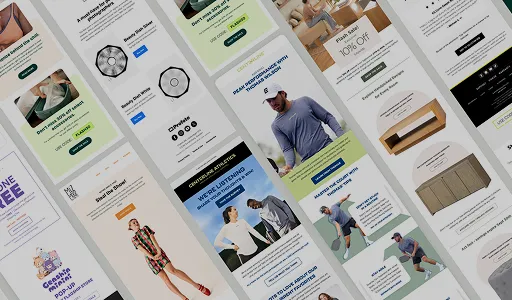

Quick Overview
An email marketing campaign means sending coordinated emails to nurture leads, make conversions, retain customers, or launch products. The idea is to build the campaign around a specific goal and determine content, design, CTAs, cadence, and frequency accordingly. The most common types of email campaigns we swear by are promotional emails, newsletters, welcome series, abandoned cart emails, and event announcements. A/B testing and tracking metrics (click-through rate, conversion rate, or revenue per email) throughout your campaigns help you know what’s working and what’s not.
What Is An Email Marketing Campaign?
An email marketing campaign is a planned email marketing initiative sent to a defined audience segment via an email service provider. All our email campaigns are built around a specific objective, such as selling goods or services, launching products, nurturing leads, or building brand awareness. It helps to ensure that the messaging, strategy, and efforts don’t get split in multiple directions.
Automated Versus Manual Email Campaigns
Email marketing campaigns split into two broad categories: manual or one-time broadcast emails and automated or triggered email campaigns.
Broadcast Campaigns (Manual/One-Time Sends)
Manual campaigns get built, scheduled, and sent once to a segment or entire subscriber list. We use broadcast emails for single-event emails, narrative campaigns, and thought leadership messages. It enables us to send time-sensitive, unique, direct messages to each subscriber.
Broadcast or Manual Campaign Examples: Newsletters, Promotional Blasts, Product Launches, and Seasonal & Holiday Sends
Automated Campaigns (Trigger-Based/Drip Flows)
Automated campaigns involve sending pre-built email sequences based on customer behavior, timeline, or lifecycle stage. Automation saves time when we need to reach the target audience at the right moment and scale campaigns. We segment the audience and incorporate personal details, names, buyer’s history, etc. into emails.
Automated Email Campaign Examples: Welcome Series, Abandoned Cart/Browse, Lead Nurturing (Drip), and Re-engagement/Win-Back.
Brands need both manual and automated email campaigns to engage and convert subscribers. A welcome series to onboard a new subscriber, and over the course of the relationship, you send promotional blasts for time-sensitive flash sales or lead nurturing campaigns to educate them.
Below we will discuss in detail how you can map email campaigns to the customer funnel. So at every stage of the buyer’s lifecycle, you have a broadcast or automated campaign to engage, educate, and convert subscribers.
What Makes an Email Campaign Work
Our best email campaigns are built around the client, their goals, and audience. Here are the core components common across the board:
Deliverability and authentication:
For all our clients, we set up SPF, DKIM, and DMARC records with your domain host. We maintain clean list hygiene, monitor overall sender reputation, and warm up new sending domains or dedicated IPs as your brand scales.
Email Compliance:
We have seen negligence in upholding email marketing laws derail campaign performance before the client gets to us. That’s why we make compliance checks mandatory for every email we send out. Whether it’s a valid physical postal address, a clear way for recipients to opt out, or accurate header and subject line information. In the long run, these steps can also help reduce spam complaints and protect sender reputation.
Subject lines:
They decide whether subscribers ever give your email a chance. For all our email campaigns, we have seen concise, important-information front-loaded subject lines deliver better impact. We treat the preview text as a second sentence to carry your message forward. Proper A/B testing helps us decide the best way to incorporate personalization, curiosity, and emojis in subject lines.
Personalize:
We leverage purchase history, lifecycle stage, and browsing behavior to build targeted, relevant email campaigns. Our emails with dynamic content based on customer data or location, for example, the London Store, showed improved engagement. When you’re scaling emails, AI tools can help with personalization.
Mobile-friendly:
41% of opens occur on mobile devices, according to MailButler. So for all our emails, the design, images, text, CTAs, and subject lines are mobile-friendly. We ensure this while A/B testing.
Recognizable sender name:
Sending address is a trust signal for subscribers, and we get that. Our email campaigns use a recognizable sender name, which makes emails feel more personal and helps subscribers recognize who they are hearing from.
Blended campaigns:
Our email campaigns don’t work in isolation. We combine our email marketing efforts with SMS, social media, and other channels for broader reach and engagement.
A/B Testing and Optimization:
We don’t always get it right the first time; there is definitely room for improvement. Our email marketers continuously test the subject line, preheaders, content, images, CTAs, and send times. All our decisions are actually backed by audience response. We test one variable at a time and use a large sample to get accurate results.
Email Marketing Campaign Types at a Glance
| Campaign Type | Primary Goal | Use Case | KPIs |
| Promotional | Short-term revenue | Sales, flash offers, product drops | Conversion rate, revenue per email |
| Newsletter | Brand visibility and trust | Staying top of mind between purchases | Click-through rate, click-to-open rate |
| Product launch | Awareness and early sales | New SKUs, feature releases | Click-through rate, pre-order revenue |
| Seasonal/holiday | Peak-period revenue | Black Friday, back to school, festive gifting | Conversion rate, average order value |
| Event and Announcement | Drive awareness, registrations, or attendance | Events, webinars, conferences, major announcements | Registration rate, attendance rate, click-through rate |
| Welcome series | Onboarding and first purchase | New subscribers, new customers | Open rate, first-purchase conversion |
| Lead nurture/ Drip campaigns | Move prospects towards conversion | Complex or considered purchases | Click-through rate, conversion rate |
| Abandoned cart | Recover lost checkout revenue | Ecommerce with cart abandonment | Recovery rate, revenue per email |
| Post-purchase | Retention, upsell, or for reviews | Existing customers after conversion | Repeat purchase rate, review submission rate |
| Transactional | Share information or complete a requested action | Password resets, order/purchase/registration confirmations | Delivery rate, completion rate, click-through rate where applicable |
| Re-engagement/win-back | Recover inactive subscribers | Lists with rising inactivity | Reactivation rate, unsubscribe rate |
| Retention/Lifecycle | Increase repeat purchases and customer lifetime value | Existing customers, replenishment, renewals, milestones, and loyalty | Repeat purchase rate, customer lifetime value |
Email Campaign Strategy: Map Email to the Customer Funnel
We build manual and automated email campaigns that move subscribers through the full customer lifecycle, from their first impression to loyal advocates. This email marketing strategy ensures our clients engage customers at every possible touchpoint and never leave money on the table.
Awareness and Interest Stage
For the best first impression, we use educational newsletters, welcome emails, and free resources. We introduce the brand and share something of value.
Consideration Stage
When we want subscribers to explore products, we design email campaigns around product launches and promotional content to showcase product features, benefits, and social proof.
Conversion Stage
Our abandoned cart and post-purchase emails recover lost sales. They nudge hesitant buyers and turn first buyers into loyal customers using incentives and social proof.
Retention and Advocacy Stage
We layer in milestone emails, win-back series, and loyalty and reward programs to deepen personal connections and drive long-term repeat customers.
| Customer Funnel Stage | Campaign Type |
| Awareness | Welcome Email Educational Lead Nurturing |
| Consideration | Newsletters Product Launches Case Studies Client Testimonials Product feature breakdown |
| Conversion | Cart Abandonment Promotional |
| Retention | Transactional Upsell Re-engagement Referral Requests Loyalty Programs |
12 Types of Email Marketing Campaigns + Real InboxArmy Examples
What kind of email campaigns does your brand need? Is it a welcome series, promotional emails, or cart abandonment email? These campaign types aren’t mutually exclusive.
You can classify an email campaign by its primary marketing goal, lifecycle stage, or the trigger that starts it. Here are the most common email marketing campaigns we operate for our clients:
1. Promotional Campaigns
When you need to move inventory or hit a revenue target, promotional email campaigns are the way to go. An urgent message centered on discounts and deadlines can be effective.
Promotional Email Example – Runway Rogue
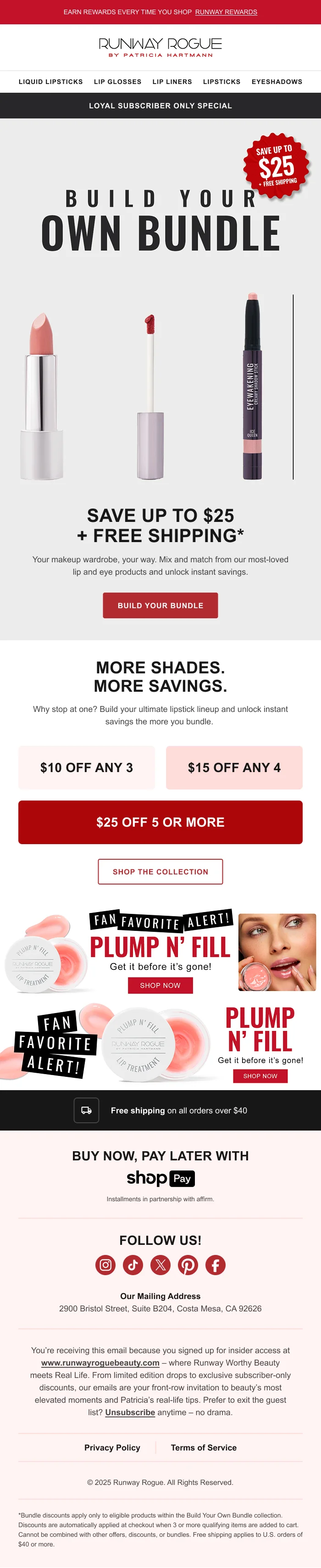
Promotional Email Example – Runway Rogue
A loyalty-exclusive email template built entirely around a bundling mechanic. The tiered pricing drives the offer structure, nudging people to add just one more item to hit the next discount tier. On top of that, we created the “Fan Favorite Alert” badge urgency around bestsellers without relying on a countdown timer or scarcity gimmick. It fits the more polished, editorial beauty brand feel.
2. Newsletter Campaigns
Newsletters aren’t primarily focused on a direct sale. You can share updates, brand story, and educational material. Newsletters carry the brand’s actual voice and engage subscribers without actively trying to sell.
Newsletter Example – SimplyFun
It opens with a genuinely timely hook, “AI is everywhere, but it isn’t perfect,” to set up why critical thinking games matter right now. We tied each featured game to specific skills it builds, such as risk-reward and adaptation. It lines up with the brand’s pitch of developmental value over price.

3. Product Launch Campaigns
If you have a new product or service coming up, it’s good to create curiosity among the audience. You can have pre-launch teasers and then an announcement email with key features and what’s new. Brands can continue the sequence with follow-ups, customer reviews, press coverage, or early sales figures.
Product Launch Email Example – Scent Split
Our new arrivals email for Scent Split uses hierarchy effectively; it gives one hero fragrance. “Once Upon a Time” has the entire top section to itself before dropping into the rest of the new arrivals in a clean grid. That structure signals to the reader which product the brand actually wants them to notice first, then lets everyone else browse at their own pace.

4. Seasonal and Holiday Campaigns
Seasonal and holiday campaigns can work for sales, bring back inactive customers, and build brand loyalty. Whether it’s Black Friday, Labor Day, back-to-school, or festive gifting, you’re competing with thousands of other businesses for inbox space. Deliverability and send timing matter more than ever.
April Mullen, Senior Director of Communications and Brand at Insider, suggests creating highly personalized, impactful emails tailored to each customer to stand out in crowded inboxes during the holiday.
Black Friday Email Example – Discount Filters
A seasonal sale email and a good example of leading with the offer visually before saying a word. One blanket CTA is replaced by split CTAs across three product categories. From our experience, letting subscribers jump straight to their category cuts friction.

5. Event and Announcement Campaigns
Event or webinar coming up? This is how you inform your subscribers directly. These campaigns can span event teasers, invitations, reminders, and post-event thank-you emails. Even here, segment the email list and tailor content according to past engagement, roles, or VIP status.
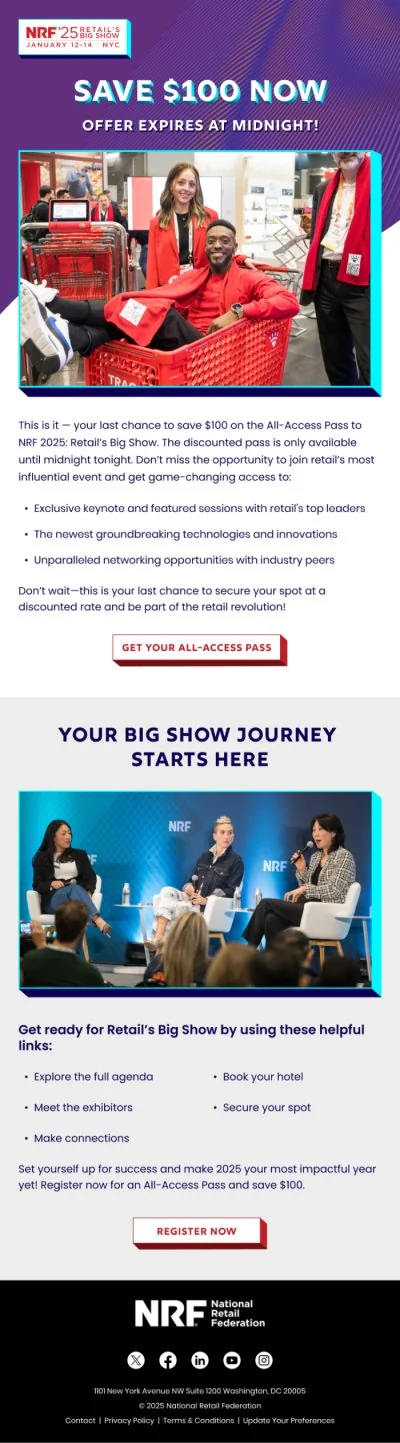
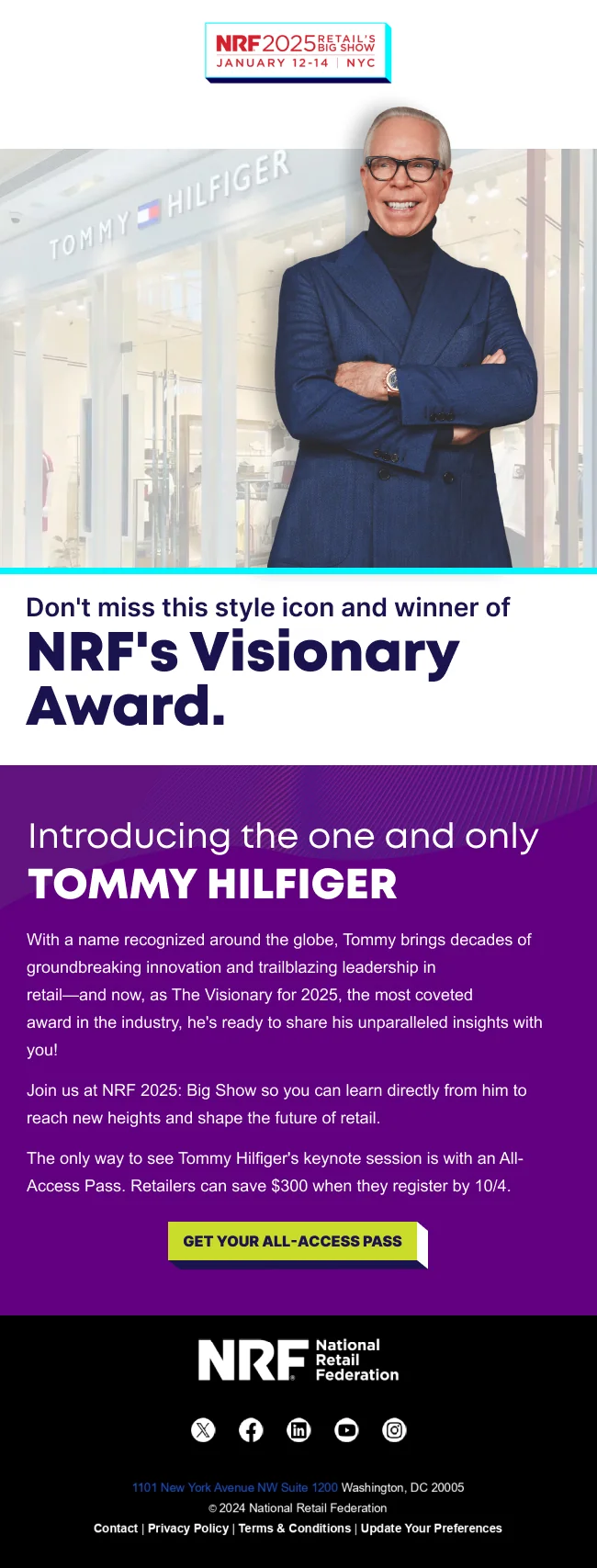
Event Email Campaign – NRF 2025: Retail’s Big Show
The National Retail Federation (NRF) hosted major global events in 2025, including NRF 2025: Retail’s Big Show. We created a series of emails for the campaign, invitations, confirmations, and follow-ups. To maintain engagement, each email highlighted unique aspects, such as offers, scale, and key speakers.
While the content varied to keep subscribers hooked, the email design stayed consistent across the event campaign.
6. Trigger-Based and Automated Campaigns
Email campaigns can be built on triggers: subscribers joining a list, browsing a product, abandoning a cart, making a purchase, or becoming inactive. These triggers can power welcome, abandoned-cart, post-purchase, and re-engagement campaigns.
7. Welcome Series
A welcome series introduces new subscribers to the brand after signup. It is usually the highest-performing sequence in any account we manage because the curiosity hasn’t faded yet. You can carry that momentum into a first purchase and nurture leads before they go cold.
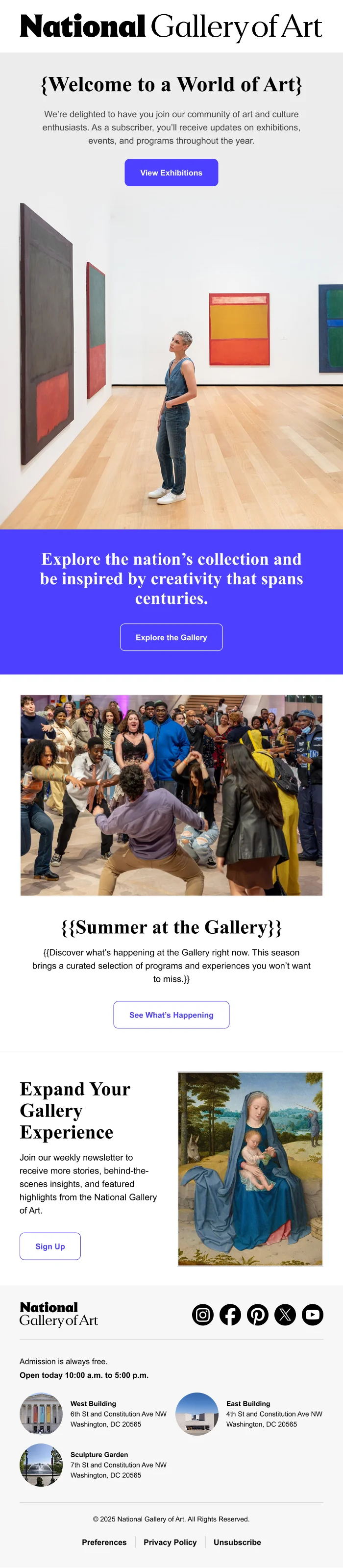
Welcome Email Campaign – National Gallery of Art
Welcoming a new subscriber to the National Gallery of Art involved making them feel part of their art and culture community. We kept the email design plain and simple, without overwhelming them with too much information.
It gives them a peek into their gallery and current exhibitions and asks them to sign up for their newsletter.
Welcome Email Example – Qualia
Qualia, a wellness brand, anchors its welcome emails with product information, how to take it, and USPs. We introduced new subscribers to the brand with facts. There is transparency about subscription, customer service, and more to instil trust and accountability.

Lead Nurture/ Drip Campaigns
Lead nurture or drip campaigns move prospective contacts from initial interest to conversion through a series of automated, persuasive emails. We typically use these campaigns for brands with B2B software, high-ticket products, or complex or unfamiliar services. Each email in our sequence builds on the last to reduce friction and convince subscribers.
Lead Nurture Email Sequences include:
- Educational content addressing the common objections
- Case studies, testimonials, and social proof
- A clear next step, such as a demo, trial, or consultation
8. Cart or Browse Abandonment Campaigns
Shoppers who leave the site before completing a purchase can be brought back with reminders that address doubts and offer incentives. Typically 2–3 emails, although some programs use longer sequences, as we did for Sixthreezero, and speed matters more than volume.
Cart Abandonment Campaign – Sixthreezero
Sixthreezero, a bicycle and electric bike brand, had a sizeable abandoned-cart-list that needed targeted emails. We built a 5-email abandoned cart email sequence highlighting offers, object handling content, customer testimonials, and an exclusive social media group invite.
| Cart Abandonment Email 1 | Cart Abandonment Email 2 | Cart Abandonment Email 3 | Cart Abandonment Email 4 | Cart Abandonment Email 5 |
|---|---|---|---|---|
| Open Rate:77.15% CTOR:16.99% |
Open Rate:46.4% CTOR:31.17% |
Open Rate:49.01% CTOR:20.3% |
Open Rate:47.44% CTOR:21.62% |
Open Rate: 77.15% CTOR:16.99% |

Browse Abandonment Email Example – Keeps Home
The browse abandonment emails we created for Keeps Home didn’t emphasize urgency. The discount code is there, but it’s not the star of the email. Customer reviews provide hesitant shoppers reassurance.

9. Post-Purchase Email Campaigns
Post-purchase campaigns can include both transactional and marketing emails. Transactional messages such as order confirmations, shipping confirmations, and delivery notifications provide essential information about a completed purchase. Marketing emails push product education, review requests, cross-sells, replenishment reminders, and loyalty messaging.
10. Transactional Emails
These automated, triggered emails help customers complete a specific action or provide information. Unlike promotional campaigns, their primary purpose isn’t to sell. Common examples include:
- Password Reset Emails
- Order Confirmation Emails
- Purchase Confirmation Emails
- Registration Confirmation Emails
Feedback/survey emails can be marketing or transactional depending on the purpose.
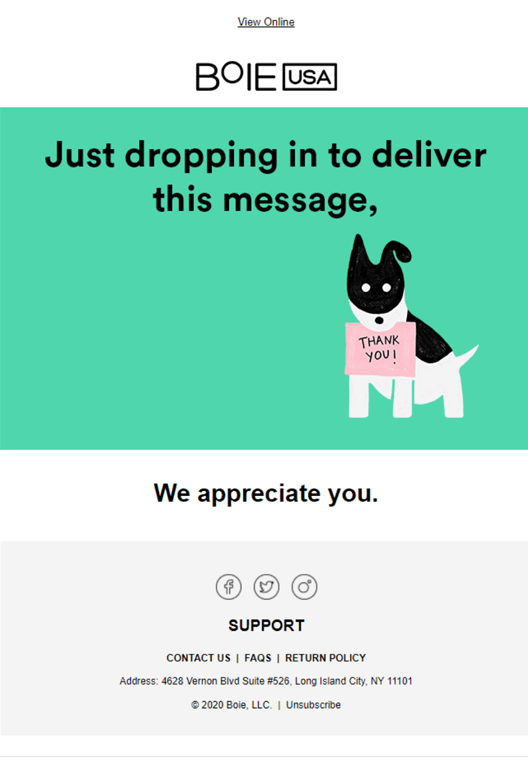
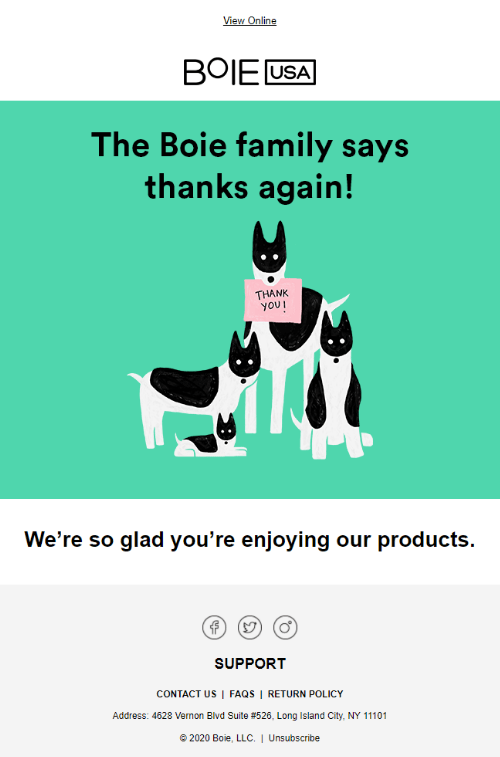
Thank You Email Example – Boie USA
The thank-you emails we built for Boie’s new and repeat customers had a 60% open rate, 2% click rate, and 0.1% conversion rate.
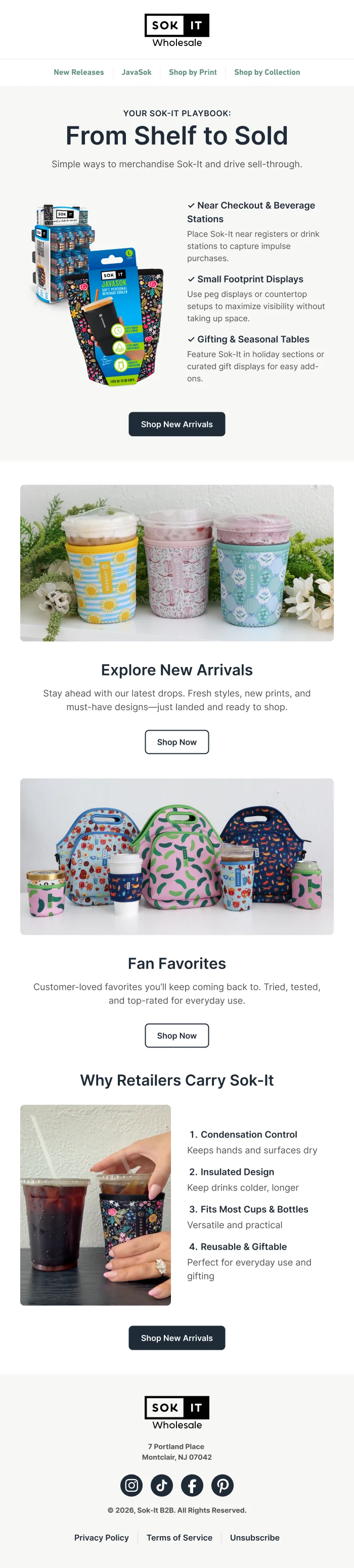
Post-Purchase Email – Sok-It
For Sok-It, a retail brand, we segmented its post-purchase emails for first-time and repeat customers. It allowed us to tailor the information, CTA, and product recommendations according to their needs and interests.

Post-Purchase Email Example – USANA
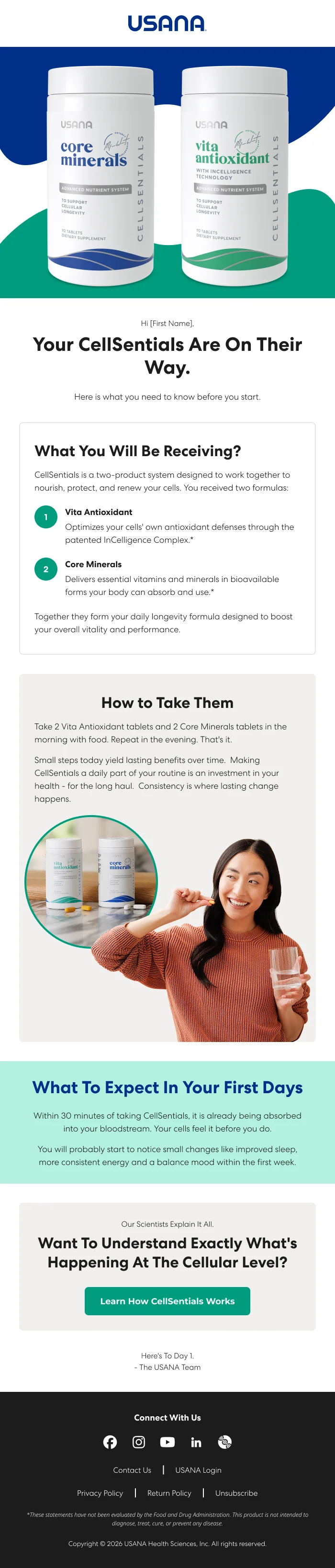
This is a post-purchase email we sent right after someone buys the CellSentials supplement system. The USANA email template is focused on walking the new customer through exactly what they bought and how to use it. Even the CTA at the end, “Learn How CellSentials Works,” is educational.
11. Re-Engagement and Win-Back Campaigns
Re-engagement campaigns target inactive subscribers who’ve stopped opening your emails. Many brands now run these as automated flows. Reactivation emails are designed to bring inactive subscribers or customers back into engagement.
Re-Engagement Campaign Example- Snake River Farms
Reconnecting with inactive users or subscribers is about proving to them that the relationship still holds value. For Snake River Farms, that meant one email doing three things at once: introducing new arrivals and bestsellers, reminding subscribers of unused reward points, and offering exclusive recipes. It’s more content than a typical send carries, but keeping it short with a clean, image-heavy design kept it scannable rather than cluttered. The density comes from stacking proof points toward one goal, not from competing asks.

Win Back Email Example – Doppler
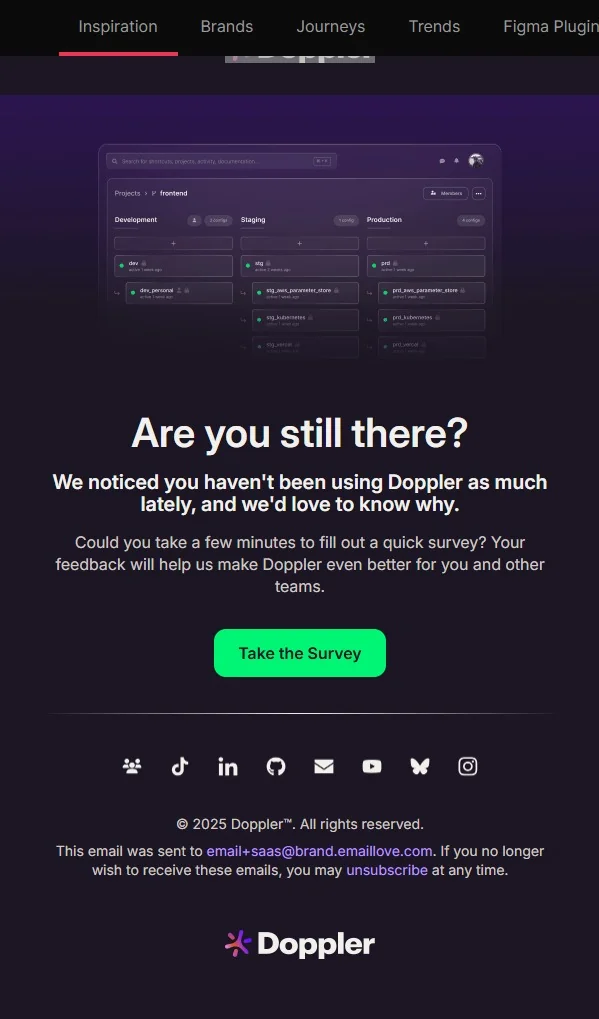
A re-engagement email aimed at users who’ve gone quiet. The tone is the standout here; it opens with a simple, human question. Then we ask for feedback through a quick survey. Across our brands, we’ve seen that’s a much softer way to win someone back than leading with an incentive, and it fits a B2B SaaS tool where trust matters more than urgency.
12. Retention/Lifecycle Campaigns
Lifecycle campaigns target customers throughout their journey with behavior-driven content. The goal is to turn one-time buyers into long-term customers. It can include product onboarding, regular engagement emails, milestone emails, replenishment or renewal emails, and win-back campaigns.
Milestone Email Example – LinkedIn
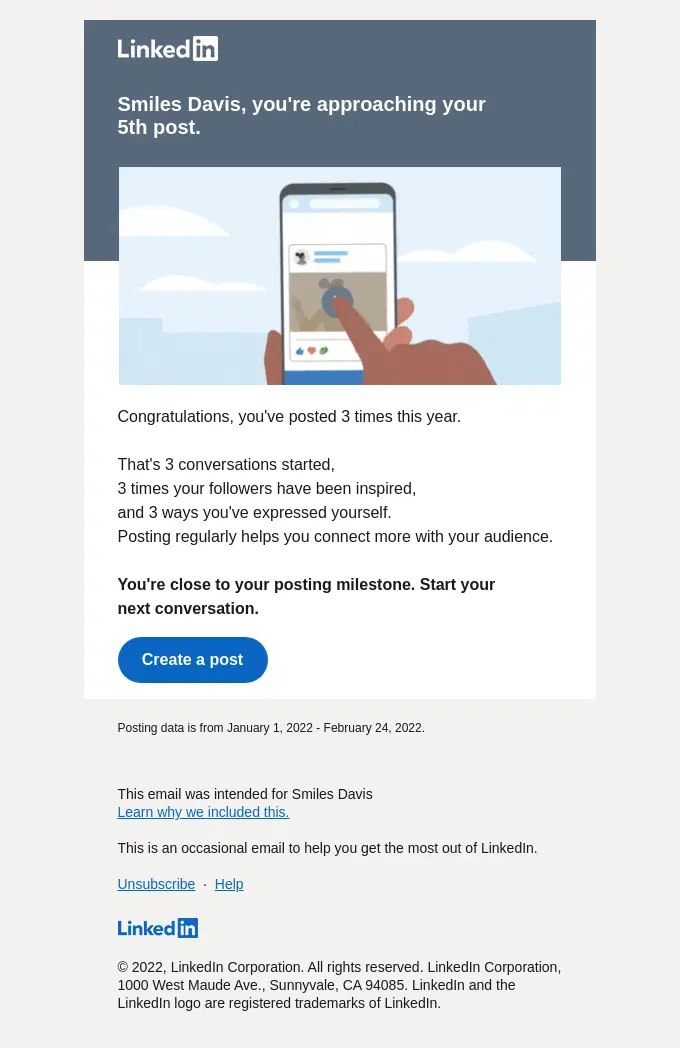
Milestone emails are often associated with customer anniversaries, a tenth order, a birthday, and usage/activity and consistently earn stronger engagement. LinkedIn used it to congratulate users on their posting milestone, encouraging them to post more frequently.
How to Execute an Email Marketing Campaign
Creating high-performing email campaigns requires proper planning, strategies, and tools. At InboxArmy, we typically work through the campaign in this order:
1. Email Marketing Campaign Goals
Every one of our campaigns is built around one solid goal. Whether it is generating revenue, driving registrations, increasing repeat purchases, reactivating customers, or building engagement, all the strategizing that follows depends on it.
Revenue-focused campaigns rely on urgency and targeted offers. Emails highlight limited-time discounts, abandoned cart reminders, and targeted product recommendations. The credibility of deadlines or price reductions is key to building trust and email compliance.
Retention-focused campaigns are about targeting existing customers to instill loyalty and encourage repeat purchases. It involves providing something of value to the customers, such as incentives, loyalty programs, VIP perks, renewal reminders, and so on.
Email list growth campaigns use rewards and referral mechanics to bring in more potential customers. When growing an email list, generous incentives often attract low-intent signups. They’re much less likely to engage or convert.
Brand awareness campaigns are to increase brand recall and familiarity. Mostly we use newsletters, behind-the-scenes content, or thought leadership emails for these campaigns. Sticking to one goal per campaign is best, so if you’re looking to improve brand recognition, don’t include a hard sell.
It’s easier to accomplish goals when campaigns are designed around a single ask.
2. Target Audience
When you have a set objective, next is deciding who the campaign is for. There is no point in sending a common message to everyone. VIP customers and inactive subscribers need a different kind of approach. Segmenting the audience based on behavior, needs, and interests is a top priority for us. This helps to plan the content calendar, timing, and frequency. Common audience segments include:
- First-time buyers
- Repeat customers
- High-value or VIP customers
- Cart abandoners
- Product browsers
- Highly engaged subscribers who have not converted
- Inactive or lapsed subscribers
- Customers in specific geographic regions
- Lifecycle stages (new, active, at-risk, churned)
Exclude recent purchasers, already-converted users, or subscribers who are not relevant to the offer.
3. Building Email List
For brands without a healthy email list, segmentation and personalization can only do so much. At InboxArmy, we employ the following strategies to build an engaging subscriber list.
- Website sign-up forms and pop-ups
- Checkout opt-ins during purchase
- Event and webinar registration
- Gated content or lead magnets
- CRM contacts from demos or consultations
Once we have a list, we maintain list hygiene, suppress inactive contacts, and constantly tag to keep it accurate.
Note: We only build campaigns on permission-based, first-party data, never purchased or rented lists.
4. Email Design and Content
All our email design, content, and CTAs support the campaign objective and audience stage. Revenue-focused campaigns do well with clear messaging and one primary CTA. Brand awareness emails involve visual storytelling focusing on multiple ideas.
Decide on the offer or message: Determine what the subscriber should understand or do after receiving the email.
Build the email destination: Make sure the landing page, product page, checkout experience, or registration page delivers what the email promised.
Apply campaign logic: Set the appropriate audience rules, exclusions, frequency limits, personalization, dynamic content, and automation or scheduling conditions before the campaign goes live.
5. Timing
When and how often you send emails can affect performance. Previous engagement data and benchmarks can tell the best timing and frequency. For revenue or list-growth campaigns, we send emails more often than for brand awareness campaigns. This isn’t a one-time decision; you have to keep adjusting the timing based on the results.
6. Email Marketing Platform
We work with more than 40 ESPs for all kinds of email campaigns. Every platform supports send volume, segmentation, and automation needs differently. You need the one that aligns with your marketing requirements. Automated email workflows and templates can make the campaign setup process painless.
Whether your carefully built campaign even reaches the inbox depends on authentication support (SPF, DKIM, DMARC), list hygiene features, and sender reputation monitoring.
7. Run pre-send QA
We ensure the email campaign is error-free, compliant, and aligned with goals before launching. Email marketers should check:
- Links
- Personalization
- Unsubscribe functionality’
- Offer codes
- Landing pages
- Sender information
- Suppression rules
8. A/B Testing
When we test emails, we focus on one variable at a time, whether it’s the subject line, email copy, send time, or layout. What’s worth testing varies as per campaign type; for example, revenue campaigns benefit most from testing CTA copy and offer framing (percentage off vs. dollar amount).
9. Analyze and Optimize
After the campaign has generated enough data, evaluate clicks, conversions, revenue, unsubscribes, and other relevant metrics against the original objective. Use what you learn to determine what should change in the next campaign.
Email Campaign Mistakes to Avoid: 12 Common Errors That Hurt Results
Among the 5000+ brands we have served across industries, from hospitality to ecommerce, we have seen some common mistakes crop up again and again, preventing brands from achieving the full value of their email campaigns.
1. Sending to the whole list
A manufacturing company approached InboxArmy because their email marketing efforts weren’t generating the expected results. Once we audited the existing campaigns, the reason was clear. They had a healthy email list of distributors, retailers, buyers, contractors, builders, and business executives with no strategic segmentation. The company was sending the same campaign across the whole list. This off-the-shelf messaging means no one was getting educational content, offers, and product recommendations tailored to their need.
2. Optimizing for opens instead of revenue
Open rate isn’t always a true benchmark of email campaign performance. Especially since Apple’s Mail Privacy Protection and similar features can inflate or skew your real email opens.
We use it to evaluate subject line and list health, but high open rates are never the end goal of our email campaigns.
For a B2C promotional campaign, a subject line in A/B testing that had a higher open rate ended up with lower revenue-per-recipient. While a “Claim your $100 value now” subject line can attract “freebie seekers,” they have no intention of taking a high-value action.
3. Weak offers can’t save decent email copies
Subscribers need an instant answer to “what’s in it for me?” from an email campaign. One of our clients, a furniture brand, ran a promotional campaign with a low discount offer. The campaign didn’t convert because it was asking for a major commitment without giving much in return. The following are the most common mistakes brands make when they think just a discount is enough to convert contacts:
- Low-value discounts
- Generic, unexciting, or outdated incentives
- For high-friction purchases, offers without objection handlers, customer testimonials, etc.
- Vague or redundant offers
4. Subject line and email don’t match
A mismatched subject line and email copy can hurt subscriber trust and lower your click-through rates. A California-based retailer tried to improve its email performance with the subject line: “You won’t believe what we are giving away today!” But the email copy had a standard 15% off regular promotion. While they enjoyed high open rates for a while, the click-through rates dropped drastically. Once they became our client, we had to work hard to earn back subscribers’ trust in the next campaigns. That’s why we avoid clickbait traps, false urgency, and fake reply subject lines in all our email campaigns. Whatever the subject line promises, we deliver it in the email.
5. Too much going on in one email
We have seen ecommerce brands sell products, share blogs, social media sign-ups, and referral programs in a single email. And the result? You don’t achieve any of the goals when four different CTAs are competing for attention at the same time. At InboxArmy, every email campaign serves a single purpose, from the subject line to the CTA to the email copy.
6. Using dirty or stale lists
You can’t keep sending to the same lists indefinitely. When a non-profit organization reached out to us due to high bounce rates, spam complaints, and damaged sender reputations, our priority was auditing their email list. They had a large segment of inactive or unengaged subscribers, and they were targeting them across the board with the same campaigns. Pruning these lists or using proper segmentation for engaged and unengaged subscribers can improve deliverability and performance.
7. Making the email itself do too much selling
Email campaigns must grab subscribers’ attention without overwhelming them. We’ve seen email copy with full product specs, pricing tiers, or customer testimonials killing engagement. This is why our email marketers use landing pages to align with campaign goals.
Avoid Weak landing page continuity
However, the landing page only works if it does the heavy lifting and does the detailed selling without moving away from the email content. If the campaign is promoting 50% off winter apparel, the landing page must prioritise that.
8. No resend strategy
If we have a strong value proposition, we target non-openers with a fresh subject line and an optimized delay. For an American technology company, resending promotional emails to the non-opener segment 2-3 days later with tailored subject lines improved engagement.
9. Sending too infrequently or hammering the list
We have seen sending too much and too little both working against a brand’s email marketing efforts. One of our clients in the entertainment and hospitality business had an email list of 500,00+ recipients. They had multiple email campaigns live at the same time with no consistent sending intervals. The sudden spikes in email volume often dropped their deliverability and open rates.
That doesn’t mean cutting back entirely on email volume; we let engagement and economics decide the frequency and cadence. For this specific client, InboxArmy balanced volume across campaigns and reduced simultaneous high-volume sends.
10. No lifecycle strategy behind campaigns
If you don’t have a lifecycle strategy for email campaigns means you’re disconnected from your subscribers. A mattress company had a lot of customer data available, yet was sending random promotional blasts across email lists. This lack of segmentation and tailored content for abandoned carts, browse abandonment, and unengaged subscribers is a lost opportunity.
11. Lack of suppression logic
Sending irrelevant or duplicate email content triggers spam complaints and damages your domain reputation.
Our suppression lists include:
- Unsubscribes
- Spam complaints
- Hard bounces
- Severe soft bounces
Note: We also have purchase-based exclusion rules to stop sending specific campaigns or automated flows to existing customers.
12. No learning loop
Email campaigns are a continuous learning process for us; we keep refining our email strategy based on real subscriber data. For a pharmaceutical company, when general promotional emails weren’t yielding results, we added visual interest without overwhelming the important content.
Key Metrics to Track Your Email Marketing Campaign Performance
| Goal | Metric | How to Improve |
| Building awareness | Open rate | Compelling subject lines, sender name recognition, and optimal sending time |
| Delivery rate | Clean email list, proper authentication, and avoid spam triggers | |
| Engagement rate | Personalization, segmentation, consistent sending | |
| Driving clicks and traffic | Click-to-open Rate (CTOR) | Improve the subject line and CTA |
| Click-Through Rate (CTR) | Relevant emails, targeted audience segmentation, strong CTA | |
| Website Visits | Clear landing page, promintent CTAs, mobile-optimized links | |
| Generating sales | Conversion Rate | A/B testing, targeted audience segmentation, mobile-friendly design |
| Revenue Generated | Personalized product recommendation, timely promotions, cross-sell/upsell offers | |
| Average Order Value | Bundling offers, tiered incentives, free shipping thresholds | |
| Nurturing leads | Content Engagement | Educational content, relevant resources, drip email sequences |
| Lead Progression | Behavior-based triggers | |
| Demo or sign-up Conversions | Low friction CTAs, clear value proposition | |
| Win-back Customers | Reactivation Rate | Exclusive incentives, re-permission emails |
| Repeat Engagement | Loyalty programs, personalized follow-ups | |
| Conversions after Reactivation | Targeted offers, urgency-driven CTAs | |
| Customer Relationship | Replies/Survey Responses | Incentives, conversational two-way communication |
| Customer Engagement | Value-driven content | |
| List Health | Bounce Rate | Address deliverability issues. |
| Unsubscribe Rate | List cleaning, segmentation, preference center | |
| Spam Complaint Rate | List quality, frictionless opting-out, and avoiding misleading subject lines |
From what we have seen across our clients and industry benchmarks, we maintain list health by keeping the bounce rate below 2%, the unsubscribe rate at 0.2%-0.5%, and spam complaint rate below 0.1%.
The CTOR varies by campaign type and industry; GetResponse and ActiveCampaign suggest a healthy range of 10-20%.
Quick Decision Guide: Which Email Marketing Campaign Do You Need?
The right email marketing campaign depends on your business goal and where the subscriber is in the customer journey. This is the shorthand version of the planning workflow we walk through with every client.
| Campaign Goal | Campaign Type | Cadence | KPIs |
| Onboarding new subscribers | Welcome series, lead nurturing | Automated (3 to 6 emails) | Open rate, first-purchase conversion |
| Immediate revenue | Promotional, seasonal, or holiday emails | Scheduled | Conversion rate, revenue per email |
| Growing repeat purchases | Post-purchase or retention/lifecycle | Ongoing, triggered by behavior | Repeat purchase rate |
| Recovering lost sales | Abandoned cart or browse abandonment | Triggered within hours | Recovery rate |
| Winning back inactive users | Re-engagement/win-back emails | Automated flow or monthly push | Reactivation rate |
| Engagement | Newsletters | Weekly to monthly | Click-through rate |
| Product launch | Product launch campaigns | Pre-launch, product launch, post-launch | CTR, pre-order revenue |
| Event | Event and announcement campaigns | Teasers, reminders, follow-ups | Registration rate, Attendance rate |
Conclusion
A lot goes into building successful email marketing campaigns, from choosing the right marketing platform to continuously monitoring performance. We have handled campaigns for brands across the board and have seen tangible results. It’s never about one single strategy or campaign type. Our email campaign management services cover every aspect of it to ensure results, including planning, copy, design, coding, deployment, and reporting.
FAQ
How should you measure email campaign performance?
Performance depends on the type of campaign you’re running; sales don’t matter in newsletter and transactional emails as much. Mostly, monitor click-through rate, click-to-open rate, and conversion rate.
How can you avoid subscriber fatigue when sending email campaigns?
Subscribers’ inboxes are a crowded space; generic emails won’t help the matter. Personalization and audience segmentation can ensure subscribers only receive email aligned with their interests and needs. Set cadence based on actual engagement data; you can have consistency without overdoing it.
What’s the difference between an email campaign and an email automation?
An email campaign is a planned marketing initiative tied to a specific goal. It can consist of a single email or multiple emails. Automation is how we send these emails, triggered by subscriber behavior or pre-scheduled.
How many emails should be in an email campaign?
There is no one correct answer for every email campaign. A promotional campaign often runs one to four promotional emails, while a welcome series frequently runs 3 to 6 emails over several weeks.
How do I know if my email campaign is working?
Continuously monitor metrics that matter to your email campaign goal. For engagement, look at click-rate and click-through rate, and for financial performance, look at conversion rate and revenue-per-mail.
Can I run multiple email campaigns at once?
Yes, brands can run multiple campaigns at once, but they should target different segments or serve different goals. Two promotional campaigns aimed at the same audience on the same day will split attention and won’t do any good for either campaign.
What are some simple email list growth strategies?
Pop-up forms with a genuine incentive, referral programs, gated content, and social sign-up links all work well.
Why is email segmentation and tagging important?
Segmentation lets a brand send relevant messages to the right subscribers, and tagging by behavior, purchase history, or engagement level makes that targeting possible at scale.
What is the difference between a broadcast and drip email campaign?
A broadcast is a single email sent to a defined audience at a specific time. A drip campaign is a scheduled sequence of emails, usually sent automatically according to a defined timeline or trigger. Depending on the platform, drip campaigns may also be called automated sequences or flows.
How often should I send email marketing campaigns?
Most brands land somewhere between one and four sends a week, depending on the industry, audience expectations, and how much value each individual email delivers.
Can small businesses benefit from email marketing campaigns?
Yes. Email is one of the most cost-effective channels available to smaller brands, since it doesn’t require a large ad budget.
What legal requirements do I need to follow for email marketing?
Email campaigns must uphold privacy and data protection laws when collecting, storing, and using subscriber data. Email marketing compliance requirements vary by region and industry, but most emphasize clear sender information, valid user consent, and a frictionless unsubscribing process. Under CAN-SPAM specifically, that means:
- No false or misleading header information
- No deceptive subject lines
- Clear disclosure that the message is an advertisement
- A visible, valid physical mailing address
- A clear and functioning way to opt out, with opt-out requests honored within 10 business days
- Oversight of anyone sending on the brand’s behalf, including agencies