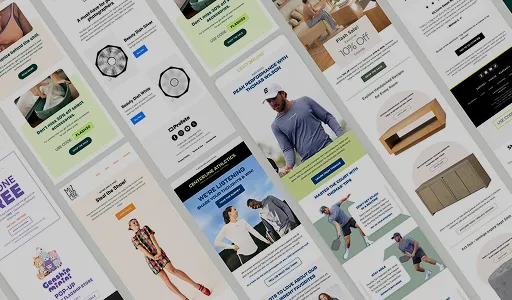

A welcome series is the sequence of automated emails a new subscriber gets after they sign up, create an account, or place a first order. At InboxArmy, our most welcome email sequences run 3 to 6 emails across 7 to 20 days. The first email should go out immediately, or within 24 hours at the latest, after a subscriber shows interest. Klaviyo’s benchmark data puts the average open rate for welcome emails at 51%. Top performers push placed order rates near 10%.
Quick Overview
What Is a Welcome Email Series?
A welcome email series is the automated sequence a brand sends to new subscribers after they sign up for the email list.
Where a single welcome email says hello once, a series carries that introduction across several emails. It’s an opportunity for brands to make product recommendations, collect client information, and build trust.
Why Create a Welcome Email Series?
When contacts sign up for your email list, they’re most attentive to your brand. You don’t waste this attention by sending a single ‘thank you for signing up’ email. At InboxArmy, we design a welcome sequence to:
- Set clear expectations about what they can expect from the brand, email frequency, and value.
- Gain insight into your subscribers’ interests, needs, and feedback, so you can personalize content moving forward.
- If you have complex products that need some consideration, this is the time to educate your new subscribers.
- Share the brand’s story, values, or personality to build a connection with subscribers.
- Drive early conversion with exclusive discounts or offers.
Here are some real results from the InboxArmy Welcome Series
| InboxArmy Client | Welcome Series Tactics | Success Metrics |
| Maven Lane | On-brand sequence with bestsellers and core values | Open Rate: 88.75%
Revenue Generated: $434,180 |
| Sixthreezero | Address customer objections, incentives, brand story, and social proof | Average Open Rate: 64.6%
Average CTOR: 13.19% |
| RCJuice | Brand story, CEO’s message, discount codes, and social proof | Revenue: 150% Increase in Monthly Revenue |
We break down each campaign later in this article
How Many Emails Should a Welcome Series Have?
At InboxArmy, we build welcome series with 3 to 6 emails for our clients across industries. For most of our campaigns, that’s enough room in the onboarding flow to give each one a distinct job. You can have individual emails for welcome, trust, offer, product, and follow-up without losing subscriber interest.
A brand-new subscriber usually isn’t a stranger to your brand; they found you somehow, but they’re rarely ready to buy either. Getting someone from that middle ground to actually convert takes more than one or two touches.
That’s where a structured welcome email sequence can prove beneficial. The table below breaks down InboxArmy’s welcome series framework that we use for our clients to map content, timing, and goals. Use it as a starting point, and then adjust based on your audience, industry, and email performance.
Welcome Email Series Template: The InboxArmy 6-Email Framework
| Content Type | Timing | Goal | Best For | Success Metric | |
| Email 1 | Welcome and Thank You | Immediately, within 24 hours | Confirm signup, deliver any promised incentive | Every business type | Open rate |
| Email 2 | Brand Story and Values | Days 2 to 3 | Build trust, humanize the brand | DTC and service brands with a strong founder story | Click-through rate |
| Email 3 | Exclusive Offer | Days 4 to 6 | Convert the first purchase | Ecommerce, discount-driven acquisition | Placed order rate |
| Email 4 | Product Highlights | Days 7 to 10 | Showcase bestsellers or new arrivals | Ecommerce with a wide catalog | Click-through rate |
| Email 5 | Educational Content and Social Proof | Days 10 to 13 | Build authority, reduce hesitation | SaaS, B2B, higher-consideration purchases | Engagement on educational content |
| Email 6 | Follow-Up and Feedback | Days 15 to 20 | Close the loop, gather feedback | Every business type, especially subscriptions | Series completion rate |
What are the 6 Types of Welcome Emails?
A welcome email series mainly involves thank you, educational & social proof, incentive-driven, product showcase, brand story, and information gathering. Throughout these emails, the InboxArmy email marketing team introduces new subscribers to the brand, shares customer stories, builds trust, encourages them to explore the products or services, gathers customer data, and finally gets them to take action.
Welcome Email 1: Welcome and Thank You
Goal: Make a strong first impression and set expectations for the relationship ahead.
The first email in the welcome sequence warmly thanks contacts for joining, subscribing, or purchasing. We set expectations for the relationship going forward, what they’ll receive, and how often.
If you’ve offered any lead magnet or discounts for signing up, deliver it in the first welcome email.
What the email copy should include:
- A warm, genuine thank-you
- Delivery of any promised lead magnet or discount code right away
- A short preview of what’s coming in future emails
- An invite to set content/channel preferences
CTAs: Browse Bestsellers, Follow on social, Complete Your profile
Note: Post-purchase welcome emails can personalize better using buyer’s name and tailored product recommendations.
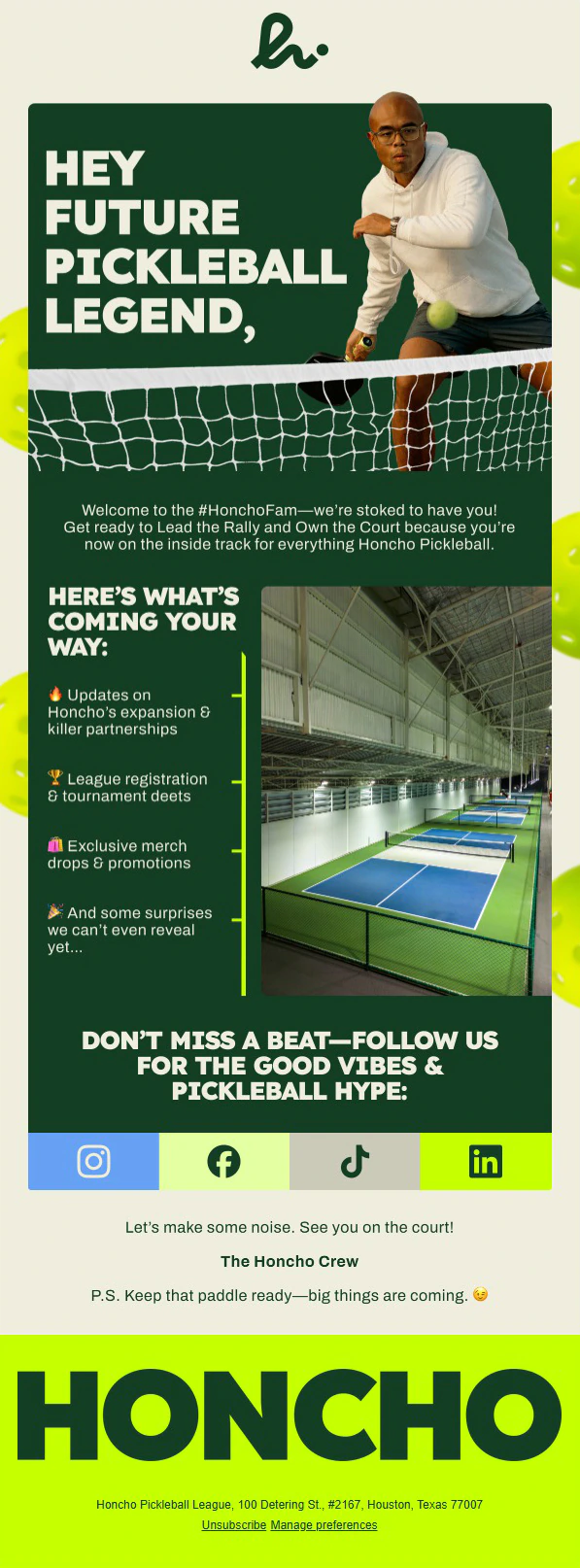
Honcho Pickleball welcomes customers to the family and gives them a rundown of what to expect, like league and tournament information, exclusive merchandise, and the latest updates.
Welcome Email 2: Educational Content and Social Proof
Goal: Build trust and position the brand as the authority, especially for products that aren’t self-explanatory.
An educational welcome email provides something useful: a guide, a comparison, and an explainer for complex products and services. This clarity and guidance matter most for higher-priced products or anything with a use case that isn’t obvious at a glance.
At InboxArmy, we use this opportunity to share exclusive tips and resources and establish the brand as an authority.
CTAs: Watch a demo, read a guide, or explore a help center/FAQ.
What the email copy should include:
- A practical resource (setup guide, explainer video, comparison chart)
- Real use cases or tips
- Light social proof if it fits naturally (reviews, ratings)
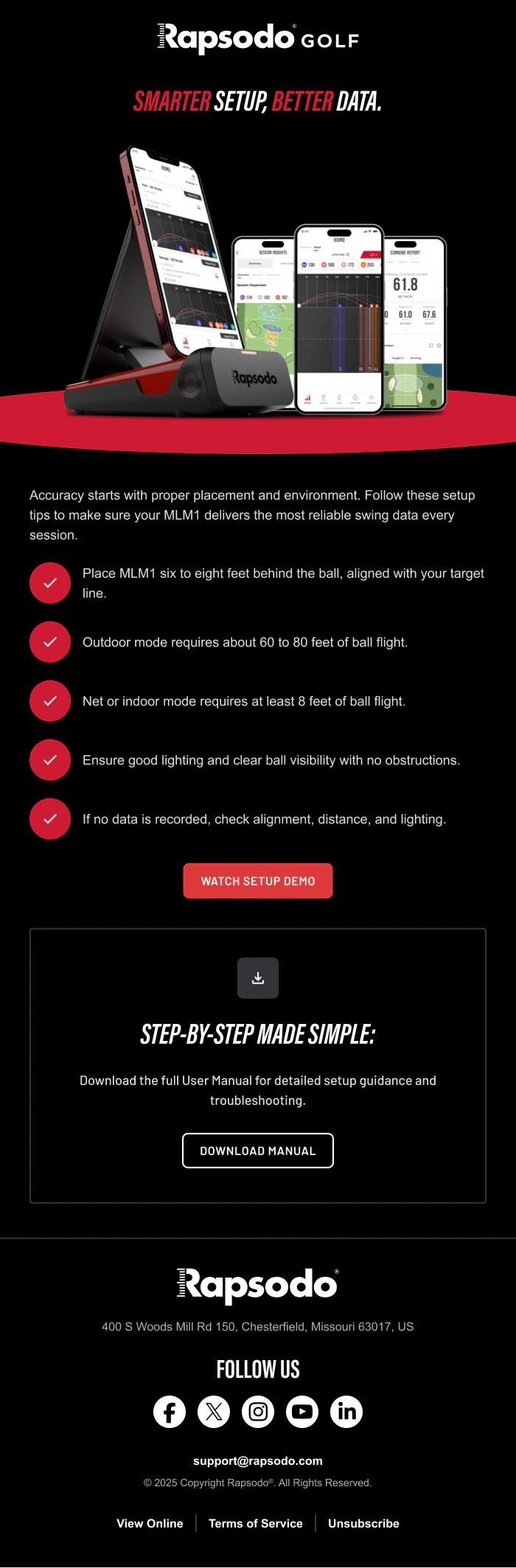
Rapsodo Golf’s welcome email educates customers on how to use their MLM1 mobile launch monitor. We included a setup demo video and manual to ease buyers’ hesitation and build trust.
Welcome Email 3: Incentive or Offer
Goal: Convert interest into a first purchase.
We often offer discounts, free shipping, or bonus gifts when contacts sign up. If we don’t lead with that, we typically introduce a discount, a free trial, or exclusive content later in the welcome series. A plainly stated deadline brings urgency.
CTA: Shop now / redeem your discount
What the email copy should include:
- The offer stated plainly, front and center
- A clear deadline to create urgency
- Supporting trust elements (bestsellers, satisfied customers, trust badges)
The welcome sequence we built for Qualia offers a 75% discount on first-order. The clutter-free design layout highlighted favorite products, satisfied customers, and trust badges to encourage conversion.

Welcome Email 4: Brand Story and Values
Goal: Build authenticity and emotional connection
Authenticity and credibility matter as much to customers as quality products. Once you have a subscriber’s attention, we use the welcome series to establish the brand’s story and values.
CTAs: Learn more / read our story
What the email copy should include:
- Highlight materials, process, product philosophy, or unique methodology.
- Show sustainability principles, craftsmanship, or community influence.
La DoubleJ frames itself as more than a fashion and homeware brand in its welcome email. Instead of simply pushing products, it emphasizes community, shared values, and sisterhood.

Welcome Email 5: Product Showcase
Goal: Drive product discovery and a first purchase through curated highlights
A product highlight welcome email showcases bestsellers or new arrivals with reviews and ratings attached. A curated shortlist consistently earns more attention than a comprehensive catalogue dump, and strong photography or a short product video carries more weight here than long copy.
CTAs: Shop the collection / quick steps to order
What the email copy should include:
- A short, curated list
- Benefit-focused (not feature-focused) descriptions
- Strong photography or a short product video
- Bundle or discount offers, if available
Sok It’s B2B welcome email gets a lot of things right.
- They highlight what’s new in 2026 or standout product categories.
- Short, benefit-focused descriptions and clear images.
- Puts bundle discount offers front and center.
- Quick steps to place an order.

Welcome Email 6: Information-gathering or Preference Capture
Goal: Learn about the subscriber so future emails can be personalized.
Information-gathering welcome emails capture subscribers’ interests and needs. This helps us personalize email campaigns, product recommendations, and offers going forward and build customer loyalty. Ask what subscribers think so far, request a review or a quick survey response, and if there’s a welcome discount still on the table, remind them before it expires.
CTAs: Take a quick quiz / complete your profile / leave a review.
What the email copy should include:
- A short, low-friction survey or preference form
- A reminder of any welcome discount still available, with urgency
- A clear reason why we’re asking (better recommendations, better fit)
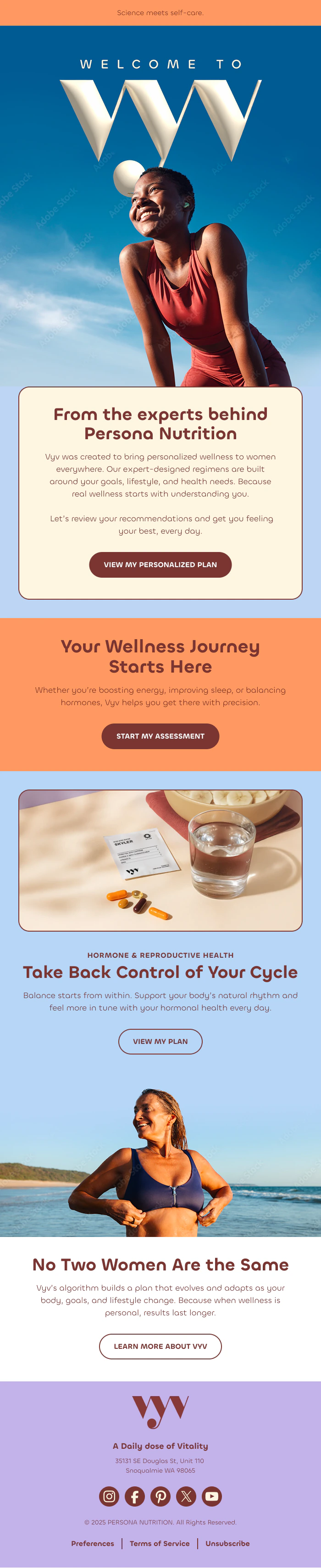
VYV Wellness welcome email includes personalized plans and assessments to curate a tailored experience for their customers.
Want to better understand why timing, cadence, and message flow matter so much in a welcome series? Dive into Chapter 3 of our Introduction to Email Marketing Course — The Importance of the Welcome Email. It breaks down how brand differentiation, consent, and personalization directly impact engagement and long-term retention.
What Are The Components Of A Great Welcome Email Series
All great welcome email series InboxArmy builds combine captivating subject lines, clear brand identity, immediate value delivery, engaging visuals, one clear CTA, a strategic welcome offer, and relevant content to keep the subscribers engaged.
Highlight the value of subscribing
We show subscribers what they can gain from engaging with the brand. The welcome email sequence is only as good as the value you offer:
- Gift and free products
- Early access to products or sales
- Exclusive content or upgrades
- Free or discounted shipping
- Loyalty points and member rewards
A strategic welcome offer:>
If your contact is signing up for the email list in exchange for something of value, deliver it in the first email.
- Single-use discount codes can encourage immediate action
- Limited-time offers instill urgency and give them a reason to purchase sooner.
- If it doesn’t lead to a conversion, offer an extension with a final email.
Captivating subject lines:
- We use available customer data to personalize subject lines, including name, sign-up channel, category interest, etc.
- From our experience, clear, brief subject lines that front-load information do better across the board.
- Evoke curiosity by teasing what’s inside the welcome email, encouraging subscribers to click open.
Establish brand identity:
The welcome email sets the tone of your relationship with existing and potential customers. From the first email, we clarify what contacts are signing up for.
- Product features and assets
- Brand value and story
- Social proof to build instant trust and reduce customer anxiety
Optimize welcome email design:
What should the welcome email look like? Whether it’s one or six emails, InboxArmy keeps it consistent with the brand’s visual identity to create a recognizable experience for the subscribers.
- Clear visual hierarchy so customers can quickly scan the main message, value, and CTA.
- Mobile-first email design for column layout, content, and images.
One Clear Call to Action:
Every welcome email should have one CTA per send; as long as nothing else is competing for the click, it will work.
- All our CTAs align with the email goal; it could be shop now, take a quiz, initiate a download, or survey questions.
- We place the CTA front and center in the welcome email.
- Even with secondary links, the primary action is always front and center.
Want to better understand why timing, cadence, and message flow matter so much in a welcome series? Dive into Chapter 3 of our Introduction to Email Marketing Course — The Importance of the Welcome Email. It breaks down how brand differentiation, consent, and personalization directly impact engagement and long-term retention.
9 Welcome Email Best Practices & Examples That Drive Conversions
1. Visible unsubscribe link
CAN-SPAM requirements govern commercial emails in the US and require subscribers to have the option to opt out. A visible unsubscribe link is a trust signal and gives subscribers control over their inbox. Across brands we’ve worked with, we have seen that contacts genuinely want to hear from you; they’re much more likely to take preferred action.
2. Collect customer data for personalization
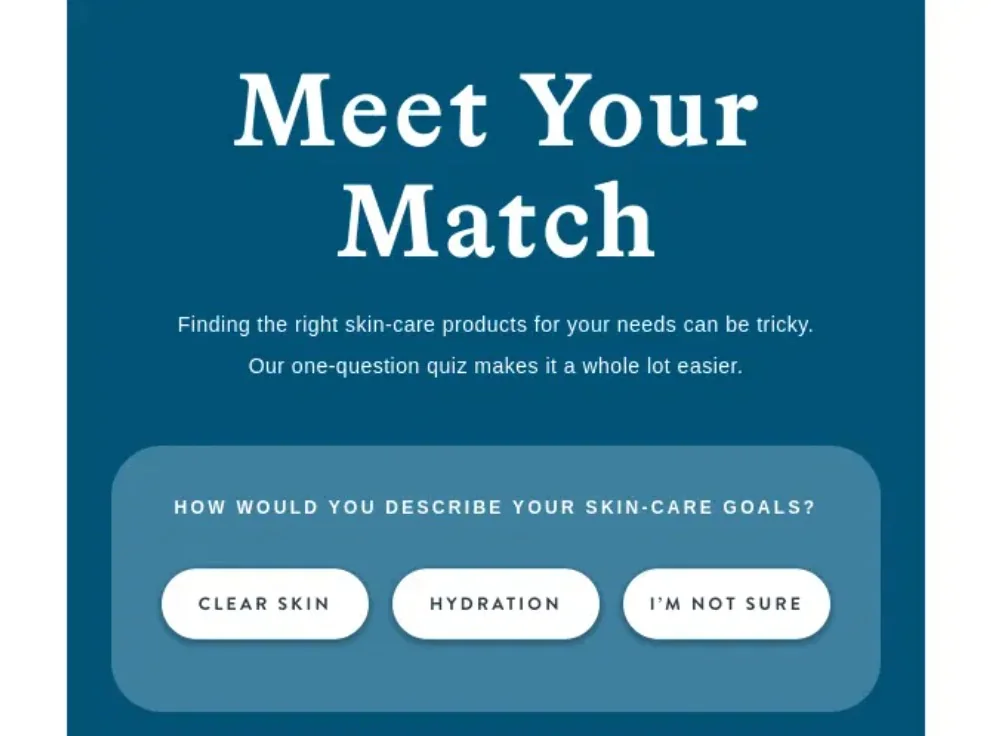
We collect zero-party and first-party customer data to make welcome emails more relevant. We get zero-party data from sign-up forms, preference centers, and quizzes. From my experience, website tracking, order data, email analytics, and CRM platforms are all excellent sources of customer information for our email marketing specialists to personalize emails.
Harry’s grooming brand asks subscribers about their skincare preferences to tailor product recommendations and offers to their interests and needs.
3. Leverage dynamic content for welcome emails
We utilize subscriber data to build dynamic content blocks. Within the same welcome email campaign, subscribers get product recommendations, offers, images, and messaging based on sign-up source, preferences, location, or history. InboxArmy’s emails leverage dynamic content to introduce new launches, best-selling products, or trending items that can improve engagement.
Apart from a welcome offer, the welcome email we created for Catastrophic introduces new subscribers to their best sellers.

4. Segmentation & suppression strategy
We segment subscribers based on their sign-up source, interests, and engagement history to avoid sending everyone the same generic welcome email. The following segmentation strategy has delivered results for InboxArmy:
- Sign-up source: social, referral, organic, or in-store
- Sign-up intent: Discount, content, or loyalty members
- Engagement: Highly engaged, moderately engaged, or inactive
- Preferences: Topics, products, or communication preferences
At the same time, our email marketers suppress contacts to avoid duplicated marketing efforts or irrelevant sends. This ensures one subscriber isn’t part of multiple email marketing campaigns at the same time.
5. Prioritize social proof
While offers and discounts can lead to conversion, social proof is the quickest way to earn trust and loyalty. When InboxArmy designs welcome email sequences, we highlight customer reviews, ratings, testimonials, and user-generated content. This works better than a long list of features and benefits.
For Nellis Auction’s welcome email, we included customer reviews and testimonials. Giving them equal priority as offers makes conversion easier.
Note: When the brand isn’t well known yet, lead with proof and make the ask second.

6. Let your brand personality shine
Most customers cite authenticity and brand value as deciding factors while shopping. We use welcome sequences to show subscribers what makes the brand different from competitors. This includes:
- Brand story and behind-the-scenes content
- Social or environmental initiatives
- Quality standards and craftsmanship
- Community involvement and sustainability efforts
7. Establish trust through your welcome email flow
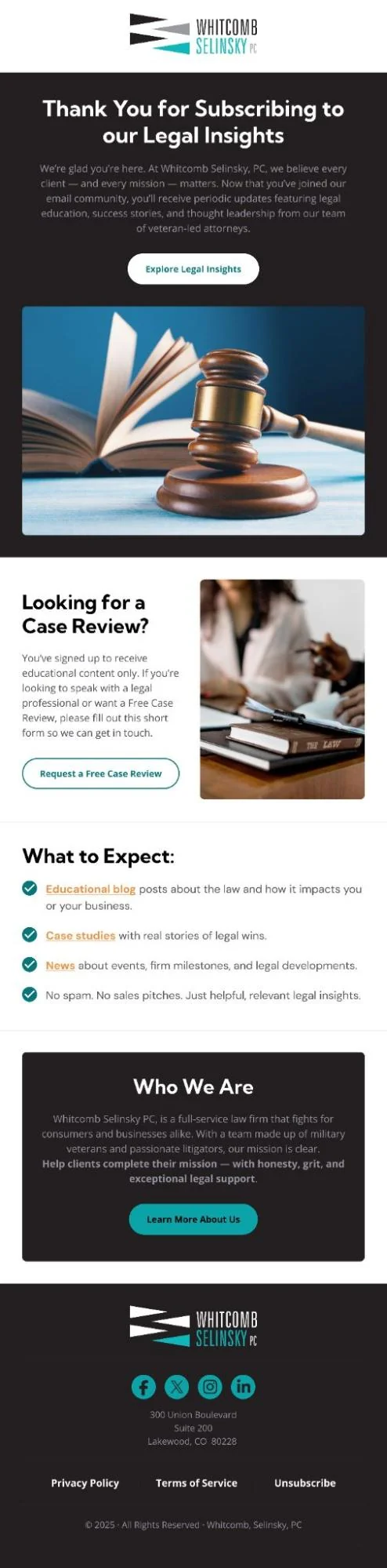
A new subscriber has no idea how often you’ll email them or what tone to expect. We answer that early, and first-week unsubscribes come down. We’ve seen this play out on nearly every account we’ve onboarded.
When we crafted welcome emails for Whitcomb, Selinsky, PC, we clearly told subscribers what kind of content to expect. This genuine sharing of insights helps prove the brand as a credible figure in the field.
8. Find the ideal timing for your welcome email sequence
Welcome emails are time-sensitive. The first one must go out immediately or at the latest within 24 hours. For the rest of the series, no universal timing works for every brand and audience. From our experience, some campaigns do well with a tight schedule, while others require ample breathing room between emails. A/B testing allows us to identify what works best for each client, with sequence length and timing schedule chosen based on data.
9. Multi-channel welcome campaign
Welcome campaigns combining emails with SMS marketing deliver better engagement and conversion rates.
- We keep timing and messaging consistent across channels.
- SMS can be useful for time-sensitive information, such as discount reminders, order updates, and deadlines.
- We use social media inclusion to create community engagement and user-generated content.
Welcome Email Series: Real Client Success Stories and Results
Client: Maven Lane
Maven Lane, a furniture brand, was struggling to make email marketing work when they approached InboxArmy. After our audit, we realized that due to their inconsistent campaigns, the company was losing out on significant revenue opportunities, including the welcome email series.
Challenge:
- Lack of automated emails mapped to the customer journey
- Underwhelming welcome sequence with poor subscriber engagement
InboxArmy’s Approach:
- Our marketing team built a welcome email series showcasing Maven Lane’s core values and bestsellers
- We revamped the email design to align with the brand’s premium image
- Mobile optimization was a top priority for us to guarantee a seamless customer experience across all devices
Results:
Our email marketing efforts for Maven Lane, including the reworked welcome series, generated $700,000 in revenue.
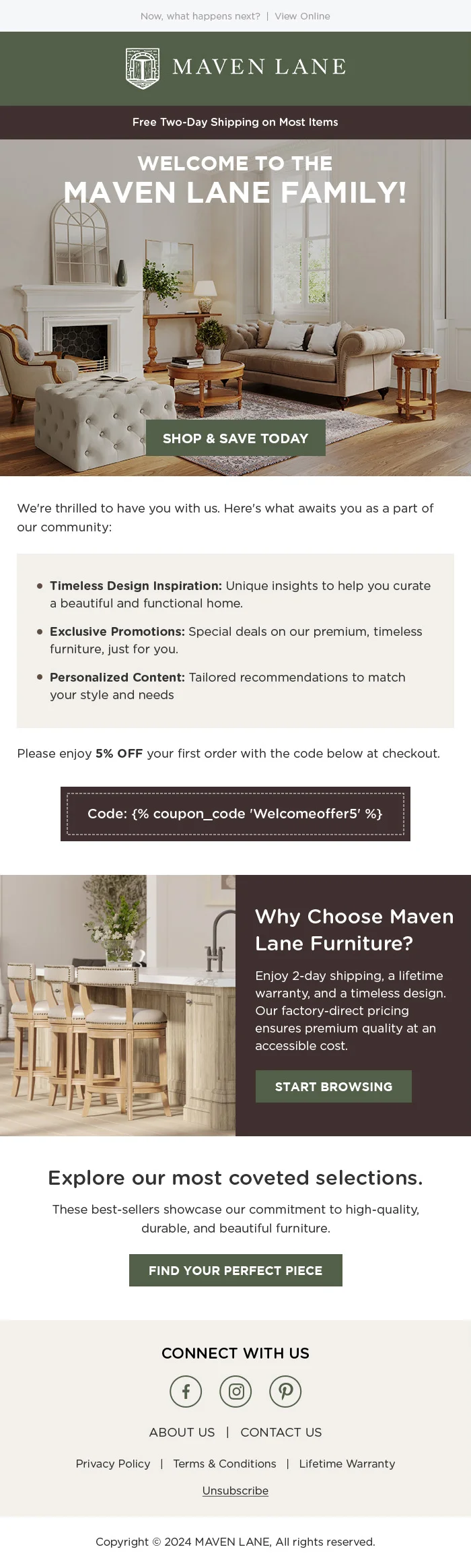
Here is the welcome email design we created for Maven Lane, matching the brand’s polish and tone.
Client: Sixthreezero
For ecommerce businesses like Sixthreezero, welcome email campaigns can engage subscribers and lead to conversions.
Challenge:
- Segmentation and list management errors
- Poor template designs
Email Marketing Strategy:
- Through the welcome emails, we addressed common objections and concerns subscribers had regarding Sixthreezero products and services.
- We shared the brand story to develop connection and build trust.
- We promoted Sixthreezero’s Facebook group to improve social engagement.
- Social proof, including customer reviews and publications, was part of every email we created to establish the brand’s credibility.
Results:
After building their email campaigns from the ground up with InboxArmy’s conception, design, and coding, Sixthreezero saw a 335% increase in revenue from the same time period the previous year.
For Sixthreezero, we built the following 3-part welcome templates to connect with the audience, reduce friction, and encourage purchase.
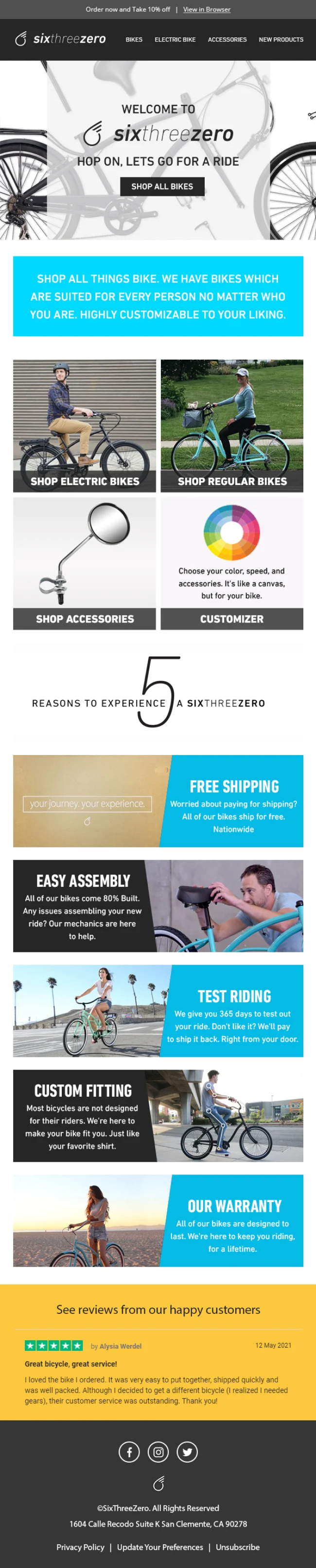
Welcome Email 1
Content Focus: 5 Reasons to experience Sixthreezero
Result – Open Rate: 70.28% CTOR: 18.6%

Welcome Email 2
Content Focus: $20 Discount
Result – Open Rate: 65.62% CTOR: 10.14%

Welcome Email 3
Content Focus: Invitation to join Sixthreezero’s pedalers Facebook group
Result – Open Rate: 60.92% CTOR: 10.85%
Client: RCJuice
For RCJuice, an online retailer, efforts to move their business from eBay and Amazon to their own website, InboxArmy, created two high-performing Klaviyo flows for welcome emails and cart abandonment.
Challenge:
- RCJuice’s existing email list was underperforming in terms of deliverability and engagement.
- Also, email campaigns were lacking in driving revenue or website traffic.
Welcome Email Strategy:
- We introduced a pop-up subscription form on the RCJuice website to capture contacts.
- Our next strategy was to introduce an incentive in the first email itself with a discount code encouraging new subscribers to convert.
- InboxArmy designed welcome emails highlighting the brand story and a message from the CEO and sharing RCJuice social media channels to build a connection with the subscribers.
- Social proof is a must for our email campaign to gain trust.
Result:
InboxArmy’s email marketing strategy increased RCJuice’s email marketing revenue by 300%.
The 3-email welcome sequence below that we designed for RCJuice is simple in design and content. It gets the point across without overwhelming subscribers with information.
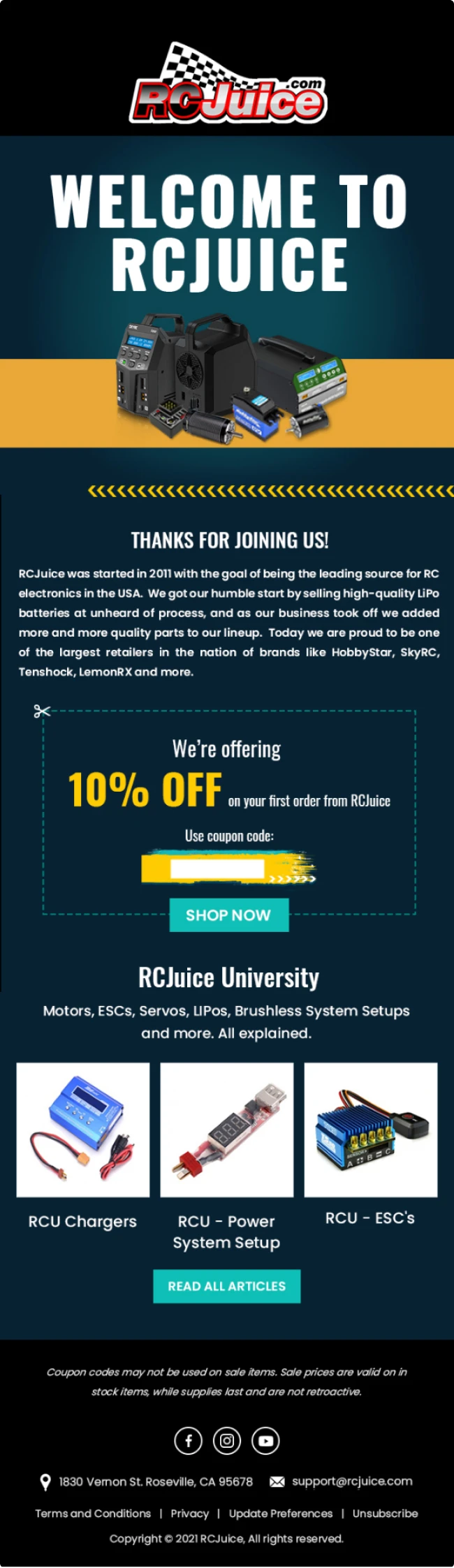
Welcome Email 1
Content focus: Thank you for joining + discount
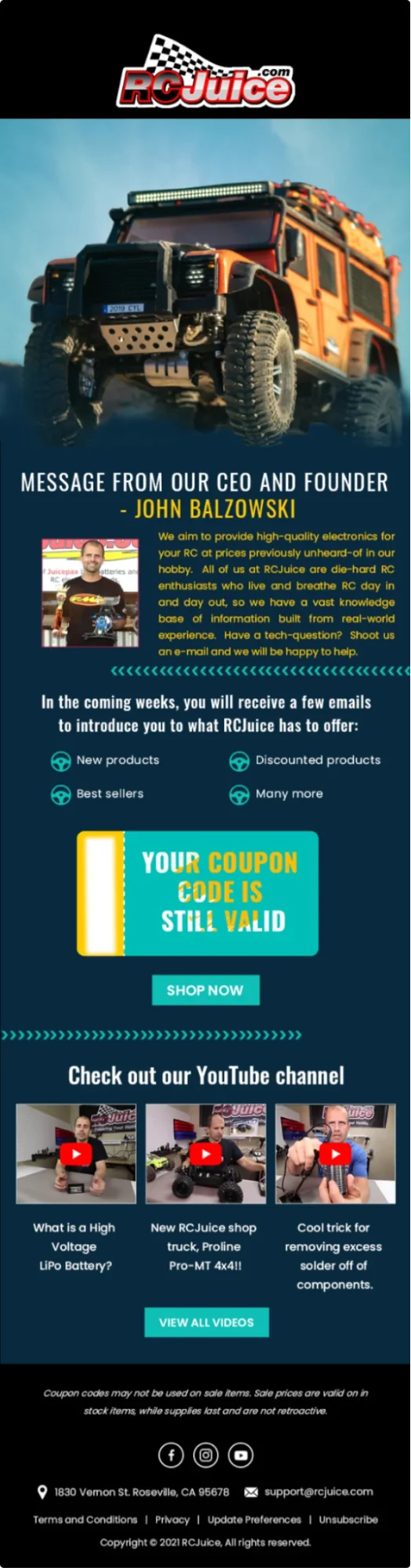
Welcome Email 2
Content focus: CEO message + introduce YouTube channel
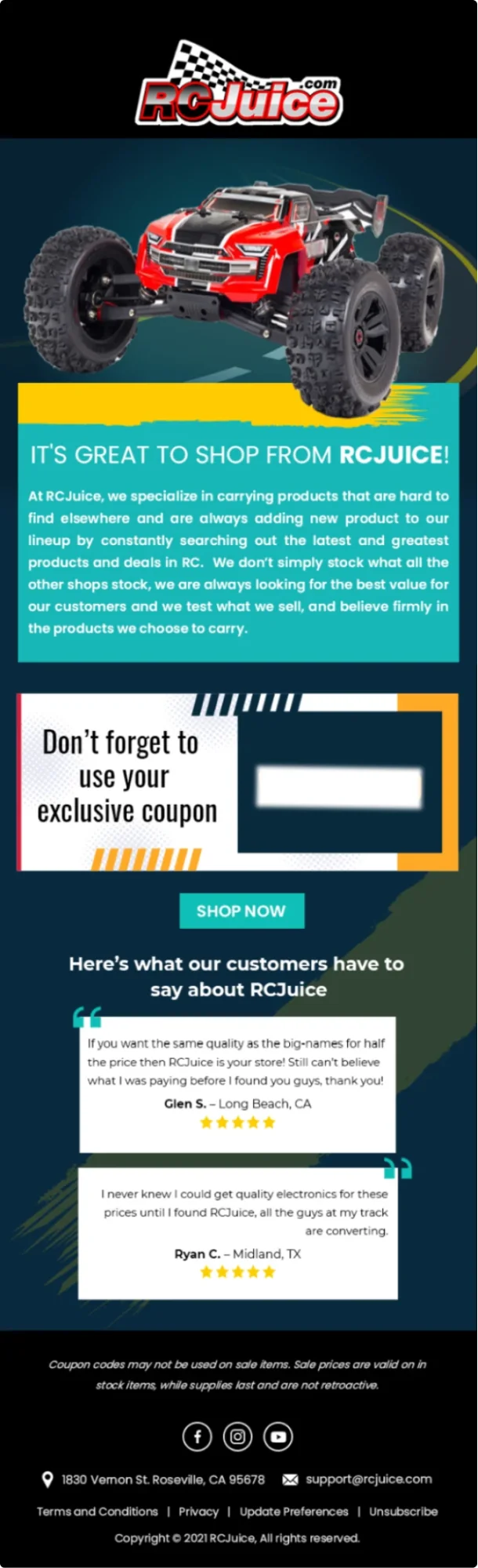
Welcome Email 3
Content focus: Discount reminder + social proof
How To A/B Test Welcome Emails
At InboxArmy, we use A/B testing for high-impact elements of welcome emails, such as content, frequency, timing, and offer type. When decisions are backed by actual performance data, we are much more likely to see desired results.
- Our email marketers test the subject line and preview text first, since nothing else matters if the email doesn’t get opened
- Offer type: percentage against flat dollar against gift with purchase
- Sequence length, shorter against longer for a given audience
- CTA placement, one clear action against several competing links
- Personalization depth, dynamic recommendations against a static version
- We run clean 50/50 splits with one variable at a time.
- For A/B testing, we send both versions simultaneously so the day of the week doesn’t alter the results.
- For our smaller lists, it sometimes takes 2 to 4 weeks before we get accurate numbers.
When we’re deciding email sequence and content length, we consider factors below to set a baseline for our clients. From there, A/B results tell us whether to add or trim emails.
When to Add More Emails to Your Welcome Email Series
- When your product or service is complex, and the purchase cycle runs long with information research and evaluation. In such cases, you need more than a three-email sprint to cover.
- For businesses with a wide catalog, the bestsellers deserve their own send. You don’t have to cram every product, review, and usage into one single email.
- If you have a real founder story, customer stories, or FAQs worth more than a paragraph tucked at the bottom of an email.
- If your current short welcome email flow isn’t working for your brand in terms of engagement and conversions.
When expanding the welcome email series for our clients, we spread the 3 to 6 emails over 7 to 20 days to reduce unsubscribe rates. Main products, offers, and social proof must be part of the earlier emails, and widen the gap as you move along, from 24 hours to days.
When to Keep Your Welcome Email Series Short
- If the email volume is low enough that an elaborate build won’t pay for itself.
- The product line is narrow, so a dedicated showcase send has nothing new to show.
- The series has already crept past six or seven emails. Past that point, we’ve watched series lose subscribers faster than they gain engagement.
How Long Should a Welcome Email Be
A 150- to 300-word welcome email can land right. Short enough for a phone screen, long enough to say something real about your brand, product, or customer testimonials.
Word count isn’t really the lever, though. On the accounts we’ve tested, a tightly organized 250-word email holds attention longer than a dense 400-word one covering the same ground. Short paragraphs and a layout someone can actually scan on a phone screen.
How To Measure Welcome Email Performance
At InboxArmy, the core metrics we monitor to measure welcome email performance are open rate, click-through rate, and conversion rate. Bounce rate and unsubscribe rate helps us assess the quality of our email list.
| Metric | What it tells you |
| Open rate | Subject line effectiveness |
| Click-through rate | Content relevance, CTA performance |
| Conversion rate | Whether the CTA drives the intended action |
| Bounce rate | List quality issues |
| Unsubscribe rate | Mismatch between expectations and content |
| Revenue per recipient | Cleanest way to compare series performance |
| Series completion rate | Where subscribers drop off |
| 30/60/90-day retention lift | Whether the series builds lasting value |
What Are Some Common Mistakes To Avoid In A Welcome Email Series?
The moment contacts sign up for your brand, you have their attention. When done right, InboxArmy has delivered conversions for our clients. We try to steer clear of the following missteps to make the most of welcome sequences:
Sending the same email to everyone without personalization
Generic welcome emails or offers across the board mean less engagement and results. We use subscriber data and segmentation to make emails more relevant.
Lack of strong CTA
Vague or multiple CTAs can confuse subscribers about what to do next. We give each email one clear action.
Ignoring mobile optimization
A welcome email must be easy to read and interact with on a mobile device, or you’re losing engagement.
Making every email promotional
It’s a good idea to push products when you have subscribers’ attention. But not every email in the welcome series can be promotional. We balance it with useful content, social proof, and brand storytelling.
Neglecting brand consistency
We keep the tone, design, visuals, and messaging consistent with the brand’s website and other customer touchpoints.
Overloading subscribers with emails
Potential or existing customers shouldn’t be part of multiple email campaigns. Email marketing specialists at InboxArmy use suppression lists to avoid overwhelming subscribers.
How To Automate Your Welcome Emails
Sending welcome emails manually can affect their timing and efficiency. Most email marketing platforms allow you to set up automated welcome flows with ease.
1. Choose a signup trigger
We set up the welcome email automation to start when someone joins your email list, creates an account, downloads a resource, or does any other relevant action.
2. Define the goal and map the welcome email sequence
We decide the purpose and timing of each email in the welcome sequence, whether it’s an incentive, product recommendation, useful content, or social proof.
3. Set up segmentation and personalization
We utilize the subscriber data, preferences, customer status, browsing history, or purchase intent to tailor the emails.
4. Add conditional logic
Subscribers shouldn’t follow the same flow irrespective of their actions. We create separate branches for when someone clicks a link or takes an action.
5. Set timing and frequency
Based on A/B testing and past performance, we establish appropriate timing and frequency for welcome emails.
6. Create suppression rules
We automatically remove subscribers from welcome campaigns if they unsubscribe or convert.
7. Test and monitor the welcome automation
We continuously monitor the performance of welcome emails and make adjustments accordingly.
Welcome Email FAQs
What’s the best timing between welcome emails?
Send the first email immediately, or within 24 hours at the latest. Space the next two or three sends by 1 to 3 days, widening to 3 to 5 days as the series continues.
How do you personalize a welcome series?
Start with what’s already known: first name, acquisition source, and browsing behavior. Expand from there through preference capture emails and product recommendations tied to site activity.
What compliance requirements apply to welcome emails?
In the US, the CAN-SPAM Act requires a visible, working unsubscribe link in every commercial email, including welcome emails. We make that link easy to find because it builds trust instead of costing subscribers.
Should you send just one welcome email instead of a full series?
One email can confirm a signup. It can’t build trust, showcase products, and make an offer without overloading the reader all at once. A short series spreads that work across several emails, each with room to actually do its job.
How do you keep a welcome series from clashing with regular campaigns?
Suppress anyone currently in a welcome series from broadcast sends. A promotional blast landing in the same inbox as a welcome email teaches a new subscriber to tune out before the relationship’s even started.
How do you transition from a welcome series into ongoing campaigns?
Once someone completes the series, move them into standard segmentation based on what they clicked, bought, or told you during preference capture, not into the same bucket as everyone else on the list.