
Every ecommerce brand eventually runs into the same math problem: acquisition costs keep climbing, ad platforms keep changing their rules, and revenue growth starts costing more than it did a year ago just to stay flat. Paid ads still have a place, but building your growth plan entirely around them is a fragile strategy, especially for brands that don’t have unlimited budget to keep outbidding competitors for the same audience.
The channels that don’t disappear when a platform changes its algorithm are the ones you own: your email list, your SMS list, your website, and the relationships you’ve already built with existing customers. This guide covers what actually moves revenue without adding ad spend, and where to focus first if you’re starting from close to zero on the retention side.
Why Owned Channels Matter More As Ad Costs Rise?
Paid acquisition only works as long as the math works. The moment cost-per-click outpaces what a customer is worth to you, that channel stops being growth and starts being a treadmill.
A few reasons this matters more than it used to:
- Acquisition costs keep rising. Paid ad costs across most platforms have climbed steadily, which means the same ad spend buys fewer customers than it did a few years ago.
- Retention is cheaper than acquisition. Keeping an existing customer costs a fraction of what it takes to win a new one, and retained customers spend more over time.
- Platform dependency is a real risk. An algorithm change, a policy update, or a rise in CPMs can wipe out a channel that was working fine a month earlier. Owned channels don’t carry that risk.
- Organic channels compound. SEO, email, and a strong repeat-purchase engine keep generating revenue long after the initial work is done, instead of stopping the moment you stop paying.
- You already have the traffic. Most stores are sitting on more revenue potential in their existing visitors and existing customers than they’re capturing. Getting more from what you already have is usually cheaper than getting more visitors.
Increase Customer Lifetime Value
Customer lifetime value (CLV) is the total revenue a customer generates across their full relationship with your brand, not just their first order. Every retention lever you pull, from better post-purchase flows to a working loyalty program, feeds directly into this number.
There are three ways to move it:
- Increase how much each customer spends per order (AOV).
- Increase how often they buy.
- Extend how long they stay a customer before churning.
CLV should be tracked regularly, not calculated once and forgotten. If it’s flat or declining, that’s usually a retention problem showing up before it shows up anywhere else.
Increase Average Order Value
Average order value (AOV) is your total revenue divided by your total number of orders. Where CLV looks at a customer over time, AOV looks at a single transaction, and it’s one of the fastest levers to pull because you don’t need more traffic to move it, just more value per order from the traffic you already have.
Ways to lift AOV without new spend:
- Volume-based incentives. Free shipping thresholds, tiered discounts, or “spend X, save Y” prompts nudge customers toward a bigger cart without discounting the whole order.
- Product bundling. Grouping frequently-purchased items into a bundle increases order size and, done right, protects margin better than a blanket discount would.
- Cross-sell and upsell placement. Recommending a genuinely relevant add-on, especially in a post-purchase email, works because the customer has already committed to buying, they just haven’t seen the second reason to add more to the order.
- A/B testing on pricing and layout. Small changes to how bundles or thresholds are presented can shift AOV meaningfully. Test before assuming what will work.
Improve Conversion Rate
A click isn’t a conversion. Someone clicking through from an email and someone actually completing checkout are two different numbers, and the gap between them is where a lot of recoverable revenue sits.
Improving conversion rate means getting more revenue out of the same list and the same traffic, which makes it one of the most efficient places to focus before spending more to acquire new visitors.
What actually moves this number:
- Segmentation and personalization. Generic blasts convert worse than messages built around what a subscriber has already shown interest in.
- One clear CTA per email or page. Competing calls-to-action split attention and lower click-through across the board.
- Ongoing testing. Subject lines, send times, and page layouts all shift performance, and none of it is a “set once” decision.
- Deliverability and mobile experience. An email that lands in spam or doesn’t render properly on a phone never gets the chance to convert, regardless of how good the offer is.
- Social proof at the decision point. Reviews and ratings placed near the CTA reduce hesitation right when a customer is deciding.
Build Owned Channels: Email and SMS
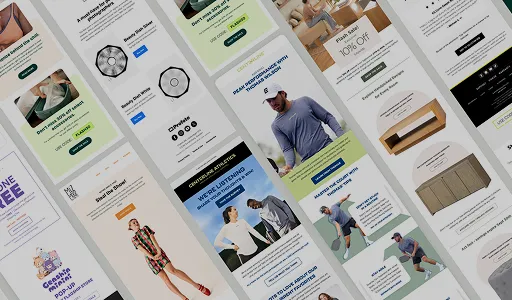
Email and SMS are the two channels where you’re not paying per interaction, and where you already have permission to talk directly to people who’ve bought from you before. That combination is why they’re consistently one of the highest-ROI channels available to ecommerce brands, and it’s the core of what an ecommerce email marketing agency is built to manage well.
The core email flows that carry most of this revenue:
- Welcome series: Introduces the brand and converts new subscribers before they’ve had a chance to forget why they signed up.
- Abandoned cart: Recovers sales that were already close to happening. This is usually the single highest-converting automated flow a brand runs.
- Post-purchase flows: Turn a first purchase into a second one and build the loyalty that lowers acquisition costs long-term.
- Win-back campaigns: Re-engage subscribers who’ve gone quiet, at a fraction of what it costs to acquire a brand-new customer.
SMS adds a second layer on top of this. Open rates run far higher than email, and it works well for time-sensitive messages, restock alerts, and flash offers where speed matters more than depth.
Invest in SEO
Paid ads disappear the moment you stop paying for them. SEO doesn’t work that way. Rankings take longer to build, but once a page ranks, it keeps generating traffic without an ongoing spend behind it.
Where to focus:
- Product and category pages built around the actual terms customers search for, not just brand language.
- Blog content targeting specific, answerable questions your audience is searching, rather than broad, competitive terms you’re unlikely to rank for quickly.
- Technical fundamentals: site speed, clean internal linking, and a structure search engines can actually crawl without friction.
None of this replaces paid traffic overnight. It compounds. A page that ranks in month six is still generating free traffic in month eighteen, which is the opposite of how a paid campaign behaves the day you turn it off.
Use Social Proof
Most purchase decisions are influenced by what other customers have said, not just what a brand says about itself. Leaning on that is close to free, and it directly increases conversion rate on traffic you’re already getting.
- Reviews and star ratings. A large share of online shoppers check reviews before buying, and a product page without them is working with one hand tied behind its back.
- User-generated content. Real customer photos and testimonials carry more trust than polished brand photography, particularly on product and landing pages.
- Visible recommendation counts. Even a simple “X people recommend this” signal reduces the hesitation a new visitor feels when there isn’t a large review base yet.
Personalize Beyond a First Name
First-name personalization is table stakes at this point. Real personalization means using purchase history, browsing behavior, and engagement data to send messages that are actually relevant to that specific subscriber, not just addressed to them.
A few practical applications:
- Referencing the actual product purchased in a follow-up, rather than a generic “thanks for your order.”
- Triggering emails off real behavior, like browsing a category repeatedly without buying, instead of a fixed send schedule.
- Using purchase data to time replenishment or restock reminders around when a customer is actually likely to need the product again.
This is where segmentation and lifecycle strategy do more work than any single email ever could. The personalization isn’t the subject line, it’s the underlying data logic deciding who gets which message and when.
Strengthen the Post-Purchase Experience
A lot of brands treat the sale as the finish line. It isn’t. What happens in the weeks after checkout determines whether that customer buys again or disappears after one order, and it’s some of the highest-leverage, lowest-cost work available since you’re emailing people who’ve already bought, not trying to convince someone new.
A solid post-purchase sequence typically includes:
- Order and shipping confirmations that do more than just relay logistics.
- A genuine thank-you touchpoint, separate from the transactional emails.
- Review requests timed to when the customer has actually used the product.
- Cross-sell or upsell emails introduced once trust is established, not immediately after checkout.
- Loyalty program invitations for customers who’ve shown they’ll buy again.
Brands that skip this step are leaving retention on the table and quietly pushing customers toward a competitor who did bother to follow up.
Run an Affiliate Program
Affiliate marketing is performance-based by design, which makes it one of the lower-risk ways to reach new audiences. You only pay out when a sale actually happens, so there’s no upfront spend at risk the way there is with paid ads.
To make it work:
- Partner with affiliates whose audience genuinely overlaps with your target customer, not just anyone with a following.
- Offer a commission structure competitive enough to make promotion worth their effort, typically somewhere in the 5–30% range depending on margin.
- Give affiliates ready-to-use assets: product images, banners, and pre-written copy that removes friction from them promoting you.
- Track performance closely so you can double down on the affiliates actually driving sales and drop the ones that aren’t.
Build a Referral Program
Referrals convert well because they come with a built-in layer of trust that no ad can replicate. A friend’s recommendation carries more weight than a sponsored post, and it costs you nothing until a sale actually happens.
What makes a referral program work:
- An incentive worth acting on, for both the referrer and the new customer, whether that’s a discount, free shipping, or store credit.
- A frictionless sharing process. A referral link a customer can send in two taps gets used far more than one buried three clicks deep in an account dashboard.
- Visibility. Promote the program in post-purchase emails and on your site. A referral program nobody knows exists doesn’t generate referrals.
- Ongoing tracking, so you know which incentives and which customer segments are actually driving new business.
Best Practices That Support Every Strategy Above
- Keep the site fast and mobile-friendly. None of the strategies above matter if visitors abandon a slow-loading site or a clunky checkout before converting.
- Invest in responsive customer support. Quick, helpful answers reduce purchase hesitation and directly support conversion rate.
- Optimize product pages properly. Clear pricing, real photos, detailed descriptions, and visible reviews all reduce the friction between interest and purchase.
- Get listed in relevant directories. Free listings add another discovery path without adding spend.
Common Mistakes That Undercut These Strategies
- Over-relying on paid acquisition. Growth that only comes from ad spend is growth that gets more expensive every quarter.
- Neglecting retention. Chasing new customers while ignoring the ones you already have caps your long-term revenue ceiling.
- Weak product pages. Thin descriptions, no reviews, and low-quality images quietly kill conversion before a customer even reaches checkout.
- A complicated checkout. Every extra field or step is another chance for the customer to abandon the cart.
- Generic messaging. Sending the same email to your entire list instead of segmenting it leaves obvious revenue on the table.
- Ignoring mobile. A broken mobile experience turns away a large share of potential buyers before they ever see the offer.
- Skipping testing. Without ongoing A/B testing, you’re guessing at what works instead of confirming it.
The Bottom Line
Growing ecommerce revenue without increasing ad spend isn’t about finding a single tactic that replaces paid acquisition. It’s a handful of owned-channel strategies, working together, that compound over time: higher CLV and AOV from existing customers, stronger conversion on the traffic you already have, and organic channels like SEO, referrals, and email that keep generating revenue without a recurring cost behind every sale. None of it happens overnight, but unlike ad spend, none of it disappears the moment you stop paying for it either.
FAQ’s
1. How can I increase ecommerce sales without spending more on ads?
Focus on owned channels like email and SMS, improve conversion rate and average order value from existing traffic, and strengthen retention through post-purchase flows, loyalty, and referrals.
2. What’s the fastest lever to pull first?
Usually email and SMS flows, especially abandoned cart and post-purchase. They convert an audience that’s already shown intent, without any added spend.
3. Is SEO worth it if I need results quickly?
Not for immediate results, but it compounds. A page that ranks keeps generating free traffic long after a paid campaign would’ve stopped the moment you cut the budget.
4. Does improving AOV require a bigger marketing budget?
No. Bundling, thresholds, and cross-sells work off traffic and customers you already have.
5. How much of my revenue should come from email and SMS?
There’s no fixed number, but ecommerce brands with mature lifecycle flows commonly see email and SMS drive a substantial share of total revenue. If it’s near zero, that’s a clear growth opportunity.
6. Should I stop running paid ads entirely?
No. Paid ads still work for acquisition. The point is not depending on them as your only growth lever, since owned channels are cheaper to run and don’t disappear when a platform changes.