
Quick Overview
Email marketing for ecommerce helps brands generate revenue, connect with customers, and build long-lasting relationships. Brands control every aspect of email campaigns, content, target audience, frequency, and timing. Welcome, cart abandonment, browse abandonment, post-purchase, and win-back campaigns sit at the center of ecommerce email marketing. Building email lists organically reduces unsubscribes and increases engagement.What Is Ecommerce Email Marketing?
Ecommerce email marketing involves using targeted messages to drive revenue, strengthen customer relationships, and increase repeat business. We use behavior-driven email campaigns, such as welcome series, cart abandonment, browse abandonment, post-purchase, and win-back emails, to engage subscribers throughout their buyer’s journey.
Why Email Marketing Matters In Ecommerce
Ecommerce email marketing delivers a higher return on investment than social media, paid ads, and other traditional marketing channels. We employ strategies to recover revenue at every step of the customer lifecycle and run manual campaigns for holidays, seasonal promotions, and sales. Targeted post-purchase emails increase repeat business and maximize customer value.
Financial Returns and Ownership:
Ecommerce emails enable brands to reach countless shoppers at a fraction of the cost of paid marketing. You have complete control over the subscriber list, message, and timing.
Stronger Brand Trust and Customer Relationship:
Sending value-driven and tailored ecommerce emails helps brands build trust and long-lasting relationships with customers. Sharing information through How-to guides, research reports, and video explainers establishes your brand as an expert.
Recapture Abandoned Sales and Lost Revenue:
Browsing and cart abandonment are inevitable in ecommerce businesses. Abandoned cart emails allow businesses to recapture lost sales with limited-time discounts, free shipping, and objection-handling email sequences.
Targeted Offers:
Brands can develop targeted promotions for audiences based on behavior, lifestyle stage, or demographics. These tailored discounts and product recommendations yield higher conversion rates. For example, exclusive rewards for VIP customers, complementary product recommendations to encourage repeat purchases, and replenishment emails for consumable products.
Data-backed Marketing:
Emails provide real-time insights into how the audience is responding to your products and marketing strategies. A/B testing results, conversion rates, and click-through rates can help you optimize ecommerce email campaigns going forward.
Acquisition and Retention:
Email campaigns can nurture new leads and retain past buyers through hyper-relevant content. You can use welcome emails and product recommendations for conversions. Across industries, our loyalty programs and VIP incentives often turn first-time buyers into repeat customers.
Personalized Messaging:
Beyond generic messaging for customers across the board, emails allow you to personalize content down to name, lifecycle stage, geography, and purchase intent. We have seen these targeted emails with custom incentives, product recommendations, and educational content yield better results than broad marketing.
Types of ecommerce emails you should be sending
Ecommerce email marketing should involve customer lifecycle emails (welcome, cart abandonment, post-purchase, and win-back) and broadcast or manual campaigns built around specific occasions (holiday or seasonal sales, newsletters, product launch, and events ). The goal is to cover every touchpoint to convert sales, build tighter customer relationships, and keep the email list engaged over time.
These are the common ecommerce emails:
Welcome email series
introducing subscribers to the brand.
Cart and browse abandonment emails
to recover lost revenue.
Product-recommendation emails
that suggest goods or services relevant to the subscriber.
Promotional emails
announce new products and special offers to drive sales.
Post-purchase sequences
target buyers with transactional emails that include order confirmations, shipping updates, password resets, and more. They also involve using product education, cross-sell/upsell emails, and review requests to keep the customer relationship active.
Win-back campaigns
can help you reengage inactive subscribers through product updates, reminders, and incentives.
Retention campaigns
with loyalty programs, promising rewards, and referral emails encourage repeat purchases and improve long-term customer value.
VIP/Exclusive access emails:
Brands can offer top-tier customers or loyal subscribers by granting access to sales and products.
Price drop notifications:
As soon as the price of a product they viewed, carted, or wishlisted drops, alert the shoppers. Work these in tandem with SMS marketing to get better results.
Back-in-stock emails:
For genuinely sold-out items, a timely back-in-stock email alert can nudge customers to act.
Note: Reward loyal customers through exclusive access to sales, anniversary/milestone emails, and birthday discount codes.
Email Campaign Types Across Customer Journey
Brands communicate directly with customers and guide them through the awareness, consideration, purchase, and loyalty stages through emails. We leverage the following data to build ecommerce email campaigns that meet customers’ needs and interests.
Map your customer’s journey: whether they subscribe to your emails, add something to their cart, or even ignore your brand for months, these are key lifecycle stages you can use for targeted emails. Add to that email campaigns triggered or scheduled for special occasions or events. It allows brands to utilize every touchpoint to engage with customers.
| Ecommerce Customer Lifecycle & Campaign Triggers | Product Scope | Email Campaign Goal | Email Campaign Type | Segmentation |
| New Subscriber | General/consumable | Convert first purchase | Welcome series with intro discount | Single series for startups Mid-level and enterprise can segment by signup source |
| High-AOV/considered purchase | Build trust before pushing sale | Educational welcome series | Product category | |
| Active Browser | General | Nudge toward first cart add | Browse abandonment or product recommendation | By category or product viewed |
| High-consideration | Extend decision window | Comparison guide and education content | Page depth and repeat visits | |
| Cart Abandoner | Consumable | Recover lost sale | Reminder emails with incentive | Cart value |
| High-AOV | Recover | Reminder + Objection handling + Reassurance | Product type, cart value | |
| First-time Purchaser | Consumable | Drive repeat purchase | Post-purchase emails and replenishment timed reminders Upsell or Cross-sell emails |
Purchase category, consumption cycle |
| Low-frequency or big purchases | Build brand relationship | Care guide, referral ask, brand story content | Purchase category | |
| Repeat Customers | General | Increase order value or frequency | Cross-sell emails, loyalty, and reward programs | By purchase frequency and AOV |
| VIP/High Value | Any | Retain and reward top spenders | Early access, exclusive offers, milestones emails | By lifetime value and purchase frequency |
| Inactive Subscribers | Any | Re-engage or win-back | Win-back emails with incentives | Last engagement dates, past purchase value |
| Post-Sunset (Non-responsive subscribers) | Any | Protect deliverability | Final incentive email and then suppression | Last engagement dates, past purchase value |
| Holiday & Seasonal | Any | Drive urgency-based sales around key dates | Seasonal sale emails, promotional email broadcasts | Product category relevance, engagement level, past purchase behavior |
| Events | Any | Increase awareness and attendance for (webinars, launch, or live events) | Teaser, announcement, reminder, and follow-up email sequences | Interest, location, past event engagement |
| Catalogue | Any | Drive browsing or discovery | New arrivals, back–in-stock emails, product catalogue, curated collection emails | Product category relevance, browsing history |
| Newsletter Subscription | General/high-AOV | Maintaining engagement and sharing brand updates | Regular newsletter cadence | Engagement level, content/topic preference |
Note: Small stores or startups’ map might have 3-4 stages, while more established ecommerce businesses can branch emails by product line or region.
Holiday and seasonal broadcasts, event email campaigns, newsletters, and catalogue-based emails must also be part of your ecommerce email marketing strategy without overwhelming subscribers.
How to Build an Ecommerce Email Marketing Strategy
Building a successful ecommerce email marketing strategy involves setting clear goals, layering in personalization and segmentation, mapping campaigns to the customer journey and relevant events, and data-driven optimization.
1. Define your ecommerce email marketing goal
Every ecommerce email strategy is designed around one measurable goal or purpose, whether it’s convert first purchase, recover lost sale, or increase repeat purchases. These goals shape your audience, email type, and metrics.
- Convert first purchase through a welcome series with an intro discount for new subscribers
- Post-purchase and win-back campaigns to increase retention and repeat purchases
- Recover lost sales with browse and cart abandonment emails tailored to your customers
- Improve order value or frequency through cross-sell emails and loyalty/reward programs
2. ESP infrastructure for ecommerce email program
With the right email marketing tool, creating, automating, and monitoring ecommerce email campaigns will be painless. What ecommerce brands should be specifically looking for is:
Trigger-based automated workflows: Brands must be able to trigger email campaigns based on customer actions, such as post-purchase sequences or abandoned cart emails.
Integration: Ecommerce businesses use countless tools, and the email marketing platform must seamlessly integrate with them to ensure frictionless processes. For instance, integration with Shopify, BigCommerce, WooCommerce, and Wix can affect the quality of email campaigns.
I get asked constantly which platform is “best,” and the honest answer is that it depends entirely on what your ecommerce business needs right now.
| Platform | Pros | Drawback | Integrations | Pricing |
| Omnisend | Comprehensive email marketing tool | Limited free plan | Shopify, BigCommerce, WooCommerce, and more | Free plan: 500 emails to 250 contacts
500 contacts: $11.20/mo |
| Klaviyo | Built-in customer data platforms | Non-Shopify users may find pre-built automations limited | Shopify’s preferred email marketing and CRM partner | Free plan: 250 contacts and 500 emails
500 emails to 500 contacts: $20/month |
| Drip | Supports building email campaigns with mystery offers, quizzes, and gamification | No free plan and SMS marketing only for US users | Shopify Plus | 2,500 contacts: $39/mo
5,000 contacts: $89/mo |
| MailerLite | Beginner-friendly platform | Fewer ecommerce automation triggers | Shopify, WooCommerce | Free plan: Up to 250 subscribers 2500 emailsUnlimited $22.50/mo |
| ActiveCampaign | Built-in CRM, advanced analytics, and landing pages | No free plan and steep learning curve | Shopify, WooCommerce | 1,000 contacts: $19/mo 1,000 contacts: $49/mo (Unlimited automation & Landing pages) |
Explore our deep dive into Email Marketing Platforms
3. Determine your audience and align the ecommerce email
Irrelevant and non-personalized content leads to 46% of unsubscribes, according to Litmus. Before sending out a single ecommerce email, we determine the audience. A fashion brand wouldn’t send the same product catalogue to Alaska as it does to California. Audience filtering isn’t limited to demographics of age, location, or gender. Bring purchase history, browsing behavior, and engagement levels into the ecommerce strategy.
4. Prepare an ecommerce email marketing calendar
For ecommerce brands, we send emails for product launches, abandonment, holidays, milestones, and countless other significant triggers and moments. But your subscribers’ inboxes shouldn’t be flooded with all these emails.
- Organize, schedule, and coordinate all your emails with a marketing calendar
- Ensure there is no overlap between different email campaigns
- Establish a consistent cadence for all your sends
- Leave breathing room for trending moments and unexpected events
Note: While having a marketing calendar mapped out in advance is valuable, we keep it flexible enough to change with audience preferences and circumstances.
5. Keep optimizing ecommerce emails
Another key strategy for a successful ecommerce email campaign is to accept that ultimately everything is for the target audience. Don’t get fixated on a marketing design, plan, or strategy. You’ll only know if something works if you keep looking at the results.
- Use A/B testing to assess subject lines, CTAs, images, design, content, and send timings
- Monitor ecommerce email performance with relevant metrics, such as click-through rate, conversion rate, and bounce rate.
13 Proven Ecommerce Email Marketing Strategies
Effective ecommerce email marketing strategies, from startups to enterprises, elevate email campaigns with segmentation, personalization, and proper deliverability management. They make emails a part of digital marketing efforts to achieve a common goal.
Stage 1: Startup Phase
If you don’t have live emails for your ecommerce business, build your foundation with an email marketing platform, organic list, and audience segmentation.
1. Lay the permission and hygiene foundation
For businesses of all sizes and types, we make it a priority not to send unsolicited email. Ecommerce businesses should get explicit opt-in, keep the list clean by removing hard bounces and chronically unengaged addresses on a regular schedule, and secure signup forms with HTTPS and CAPTCHA. This is the basic precaution to ensure your emails don’t end up in the spam folder.
2. Build your email list organically
Startups and small stores don’t need every list-building tactic running simultaneously. Pick three or four that fit your traffic and brand, execute them well, then add more once you understand what’s actually converting.
On-site and checkout capture:
- Opt-in checkbox at checkout, since that shopper is already engaged and ready to buy
- Save-your-cart prompts on product pages
- Exit-intent pop-ups paired with a real incentive, not a generic “join our newsletter” ask
Incentive-driven capture:
- Lead magnets as sizing guides or buyer’s guides gated behind a signup
- Gamified forms such as spin-to-win wheels or product-finder quizzes
- Loyalty program enrollment that requires an email address
Relationship-driven capture:
- Referral programs that reward both the referrer and the new subscriber
- Collaborations with complementary, non-competing brands for list swaps
- Live chat or chatbot capture once a conversation is already underway
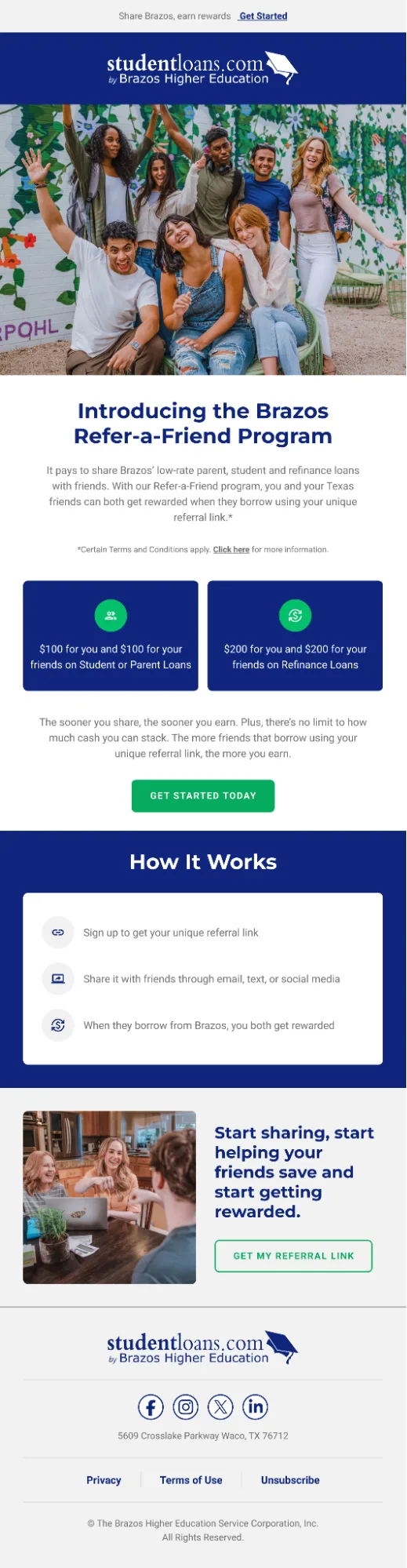
Brazos Higher Education uses referral emails to encourage its subscribers to refer a friend for student or parent loans to avail the benefits. The offer benefits both existing and potential customers.
Lower-priority but still useful:
- Contests and giveaways, segmented separately from your core list
- Offline capture at events or pop-up shops, plus QR codes on packaging
- Back-in-stock notification signups
Tip: Track which sources produce actual buyers. A smaller, engaged list will outperform a bloated one every time.
Using the above strategies, we helped our ecommerce client Boie develop emails that grew their list to over 100K subscribers.
Read more about Ecommerce Email List Building Strategies
3. Layer in transactional emails as a real opportunity
Thank-you, shipping, account creation, referral, and review emails all carry exceptionally high open rates because they’re expected and useful. Treating them as pure utility wastes an opportunity. A cross-sell CTA on a shipping confirmation, for example, costs nothing extra to build and reaches someone already paying attention.
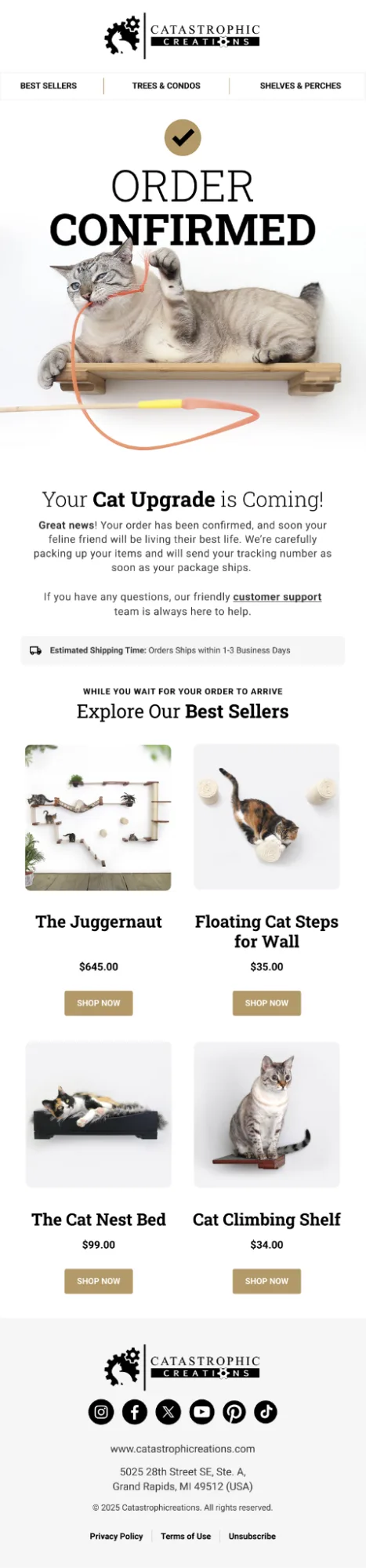
Catastrophic Creations uses its order confirmation email to introduce buyers to the brand’s best sellers. The image-heavy and clean design piques their interest without pressuring them into making a purchase.
4. Connect your store data before you build a single flow
Sync in real time. Delayed data means someone gets a cart reminder for something they already bought. Pull in order history, average order value, and browsing behavior, not just an email address, and prioritize first-party data collected directly from your own store, since third-party cookie restrictions keep tightening what you can rely on elsewhere.
Note: Most ecommerce email marketing platforms, such as Klaviyo, Drip, and Omnisend, offer deep store sync.
Stage 2: The Growth Phase
Once your ecommerce email campaigns are live, this is when you refine your email marketing process.
5. Collect customer data
Before we personalize or segment anything, we need actual customer data: who they are and what they want.
Zero-party data: This information customers intentionally and proactively share with you through preference centers, quizzes, surveys, or onboarding forms. Knowing purchase intentions, personal style, or interests can help customize emails that are less likely to be ignored.
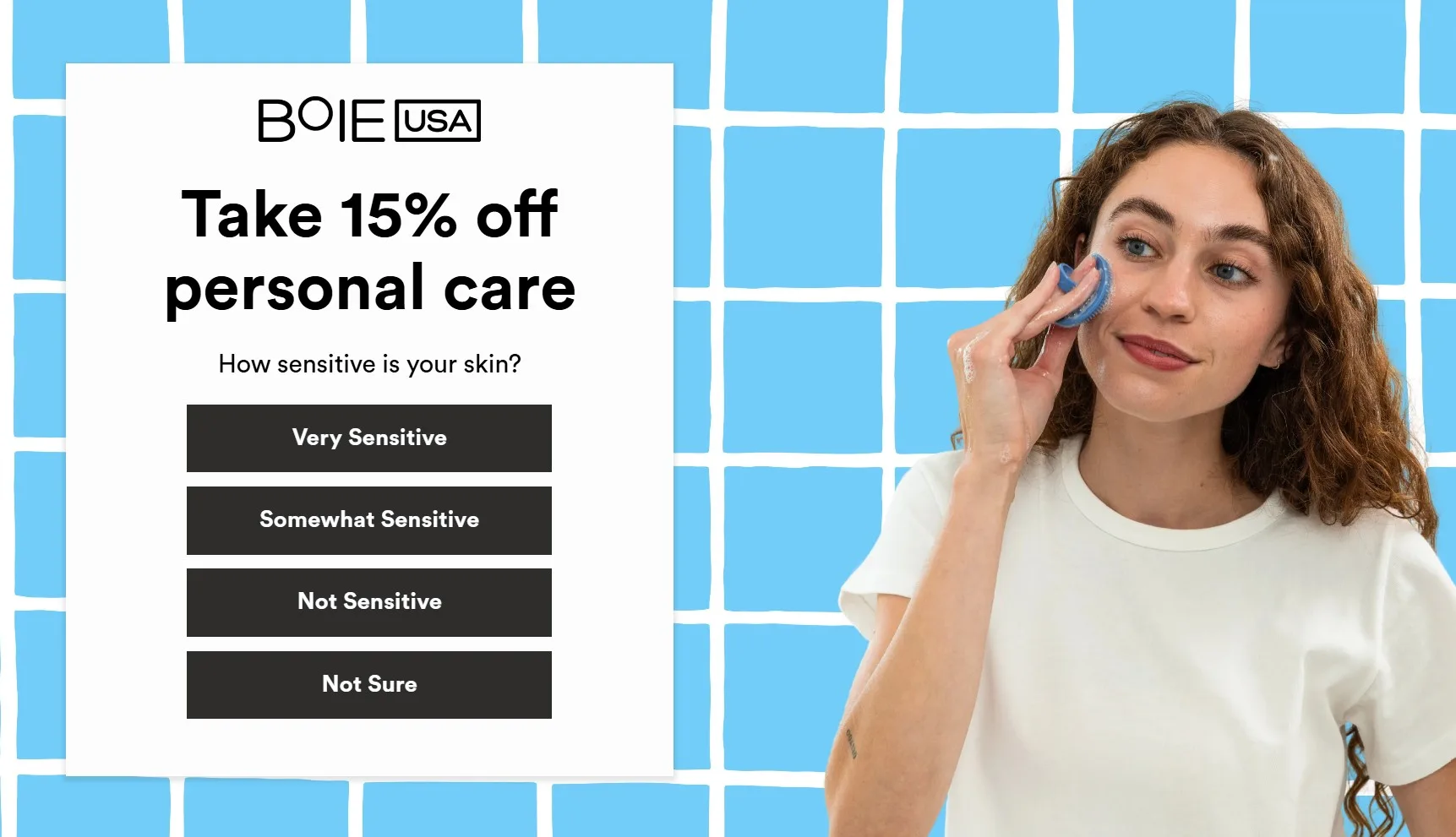
BOIE uses pop-ups on its site to collect customer data that can help personalize further communications with subscribers.
First-party data: This is the data you collect through your owned channels based on customers’ actual behavior and transactions. Purchase history, browsing behavior, email engagement, cart activity, and account details can guide your email campaigns.
6. Segment before you personalize
Sending the same campaign to your entire list trains your best customers to tune you out. Start with three segments:
- Engaged subscribers who opened or clicked in the last 30 to 60 days
- Lapsing subscribers in the 60- to 90-day window who need warmer content before they slide into win-back territory
- Purchasers versus non-purchasers, since a first-time buyer and a five-time repeat customer are at completely different points in the relationship
- As your data matures, layer in purchase category and average order value, and build VIP rules for your highest-value segment
Personalization tactics worth deploying once segmentation is in place: subject lines referencing prior behavior, behavior-triggered emails, a real sender name instead of just a company name, dynamic content by segment, and customized CTAs that speak to where someone actually is, like “Continue Shopping Your Favorite Styles” instead of a flat “Shop Now.”
7. Match copy to the moment
Three frameworks cover almost every ecommerce email you’ll write:
AIDA (Attention, Interest, Desire, Action) fits welcome emails and product launches. Hook first, build interest, create desire, and close with one clear action.
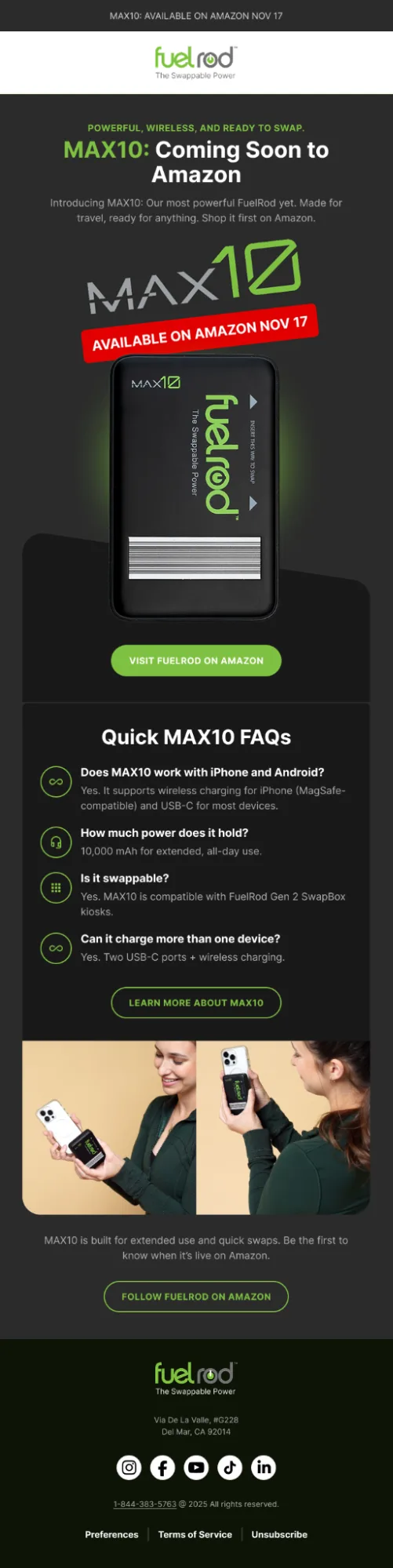
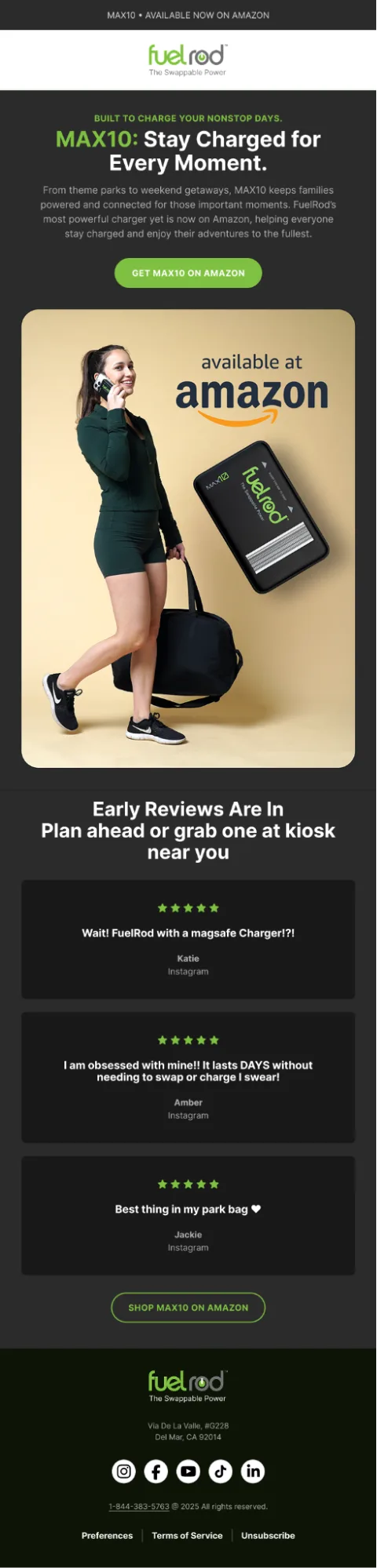
This product launch campaign for Fuelrod builds anticipation and desire through coming soon emails. In the next stage, the emails include customer testimonials and one clear CTA to encourage purchase.
PAS (Problem, Agitation, Solution) works for abandoned carts and win-back emails. Name what they left behind, make it feel relevant, and offer the fix.
HEART (Hook, Empathy, Authority, Response, Trust) suits brand storytelling and loyalty emails where the payoff is longer term.
- Keep subject lines under roughly 50 characters
- Write in sentence case so they read like a message from a person
8. Leverage user-generated content
Social proof can mean more to customers than any extensive feature list or incentive you offer. So whether you’re sending out product recommendations, cross-selling products, or abandoned cart emails, include customer testimonials, product ratings, or client photos. This is the fastest way to build credibility.
Emails aren’t only for sharing reviews but also for asking for them as well. Reviews and feedback emails are a definite part of all our post-purchase sequences. Suggest they share their opinion, answer the survey, or even post on social media.
Note: For a startup or small store, digital sharing is free promotion. So encourage and leverage that through ecommerce emails.
Stage 3: The Scale Phase
Once you have an up-and-running email marketing campaign, it doesn’t mean it’s set for life. When you get complacent, that’s when deliverability, engagement, and conversion start taking a hit. Even for ecommerce brands that are consistently achieving results with email marketing, we monitor them religiously.
9. Set deliberate timing and frequency
When do you send your emails? Morning or afternoon? How often do you send emails without causing fatigue? There is a fine line between underemailing and overemailing that you need to find.
- Don’t stick to one fixed plan till the end of time. For established businesses, look at prior customer engagement to determine the timing and frequency that works best for you.
- Leverage automation for behavior-triggered emails like welcome, cart abandonment, and post-purchase emails.
- Balance marketing emails with educational, value-driven, and non-promotional content.
10. Monitor list health
We have gone through a list hygiene setup, like opt-in, secure forms, and removing hard bounces. That’s a one-time process when you build the foundation for your ecommerce email marketing.
Brands must monitor list health continuously, because they can decay quietly when subscribers stop opening or clicking without unsubscribing.
Essential: Monthly check-ins for inactive subscribers. Most ESPs can flag if there is a shift in engagement.
Next-level: List size makes this urgent for enterprise businesses, so automated, real-time engagement scoring is the way to go.
Lapsing subscribers (60-90 days): Route them into a win-back sequence before they go fully cold.
Inactive subscribers: If the re-engagement sequence doesn’t work, move them into sunset flow. One last re-engagement offer, and if there’s still no response, remove them from active sending.
11. Extend the decision window for high-consideration purchases
Customers don’t have the same thought process for a $20 impulse buy and a $1000 purchase. So you can’t treat them the same. For higher-AOV items, we start with educational, user-generated, and comparison content to build confidence. Don’t rush them into a purchase; earn their trust, then offer the solution.
12. Utilize gamification and interactive, dynamic content
Ecommerce emails can go beyond the same image, copy, and offer for every campaign.
- Gamification emails with spin-to-win wheels, scratch card reveals, and quizzes with a reward at the end can pique subscriber interest and keep them engaged.
- Carousels, expandable sections, and embedded countdown timers are a major boost for ecommerce emails. You can use these interactive emails for sales, product recommendations, and holiday blasts.
- Personalization can be more than a customer name in the subject line. Dynamic content lets you do a lot more by using current live data, such as region, time, or event browsing history, so two people opening the same campaign see different content.
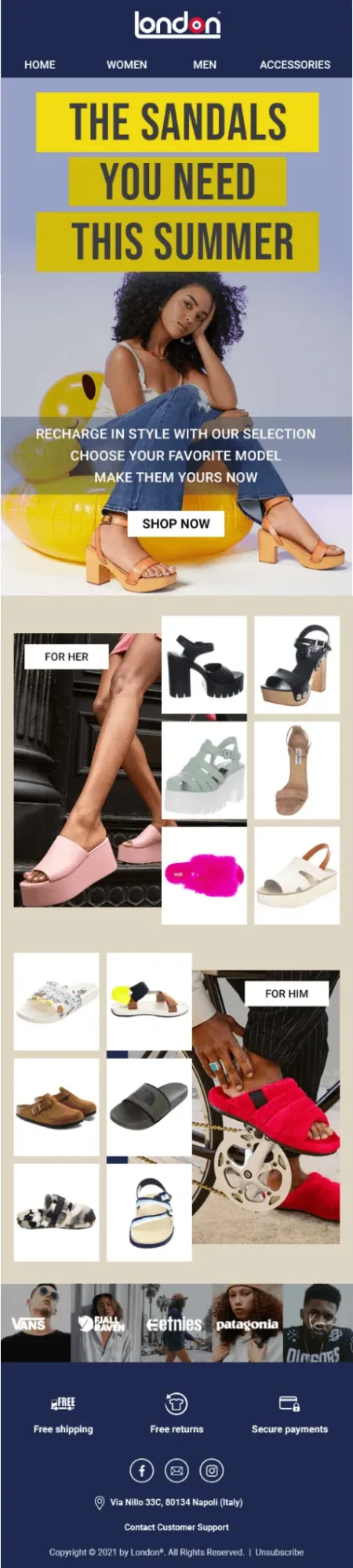
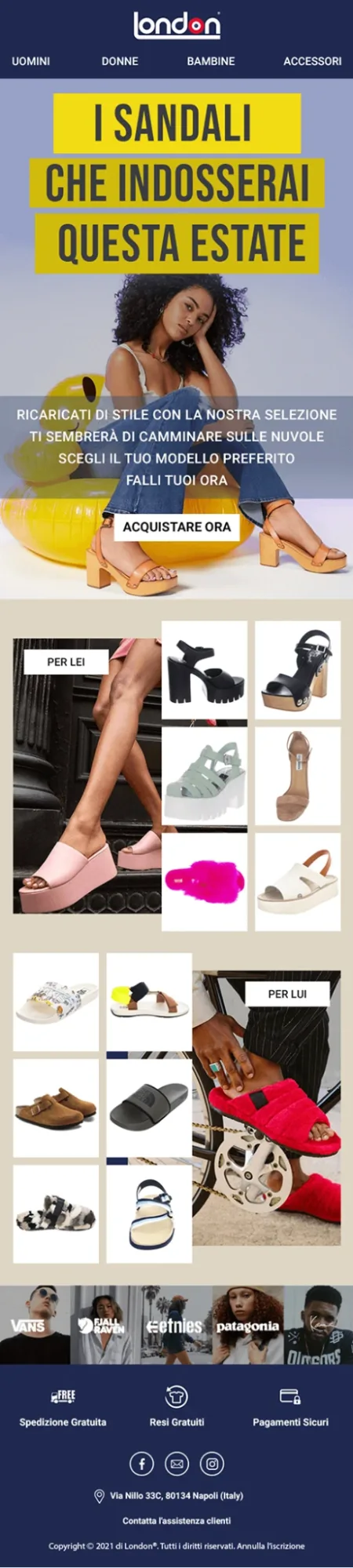
For the London Store, we used dynamic content to build personalized campaigns based on shopping and browse-abandonment history and region-wise.
13. Combine ecommerce email marketing and SMS campaigns
SMS marketing can complement ecommerce email campaigns during time-sensitive events such as flash sales, restock alerts, or last-chance cart reminders. Apart from marketing efforts, SMS can also support customers throughout their lifecycle with order confirmation, shipping updates, and delivery details.
Note: Engage loyal customers by pushing early access sales or limited releases through SMS.
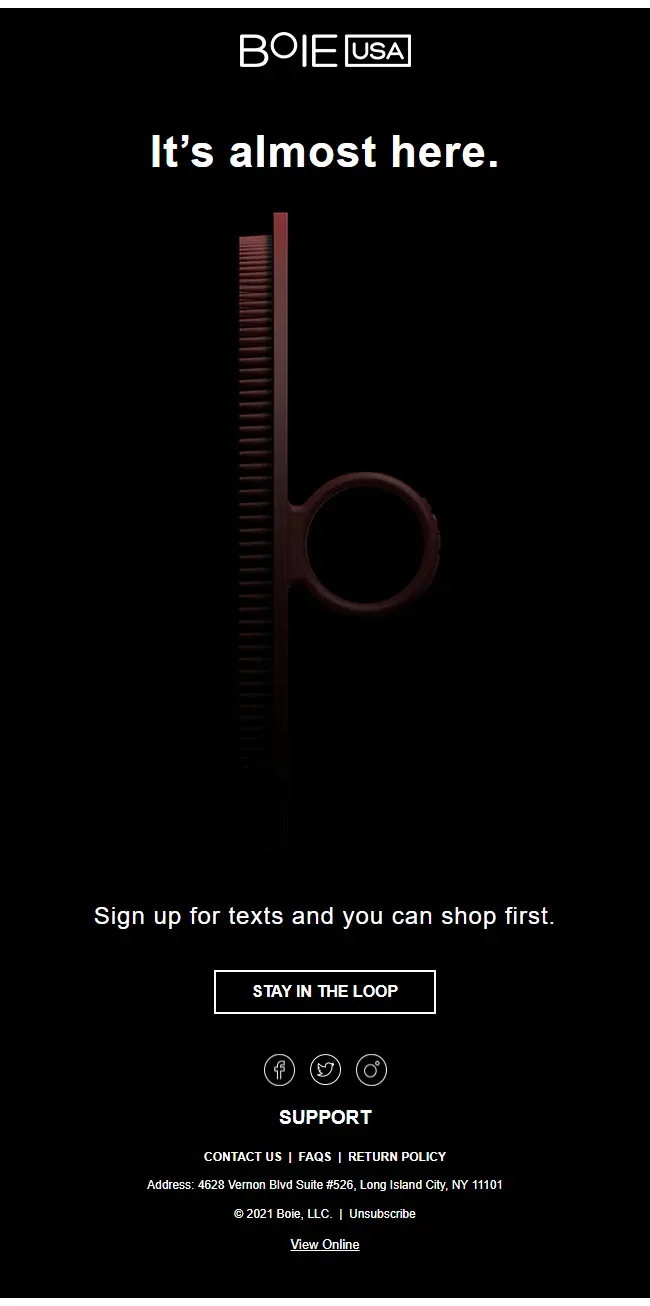
BOIE encourages subscribers to sign up for SMS marketing by providing exclusive access to catalogue information and exclusive sales.
Ecommerce Email Marketing Strategy for our Client who is one of the biggest mattress company in USA
Strategies for any ecommerce brand depend on their industry, goals, and the maturity of their email program. We prioritize based on where the biggest gaps or opportunities are for a specific client. For our DTC client, Purple, we built a 4-layer email marketing strategy to address their lack of structure in lifecycle- or intent-based marketing.
Their Goal: Enhance customer engagement capabilities across email and SMS channels
Here is what we did: 4-Layer Email Campaign Strategy
Layer 1: Planned 4-email sequence (teaser, launch, reminder, and last chance) around key sale periods (BFCM, Memorial Day, Labor Day, EOY Sale, etc.).
Layer 2: Regular mid-month campaigns between major sales focused on bundles, upsells, and category-specific promos.
Layer 3: Optimized core email marketing flows: Welcome, Abandoned Cart, Browse Abandonment, Post-Purchase, Win-Back, timing and messaging based on performance.
Layer 4: Build intent-based campaigns tailored to browsing and cart abandonment data.
Segmentation & Personalization Strategy
- For email campaigns, use past purchase/browsing data to personalize offers instead of generic rewards.
- Segment customers based on behavior (site activity, product views, cart activity, and purchase recency)
Email Design and Content Strategy
- Crafted bolder visuals and brand-consistent design elements across email campaigns and flows.
- Utilized video and playful brand voice throughout the email campaigns to improve engagement
Email and SMS Marketing
- Combined the efforts of email and SMS marketing for major event campaigns to improve reach.
Ecommerce Email Marketing Best Practices
Design for Mobile First
Use single-column templates, larger fonts, and touch-friendly buttons. Most emails get read on mobile devices, and we’ve had more than one client push back on a desktop-first template only to see engagement climb once we rebuilt it mobile-first.
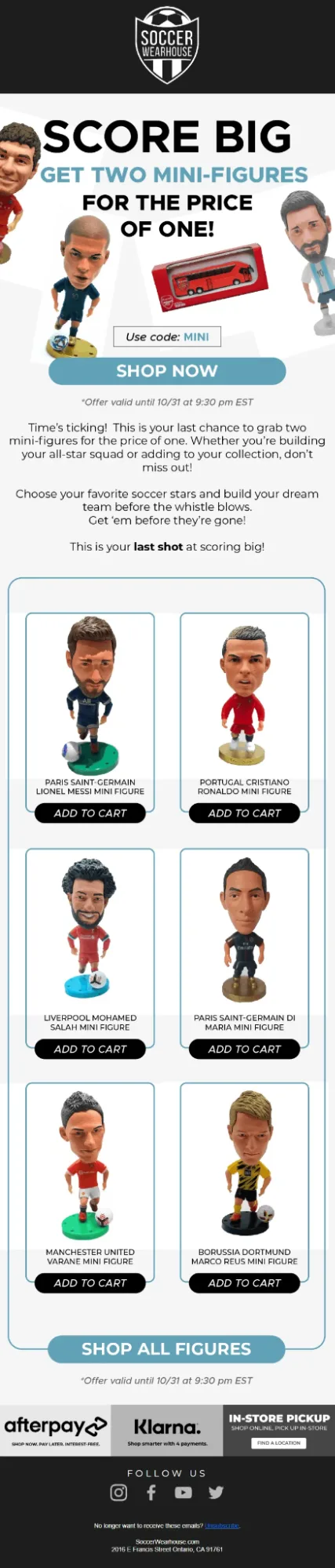
Soccer Wearhouse emails were built to read cleanly on small screens, which dramatically improved scannability and click behavior.
Time Sends Around When People Actually Engage
Mornings between 9 and 12, afternoons between 12 and 3, and midweek days from Tuesday through Thursday tend to perform well across most industries. That said, we’ve seen this rule broken plenty of times by a client’s own send-time data, which is exactly why we test it fresh for every account instead of applying it as a default.
Stick To One CTA Per Email
Multiple competing links can create hesitation in your subscribers. This is one of the first things we simplify when we inherit a client’s existing templates. There are exceptions, for instance, when you’re sending educational or product recommendation emails with multiple interest points.
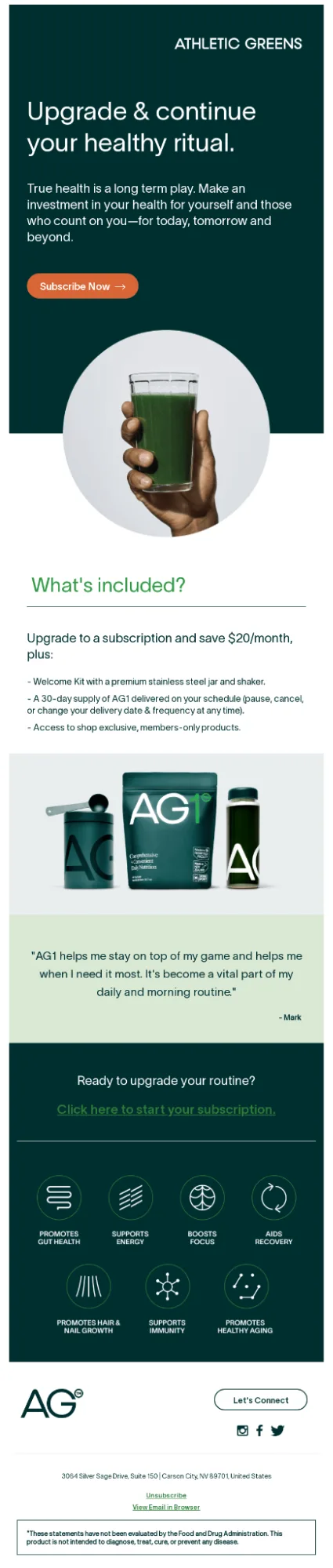
Athletic Green’s upsell emails use a single call-to-action ‘Subscribe Now.’ The rest of the content focuses on benefits and user reviews.
Personalization
Tailoring the content, product recommendations, and offers in an ecommerce email to customers’ browsing history, past purchases, or lifecycle stage improves engagement. It transforms any generic email campaign into value-driven communication.
- Dynamic product recommendations and offers
- Name/segment-based subject lines
- Adapting content to lifecycle stage or purchase history
Deliverability, List Hygiene, and Authentication
SPF, DKIM, and DMARC on your sending domain are foundational, and a single misconfigured record can quietly tank your placement without any obvious warning sign. We confirm these are set up correctly for every client we take up, warm up any new sending domain gradually, and monitor complaint rate and inbox placement on an ongoing basis.
Email Marketing Compliance And Privacy Laws
Email marketing compliance protects your subscribers and your business at the same time, and it’s not optional depending on where your list lives.
- CAN-SPAM (United States) requires truthful sender information, a clear unsubscribe option, and a real physical address in every email
- GDPR (European Union) requires a lawful basis for consent, transparency about data use, and clear data rights for the individual
- CASL (Canada) requires strict, explicit consent for commercial email, with significant penalties for getting it wrong
- CCPA/CPRA (California) gives people specific privacy rights and requires clear disclosure around personal data
If you sell internationally, build your consent process around whichever regulation is strictest among your markets. That approach makes future expansion simpler and keeps records of how and when someone consented in the first place.
Read more about email marketing compliance practices
Ecommerce Email Benchmarks And KPIs
Continuously monitoring ecommerce email campaigns allows you to improve engagement and returns.
| Metric | Healthy Range |
| Revenue per email | $0.10–$0.25 per email |
| Click-through-rate | 2–5% |
| List growth rate | 2% to 5% monthly |
| Unsubscribe rate | Under 0.5% |
| Bounce rate | Below 2% |
Common Mistakes That Quietly Sink Ecommerce Email Programs
- Most brands treat email campaigns as one-off blasts for a sale or holidays. They don’t build targeted email flows mapped to customer journey or interests
- If you don’t make the effort to collect customer data or build organic email lists, you’re just sending emails on assumptions
- Don’t depend solely on discounts for conversions. Building genuine segmentation and relevance can improve email campaign performance
- Ignoring email mobile optimization when the majority of opens happen on a phone
- Letting domain reputation, ecommerce email deliverability, and unsubscribtion rates slip without taking corrective action
FAQ
How can ecommerce email marketing improve customer retention?
By nurturing existing relationships through post-purchase sequences, loyalty rewards, and win-back campaigns that catch a lapsing customer before they disappear entirely.
How can I ensure my ecommerce emails don’t land in spam?
Set up SPF, DKIM, and DMARC correctly, gradually warm up new sending domains, clean your list on a regular schedule, and continuously monitor complaint rate and inbox placement.
What are the top picks for email marketing software?
Klaviyo provides deep behavioral segmentation and attribution, and Omnisend for strong automation without Klaviyo’s price tag.
How often should ecommerce brands email customers?
Most brands land well with 1 to 3 emails a week, though the right cadence depends on your audience’s habits more than any universal rule.
What is the difference between email marketing and SMS marketing?
Email supports longer-form content and richer segmentation, while SMS is built for urgency and immediacy. The two work best paired.
How can I improve email deliverability?
Authenticate your domain with SPF, DKIM, and DMARC, keep your list clean, warm up new domains gradually, and monitor inbox placement and complaint rate as an ongoing habit.
What are the best types of emails to send in ecommerce?
Welcome emails, abandoned cart reminders, browse abandonment nudges, post-purchase sequences, back-in-stock alerts, and re-engagement campaigns cover most of the revenue-driving ground.
What’s the role of automation in ecommerce email marketing?
Automation lets you trigger the right message at the right moment based on customer behavior, without manual effort for every send, such as cart abandonment, transactional emails, and welcome series. Ecommerce benchmarks indicate that automated flows can drive over a third of total email revenue from a fraction of total volume.