
Quick Overview
Abandoned cart emails are automated messages triggered when shoppers add a product to their cart but don’t complete the purchase. Shoppers abandon their carts when prices are high, delivery is slow, payment options are limited, or checkout is complicated. We set up 2-3 email cart-abandonment sequences to address these purchase-friction issues, offer incentives, and recover lost revenue. Our effective emails include persuasive subject lines, clear product lines, social proof, compelling CTAs, and alternative product recommendations. We personalize and segment abandoned cart emails with available customer data, continuously test relevant variables, and measure their performance to improve.
What is an Abandoned Cart Email?
An abandoned cart email is an automated message an ecommerce business sends to a shopper who left items in their cart without buying. The email reminds shoppers about the products and links them back to checkout.
When we create these emails for clients, we highlight the abandoned products, address likely concerns, and guide buyers back to checkout. Shoppers respond because the message arrives while the purchase is still fresh in their minds.
Abandoned Cart vs. Abandoned Checkout Email
An abandoned cart describes a shopper who added items and left before starting checkout. An abandoned checkout describes a shopper who began entering shipping or payment information and then left. Checkout shoppers show stronger buying intent.
We create a soft reminder for abandoned cart shoppers. For abandoned checkout shoppers, we craft an email sequence around friction-removing messages.
Why Do People Abandon Their Shopping Carts?
Shoppers abandon their carts because of unexpected costs, slow delivery, low trust, unacceptable return policies, missing payment methods, product doubts, and distraction.
Baymard Institute data shows that 69% of online shoppers who add a product to their cart never complete the purchase in that session. Our clients see the same pattern in their own dashboards.
Statista tracking shows the global abandonment rate climbing from 59.8% in 2006 to roughly 70% today. Shoppers leave for a handful of repeatable reasons, including:
- Shipping and other fees are too high: Baymard’s 2025 data shows that 39% of US shoppers cite extra costs like shipping, tax, and fees.
- Slow delivery: Shoppers often require products immediately. That is why 21% of prospective customers abandon carts because delivery takes too long.
- Trust & credibility issues: Less established ecommerce brands often lose sales because shoppers don’t trust their website with their credit card information. 19% of US shoppers abandon for this reason.
- Unsatisfactory return policies: Online purchases can feel like a big commitment, especially for high-value products. Shoppers read the returns policy before buying, and a vague policy sends them away.
- Limited payment methods: Baymard found that 8% of shoppers abandoned an order because their preferred third-party payment option wasn’t available.
- Product uncertainty: Online shoppers hesitate when size, fit, or product specifications are unclear.
- Distraction/comparison shopping: According to Statista and DHL data, 30% of global shoppers abandon their carts because they found cheaper alternatives, and 26% were only browsing.
Note: Brands can send survey emails that ask people why they abandoned their carts. Then create and test emails that address the most commonly given reasons.
Why Send Abandoned Cart Emails?
Abandoned cart emails recover sales that a store would otherwise lose. Klaviyo analyzed more than 143,000 abandoned cart flows and found a 3.33% conversion rate. It’s the highest of any automated ecommerce flow. The average revenue per recipient is $3.65, and the top 10% of brands reach $28.89.
Recovers lost sales: Abandoned cart emails bring customers back to finish their purchase. The 3-email abandoned cart series we built for London Store recovered 22% of cart abandonment revenue.
Builds interest: Reminds shoppers of items they liked. Klaviyo’s data shows an average open rate of 50.5%. So shoppers do pay attention to abandoned cart emails.
Offers incentives: We don’t recommend a discount for every abandoned cart email. In some cases, a small discount or free shipping can encourage buying.
Remove purchase friction: These emails handle the objection that stopped the sale. Baymard estimates that better checkout design can recover $260 billion of US and European ecommerce sales.
How To Build an Abandoned Cart Email Flow
An effective abandoned cart email sequence is built with 2-3 emails that remind shoppers of the product, address their objections, and offer an incentive to encourage purchase. They are triggered when customers add to cart without completing the checkout process.
Email 1: Reminder
We send the first reminder email within 1-2 hours, including the abandoned cart products and a one-click link leading back to the cart. Many shoppers only need a nudge, especially if they didn’t complete the purchase because of distractions.
Timing: Within an hour
Goal: Reminds the shopper of what they left behind
InboxArmy’s Cart Abandonment Email Template for Catastrophic Creations
For the Catastrophic Creations reminder email, we didn’t use incentives or rewards at this point. The content and image should be all about what they left in the cart.
What works:
- Clear and straightforward CTA “Resume Your Order” at the front and center.
- The email highlights the abandoned product with photos and details.
- The email addresses purchase friction by explaining their 60-day return policy.
- “Buy Now, Pay Later” option to ease the buying process.

Email 2: Objection Handling
Timing: Within 24 hours
Goal: Resolve purchase friction and establish credibility with shoppers
The second email within 24 hours addresses the reason why shoppers abandoned their cart. We add social proof, customer reviews, and shipping details to ease doubts.
| Objection | Abandoned Cart Email Copy Includes |
|---|---|
| Unexpected extra costs (shipping, taxes, or fees) | Show transparent pricing early, display shipping estimates on product pages, offer free shipping |
| Delayed delivery timelines | Offer faster shipping options, and be upfront about delivery windows |
| Trust issues | Security badges, SSL certificates, visible payment icons, reviews, and testimonials |
| Return & exchange | Explain the return policy within the email |
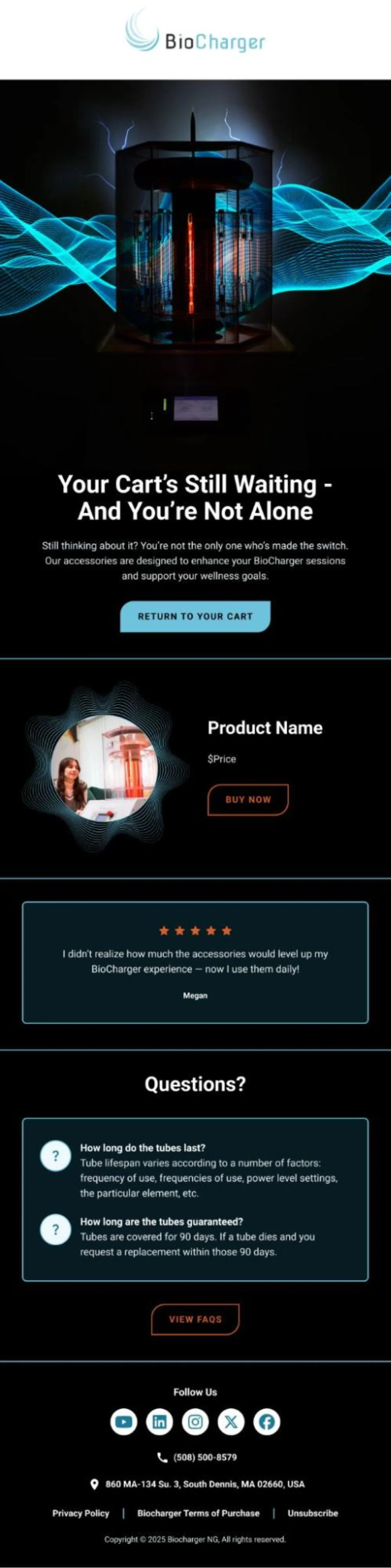
InboxArmy’s Cart Abandonment Email Template for Biocharger
Biocharger’s abandoned cart email reminds shoppers of the specific products they left behind with simple design and copy.
What works:
- “Return to your cart” and “Buy now” CTAs for frictionless, one-click checkout.
- Product image, details, and pricing for clarity.
- Incorporates customer reviews to add credibility to your products.
- FAQs about the product to ease any concerns or doubts.
Email 3: Final nudge
Timing: Within 48-72 hours
Goal: Last reminder to complete the checkout process
The final email closes the abandoned cart flow with an incentive or a deadline. We try to create urgency with this last reminder sent within 48 or 72 hours.
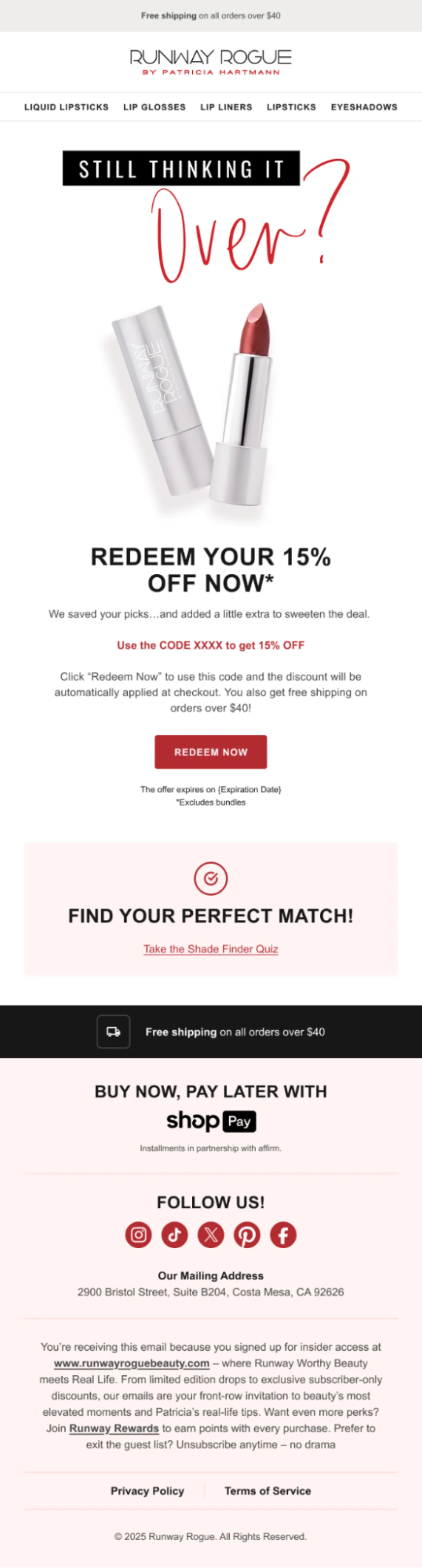
InboxArmy’s Cart Abandonment Email Template for Runway Rogue
Runway Rogue offers a 15% discount in their abandoned cart email sequence for their price-sensitive customers.
What works:
- A single “Redeem Now” CTA with a deadline for urgency.
- A 15% discount code is a compelling offer for hesitant shoppers.
- Free shipping over $40 and Buy Now, Pay Later are added incentives.
What Are The Components of an Abandoned Cart Email?
A converting abandoned cart email includes exact products, answers likely objections, and offers one clear CTA. Because these users have demonstrated high purchase intent, an optimized recovery flow with the following components has proven effective to recapture lost revenue:
Catchy Subject Line
The subject line earns the open. We name the product or the shopper’s name in the subject line. We keep the wording short and specific. Our marketing specialists test two or three versions against each other before locking one in.
To make the process of generating and testing subject lines painless, InboxArmy offers the following tools:
Email Subject Line Generator: Generate subject lines tailored to your campaign, audience, and goal within seconds.
Email Subject Line Tester: This free tool analyzes your subject line on various aspects, including clarity, length, urgency, engagement, and spam risk, so only the best version reaches the inbox.
Cart Abandonment Email Subject Line Examples:
- “Forgot to check out? It is still in your cart.”
- “Your favorite products are waiting for you in the cart.”
- “One click, and we’ll deliver your favorite products to your doorstep.”
- “Save 10% with this special coupon.”
- “REMINDER: Your special coupon expires soon.”
Product Details and Images
The product block reminds shoppers exactly what they chose. Our emails display the product image, name, price, size, color, and quantity. Each image links to the cart. We rebuild the cart with the same selections. Baymard reports that 26% of sites ask shoppers to retype the same information, so we pre-fill every field we can.
Supporting Content and Incentives
The email copy is based on the audience segment and the likely objection.
Reviews and star ratings build confidence in the product. We pull a short review that matches the abandoned item. Shoppers trust customers more than brand claims.
We address the specific reason the shopper left. The email states shipping costs and delivery windows in plain language. The email also summarizes the returns policy and lists accepted payment methods.
We add security badges and guarantees where trust is in doubt.
An incentive gives a price-sensitive shopper a reason to act. We offer free shipping or a small discount. We hold the offer for the second or third email. At InboxArmy, we track incentive cost against recovered revenue to confirm the offer pays for itself.
Clear Call to Action
The CTA button sends the shopper back to a ready checkout. We use direct wording such as “Return to your cart” or “Shop Now”. In most of our email designs, the button appears once at the top and once at the bottom. The link opens the saved cart and skips the extra steps.
Alternative Product Recommendations
Recommendations serve shoppers who are second-guessing the product. The email suggests similar items in a different price range, size, or style. We place them below the main CTA. The block gives the shopper a second path to purchase. Our emails show only a few items, so the original cart stays the focus.
For Keeps Home, a sustainable furniture brand, we introduced customer-favorite pieces complementary to the abandoned product. These alternatives, paired with discounts and reviews, improved the chance of conversion.

Best Practices for Abandoned Cart Emails
The best practices for abandoned cart emails cover timing, relevance, and respect for the shopper. We send several well-timed emails, segment and personalize them, and stop them after a purchase. Our team tests every element and measures profit.
1. Send Multiple Emails
A sequence recovers more shoppers than a single message. We send 2 to 3 emails per abandoned cart. Each email plays a different role, from reminder to objection handling to final nudge.
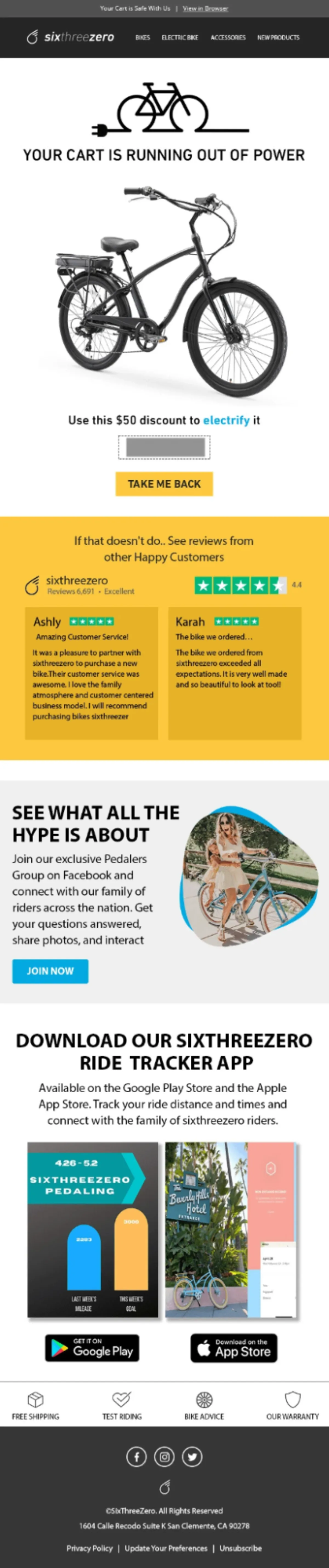
We created a 5-email cart abandonment sequence for Sixthreezero. We saw an immediate 50% increase in revenue.




What works:
- Email 5 increases the offered discount from $50 to $100.
- Email copy includes 5-star reviews from satisfied customers to demonstrate social proof.
- Establish the return policy to handle potential objections.
2. Segmentation
Segments let us match the message to the shopper. We split audiences by cart value, customer type, and product category. Category matters because EMARKETER, citing Dynamic Yield, reports abandonment rates near 81% for luxury and jewelry and between 53% and 56% for pet care.
Read more about segmentation strategies for ecommerce businesses
3. Choose Timing Based on the Product and Buying Cycle
Product price and buying cycle set the right delay. Low-cost items need a reminder within the hour. A high-consideration item needs more time between messages. Each brand should test its own schedule.
4. Use Behavioral Data to Personalize Abandoned Cart Emails
Behavioral data shows what shoppers care about. We read browsing history, past orders, and time spent on shipping details. We use those signals to pick the products, the objection block, and the offer.
5. Test Subject Lines, CTAs, and Incentives
Testing turns opinions into evidence. Our team runs one test at a time so the results stay clear.
6. Handle the Likely Customer Objections
Each product category has predictable doubts. We answer the expected doubt directly in the second email.
Yeti’s email includes alternate color options for the abandoned product and a buying guide to ease the process.

7. Optimize for Mobile Devices
Most shoppers read email on their phones. We design a single-column layout with large product images. InboxArmy marketers test every email on real devices before launch.
8. Use Urgency or Scarcity Carefully
Real urgency builds trust, and fake urgency damages it. We use actual stock levels and real offer deadlines. Our emails avoid countdown timers that reset on every visit. Shoppers remember when a store misleads them.
9. Reserve the Items in the Cart
A short inventory hold gives the shopper a reason to return. The emails tell the shopper how long the items stay reserved. We keep the hold window short and honest and release the items when the window closes.
10. Measure Recovered Revenue and Profitability
Recovered revenue only matters after discounts and costs. We track revenue per recipient, conversion rate, and incentive cost together.
11. Suppress the Sequence When the Customer Purchases
A reminder that arrives after the purchase damages trust. We connect the order event to the flow so the platform stops the sequence instantly. Marketing specialists test this rule before every launch.
12. Combine Email with SMS
Email carries the full message with product images, reviews, and objection handling. SMS delivers a short reminder that the shopper reads within minutes. We send SMS only to shoppers who gave explicit text consent, and we place it after the first email so the two channels support each other.
Note: Each SMS carries one line of copy and one link back to the saved cart.
13. Set Up an Abandoned Cart Automated Flow
An automated flow runs the whole sequence without manual work. The platform detects the trigger, waits for the delay, sends each email, and stops when an order arrives. We build every flow with the same four elements: a trigger, a delay, a message, and a suppression rule.
A general email service provider works when it accepts store events and supports conditional splits.
Abandoned Cart Automated Flow: Shopify & Klaviyo
Shopify records the cart and checkout events that start the flow. The platform includes a native abandoned checkout email, which we use as a starting point for small stores. Larger stores connect Shopify to a dedicated marketing platform for deeper segmentation and multi-email sequences.
Klaviyo reads the Shopify events and runs the flow builder. We choose the Added to Cart or Started Checkout trigger and add time delays between emails. We add conditional splits for cart value and customer type.
How to Create an Abandoned Cart Email Strategy
We create an abandoned cart email strategy by measuring abandonment rate, collecting emails, identifying why shoppers leave, and then building and testing campaigns. Our team at InboxArmy follows this order with every client. Each step feeds data into the next one.
Measure Your Cart Abandonment Rate
Divide completed orders by created carts and subtract the result from one. Baymard’s long-running data averages 68.07% across 29 studies. Statista shows about 70% globally today. Your own rate sets the baseline for every later test.
Collect Emails
An email address makes recovery possible. We ask for the email at the first checkout step, before payment details. Our clients utilize the exit intent pop-ups and pre-submit tracking to capture addresses earlier. Baymard reports that the average checkout contains 14.88 form fields, while 6 to 8 are enough, so we shorten forms to protect the capture rate.
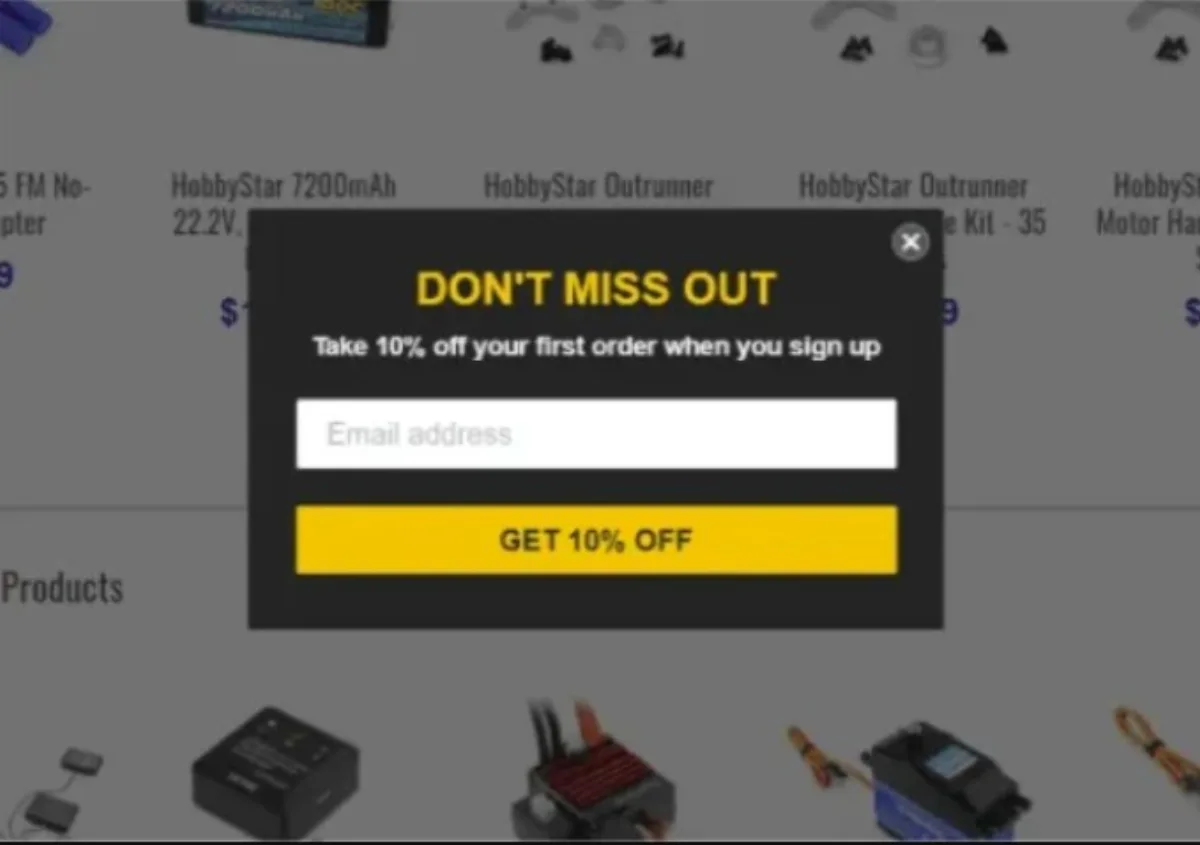
Learn more with our email pop-ups guide
Identify Why Customers Abandon
- Behavior: Pages viewed and time spent on shipping details.
- Cart value: High-value carts point to price or trust objections.
- Product: Certain products create fit or quality questions.
- Customer history: First-time buyers hesitate more than repeat buyers.
Note: Our team matches each signal to an objection before we write a single email.
Leverage Customer Support Interactions
Support conversations reveal the objections shoppers raise most often. We review support tickets and chat logs for those patterns. Our marketing specialists suppress the sequence when a shopper has an open support conversation. We add the recurring answers to the objection handling email.
Create and Test Cart Abandonment Email Campaigns
We test timing first, then segmentation, splitting audiences by cart value, customer type, and product category. Category matters because EMARKETER, citing Dynamic Yield, reports abandonment near 81% for luxury and jewelry and between 53% and 56% for pet care. Our team runs one test at a time so the results stay clear.
Test out different email frequencies and delivery times to see what works best.
Compliance Requirements for Abandoned Cart Emails
Abandoned cart emails follow the same laws as other commercial emails. In the US, the CAN-SPAM Act requires a truthful sender name, a clear unsubscribe option, and a valid physical address. GDPR requires a lawful basis and, where applicable, consent. Our team honors unsubscribes immediately and recommends that every client confirm the details with legal counsel.
5 Proven Abandoned Cart Email Examples
Here are high-performing abandoned cart email templates designed and built by InboxArmy for clients across verticals to win back lost sales.
SimplyFun Abandoned Cart Email Flow
SimplyFun, a US-based manufacturer of educational board games, set up a 3-email cart abandonment sequence to recover lost sales.
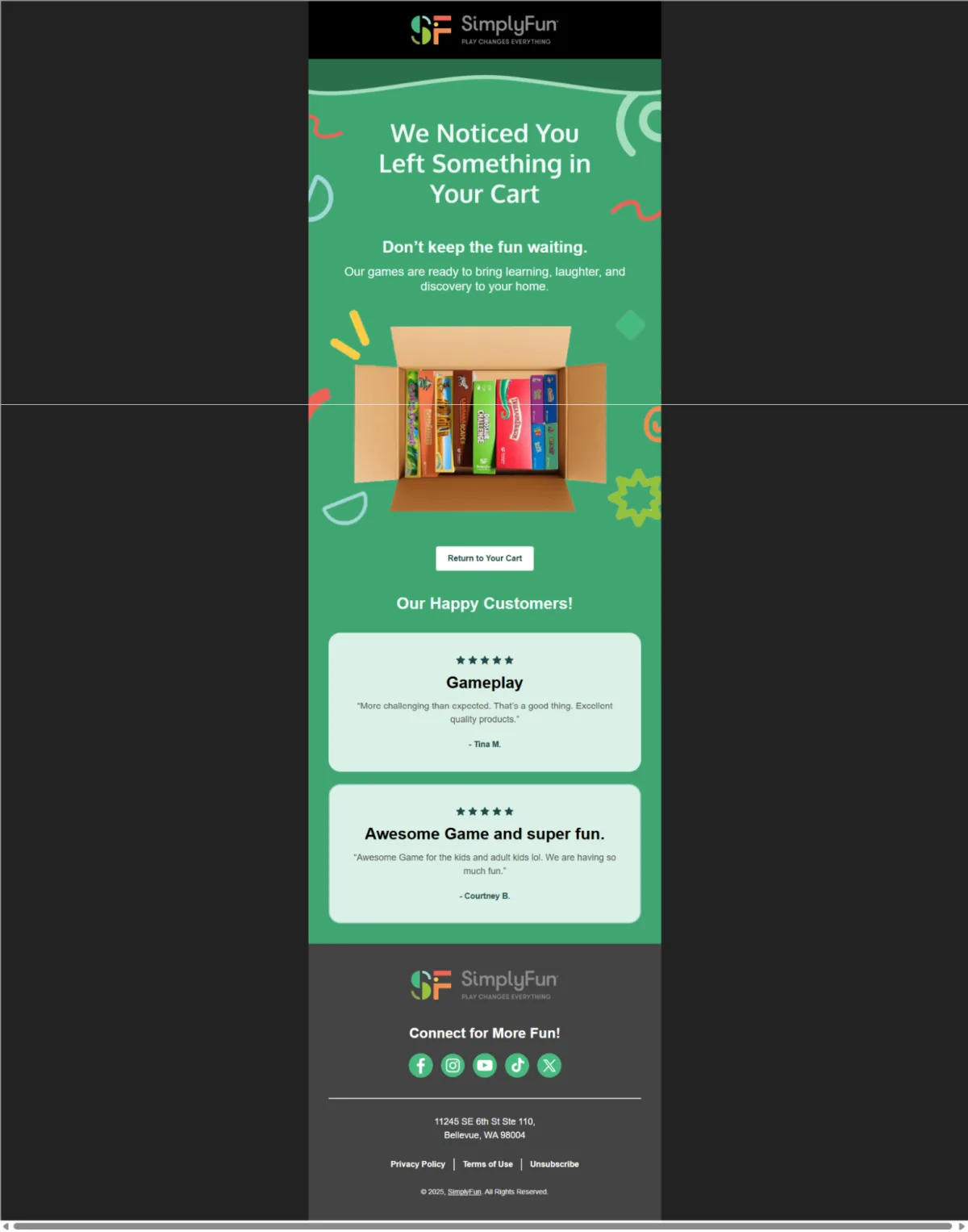
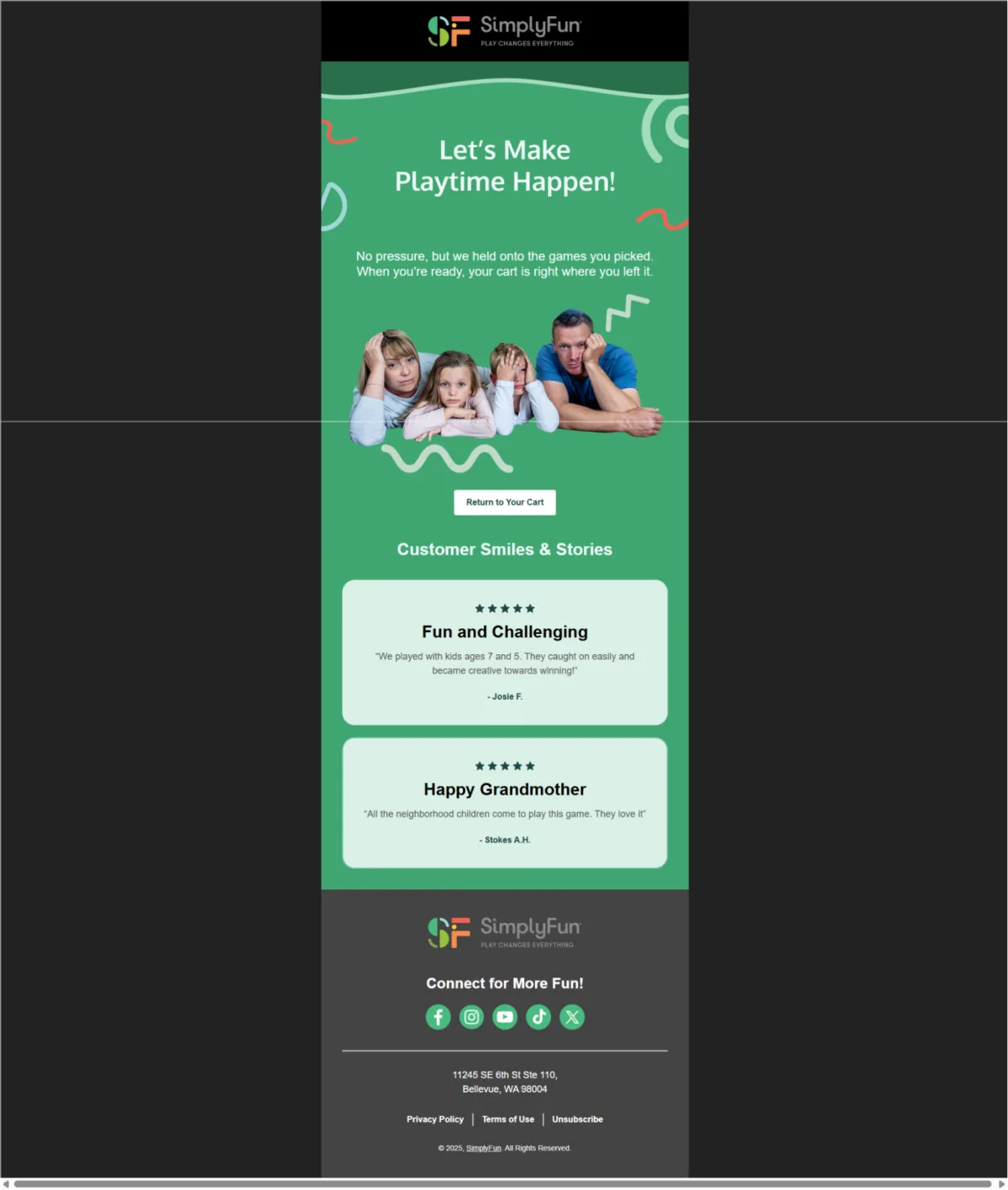
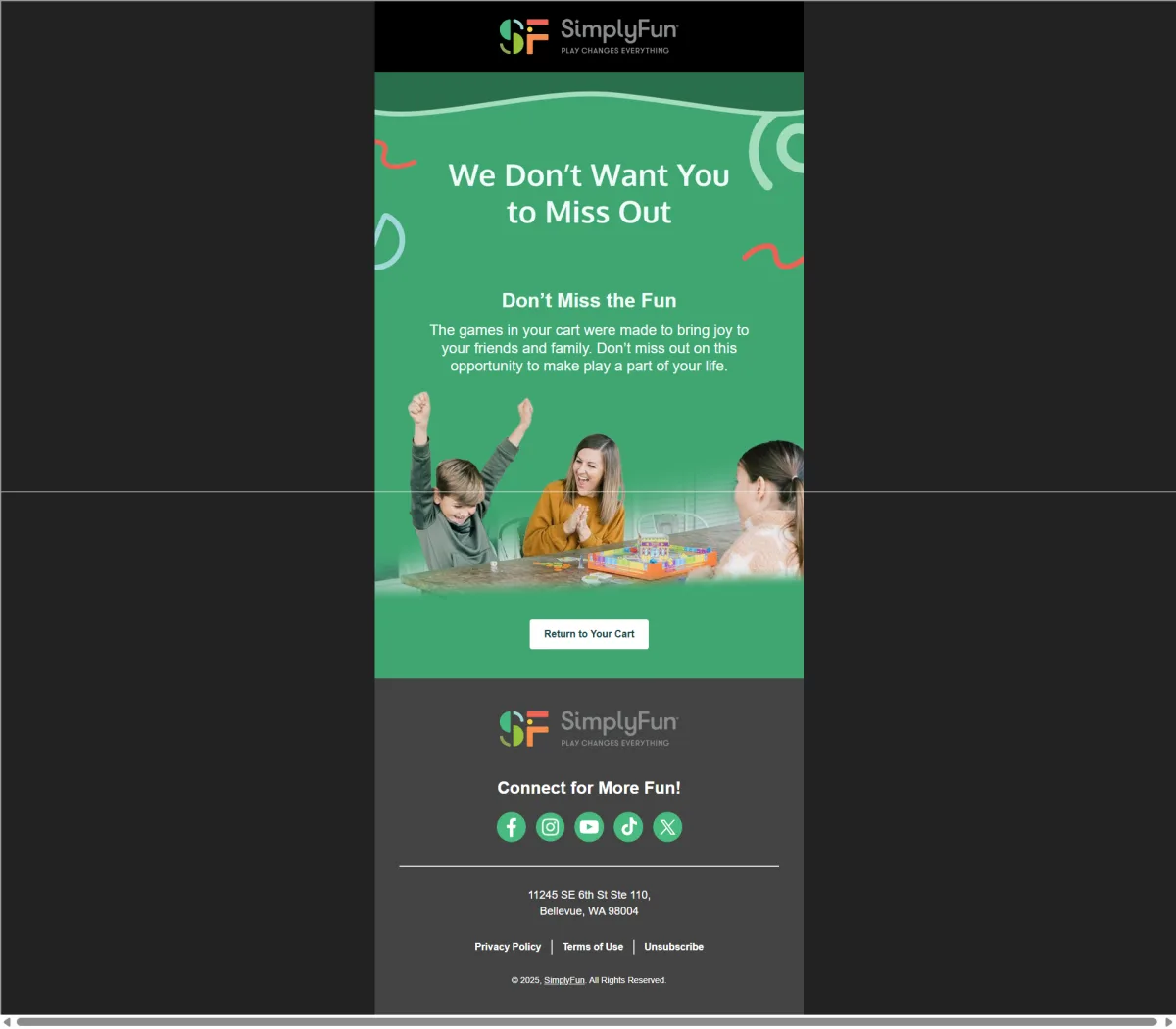
Open Rate: 50.6% Open Rate: 45.4% Open Rate: 42.4%
What works:
- A gentle, helpful reminder sent within hours of cart abandonment.
- Customer reviews and ratings for SimplyFun products included in the second and third emails for social proof.
- Clear and straightforward “Return to Your Cart” CTA.
- CTA button links leading straight to the checkout page for painless purchase.
Happy Hippo Abandoned Cart Email Flow
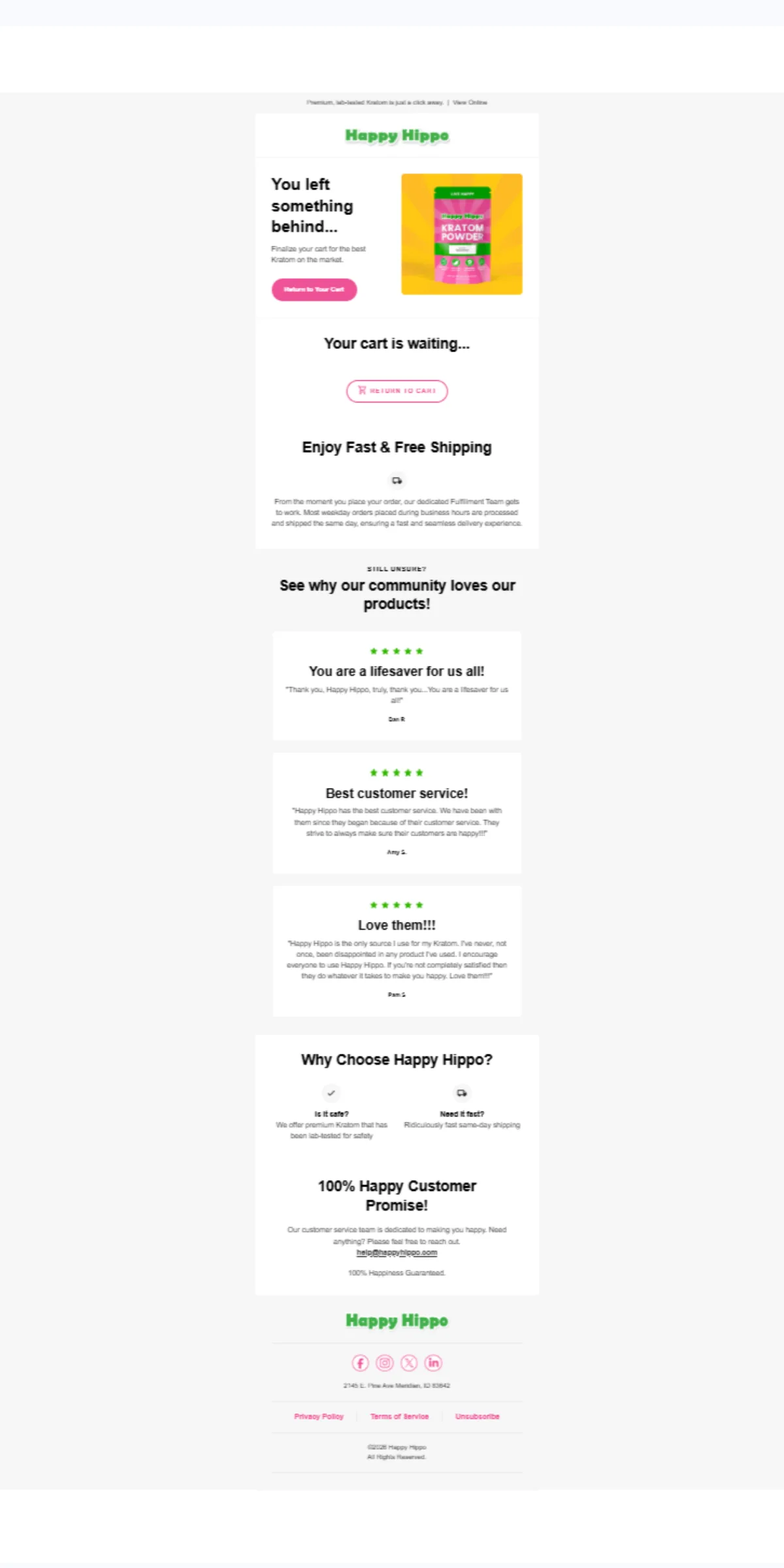
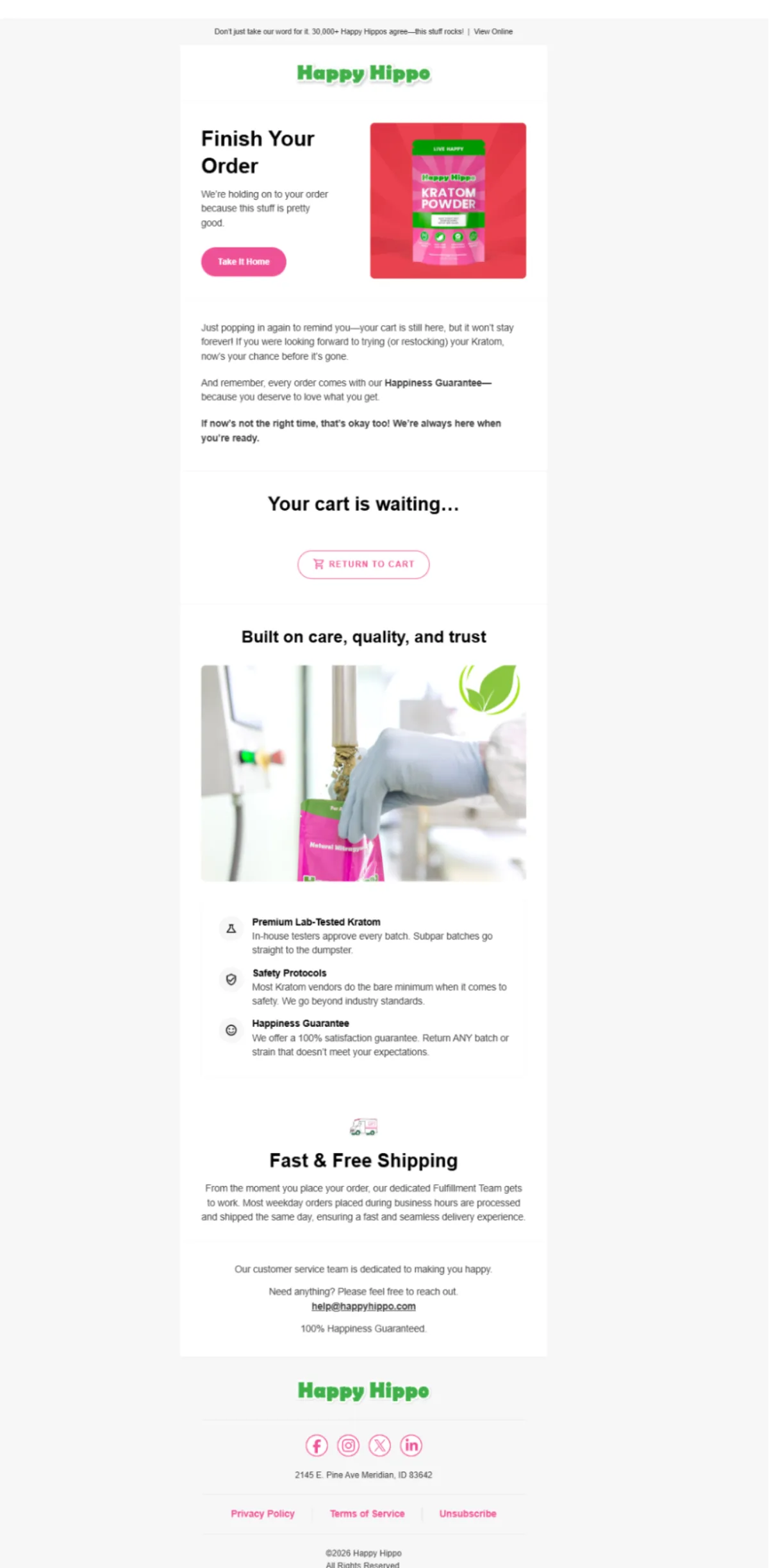
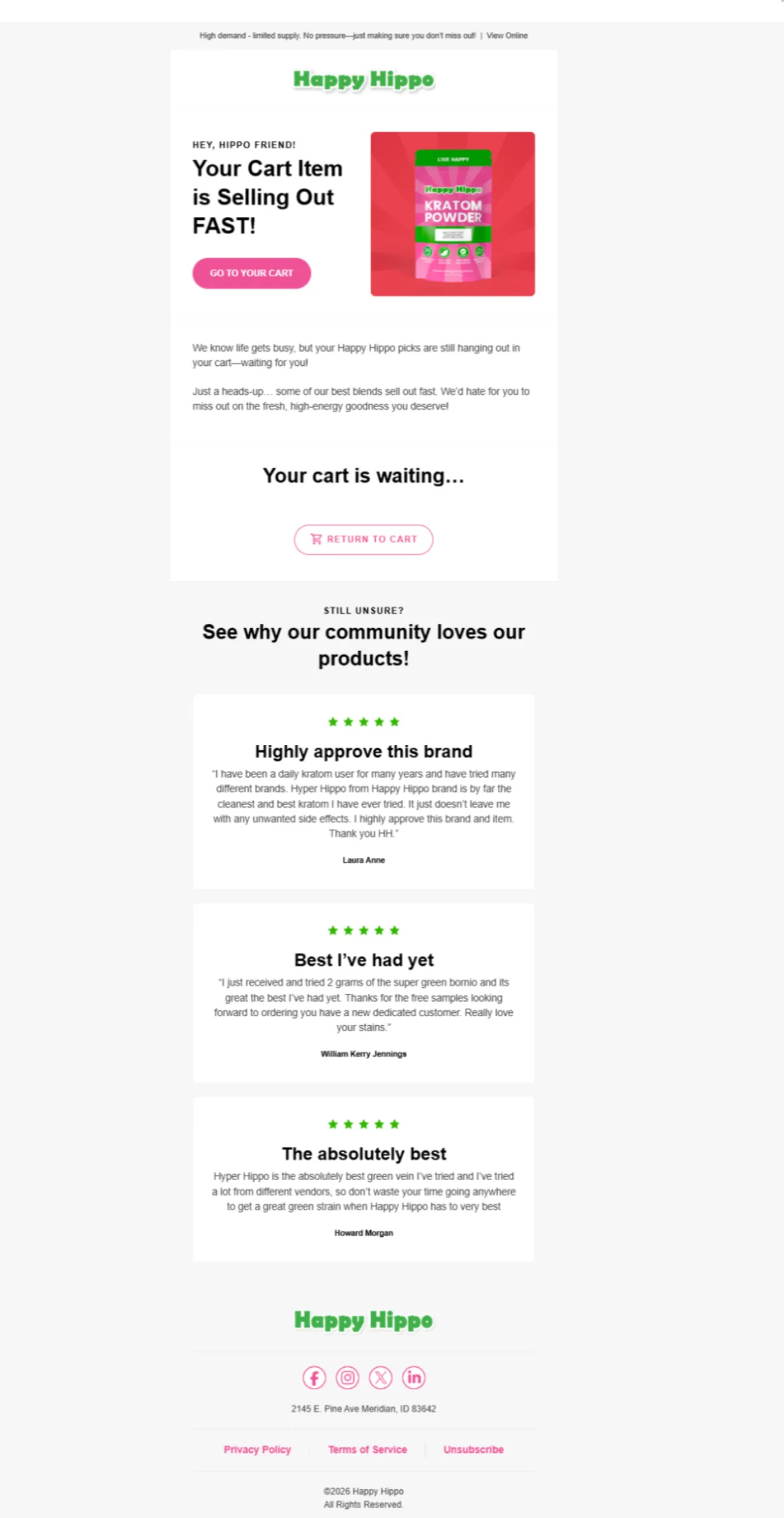
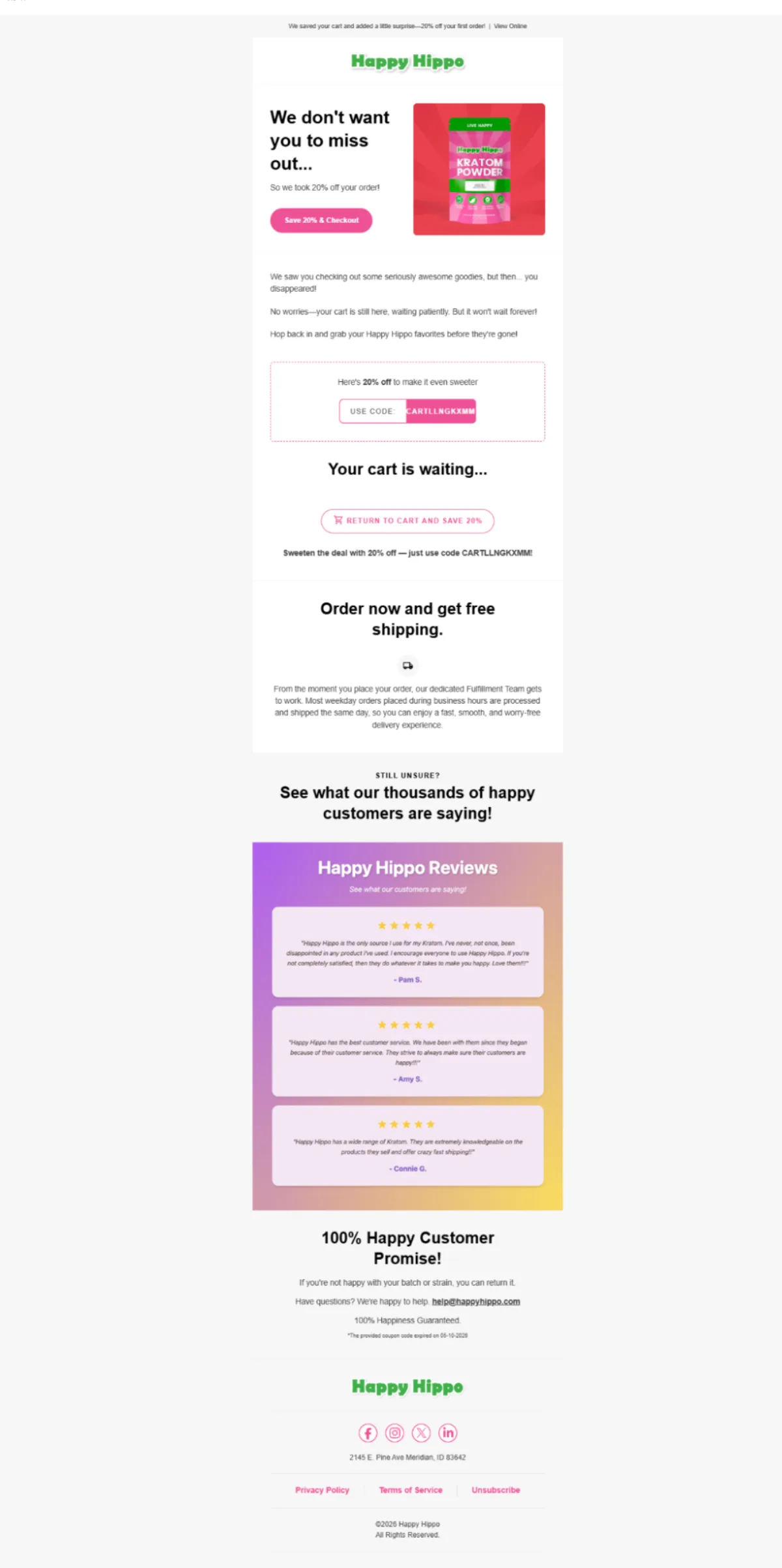
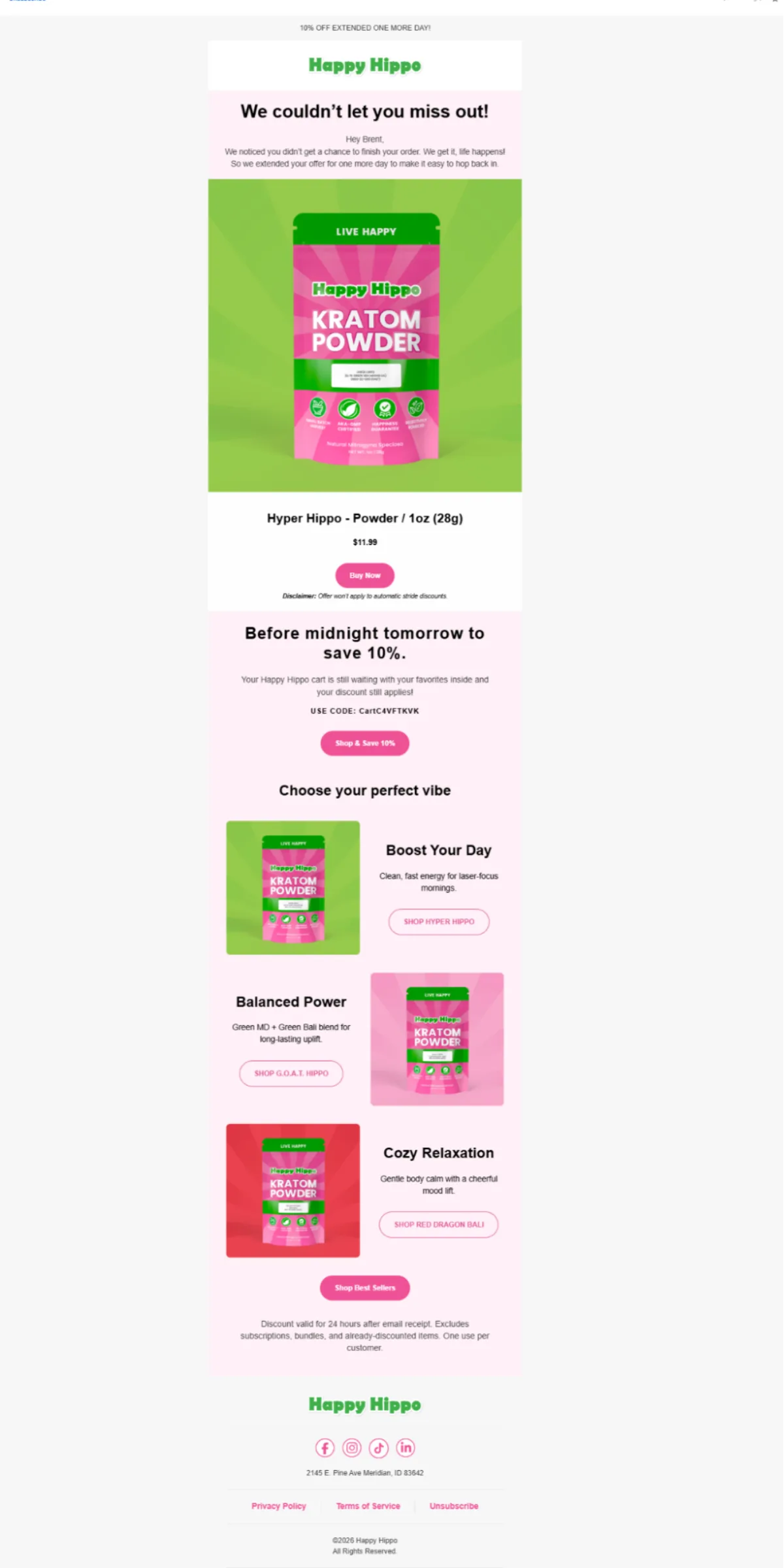
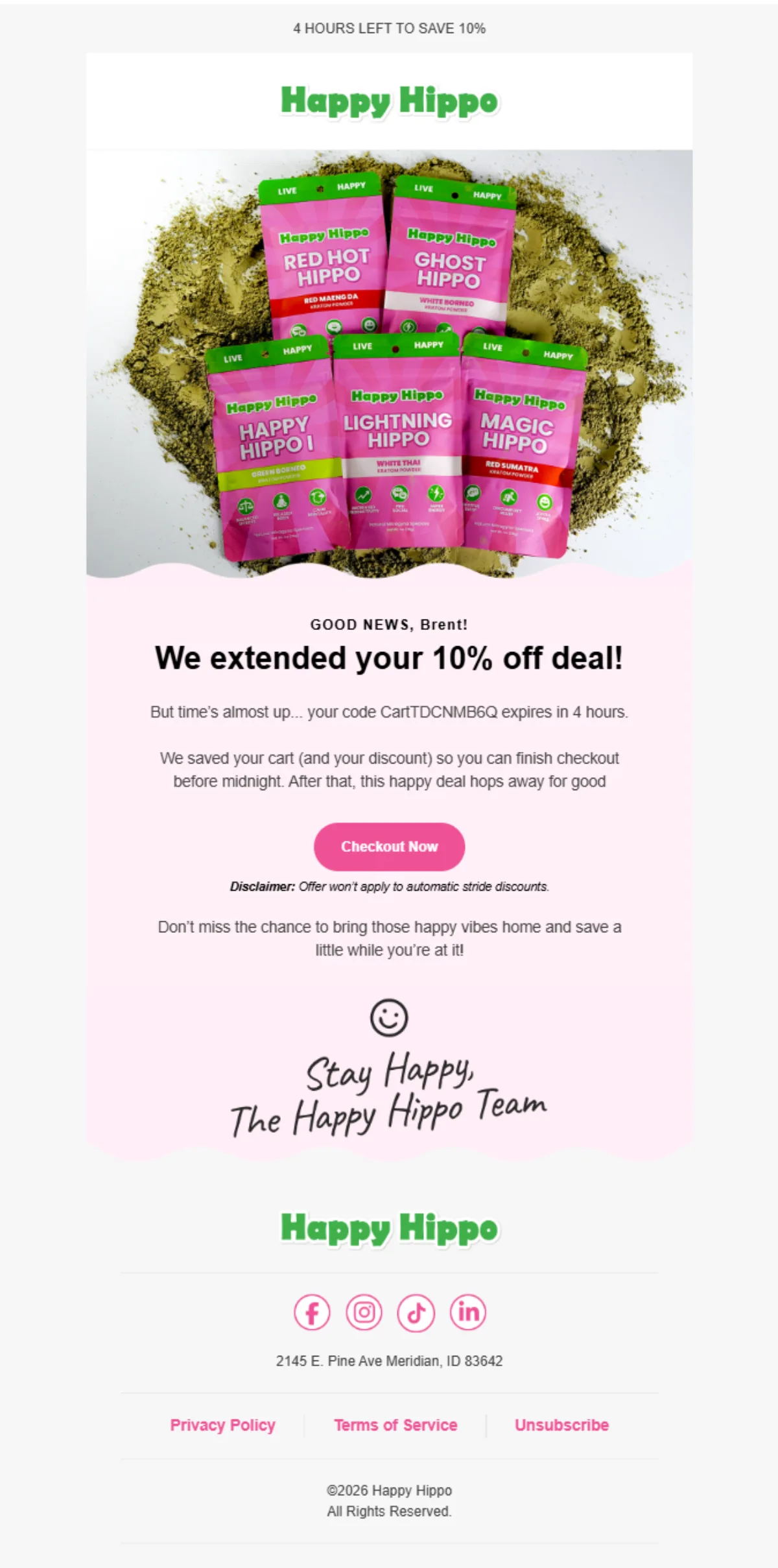
We skipped the standard 2-3 email sequence for our Happy Hippo’s abandoned cart campaign. In the 5-email automated flow we crafted, each one had a specific function.
| Happy Hippo Cart Abandonment Flow | Open Rate |
|---|---|
| Email 1 | 41.4% |
| Email 2 | 36.4% |
| Email 3 | 39.6% |
| Email 4 | 37.9% |
| Email 5(A) | 39.9% |
| Email 5(B) | 37.6% |
What works:
- The 5-email sequences drive one action with a “Return to Your Cart” CTA at the front and center. The emails incorporate clear, high-quality images of abandoned products.
- The fast & free shipping element is part of every email to resolve delivery issues.
- We also included customer reviews and ratings to establish credibility.
- Objection handling email to address safety and quality concerns.
- We introduced incentives late in the sequence in email 4 with a 20% discount.
- In the final email we tested two variations: Email A with a 10% discount and alternate product recommendations and Email B with a 10% discount and a 4-hour deadline for urgency.
KC Hilites Abandoned Cart Email Flow
The abandoned cart email flow we built for KC Hilites included 5 emails sent across 9 days.
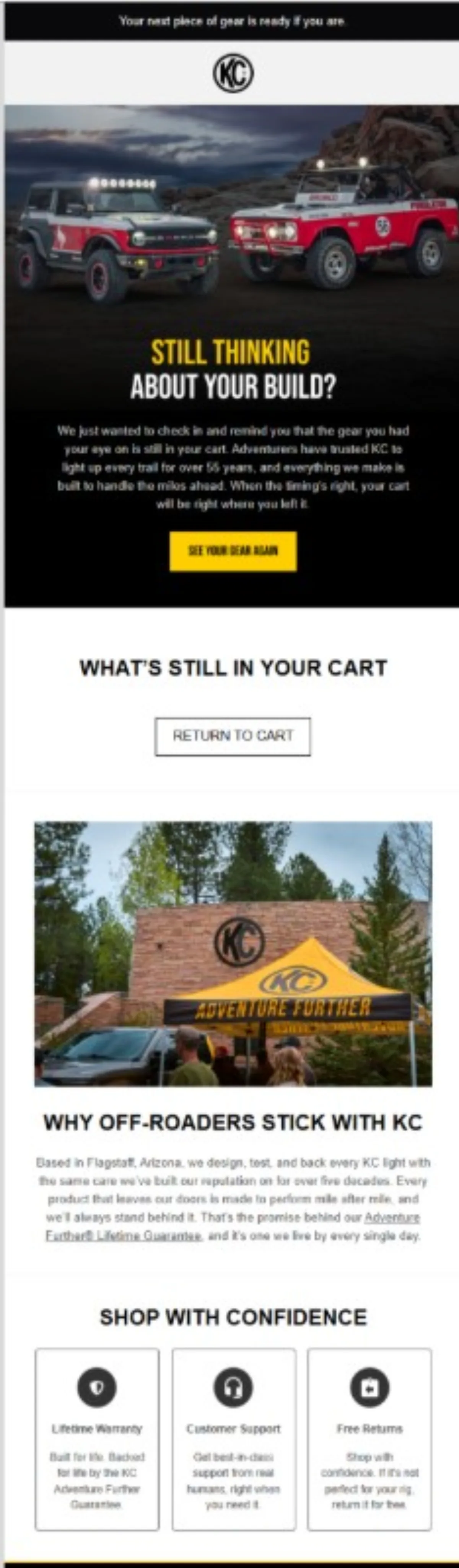
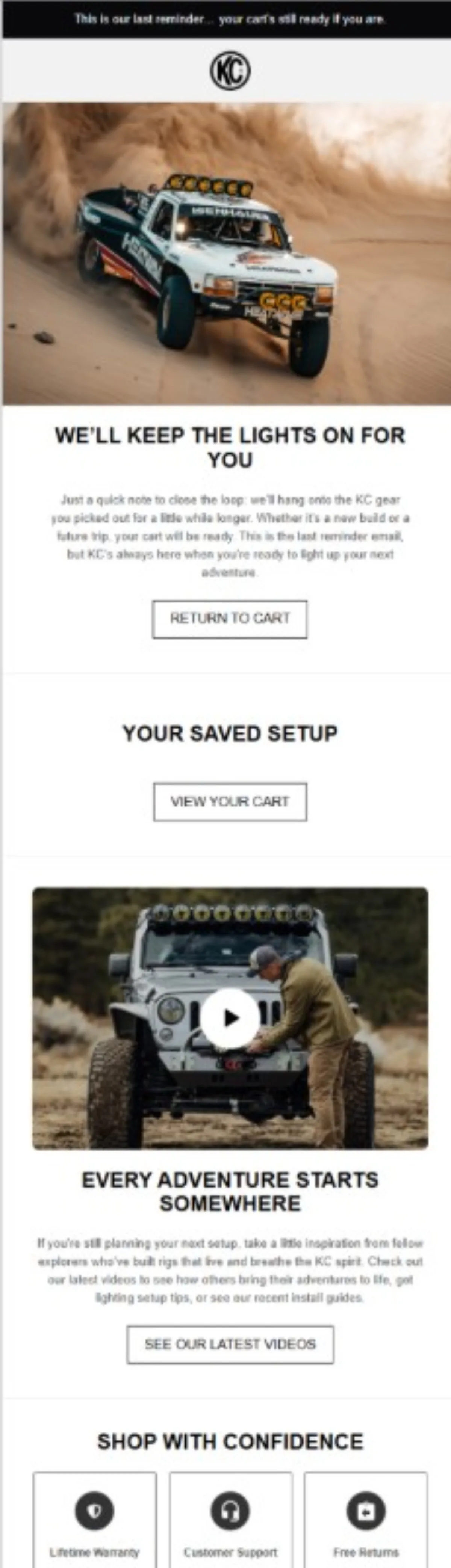
| KC Hilites Cart Abandonment Flow | Open Rate |
|---|---|
| Email 1 | 56.9% |
| Email 2 | 53.1% |
| Email 3 | 58% |
| Email 4 | 54.3% |
| Email 5 (Non-Clickers) | 56.6% |
| Email 5(High-Checkout Value) | 100% |
What works:
- Primary CTA “Complete my Order” encouraging purchase.
- After the initial reminder, we included product highlights, videos, and a link to the YouTube channel for further educational information.
- We included bestsellers in the second email to provide additional and alternate products to the customer.
- The emails also highlighted lifetime guarantees, customer support, and free shipping details to lessen inhibitions.
- Email 4 was a last reminder to complete the purchase sent on day 4 of the sequence.
- After the 4th email, there was a conditional split for higher checkout value and non-engaged.
- For non-engagement even after 4 emails, Email 5 prioritized addressing common concerns with FAQs, a link to customer support, and KC Academy. “Return to cart” CTA was not at the front and center.
- Email 5 for higher checkout value included a bonus free FLX Pack.
Runway Rogue Cart Abandonment Flow
Runway Rogue’s 3-email cart abandonment sequences started with a gentle reminder and then venturing into social proof and rewards.
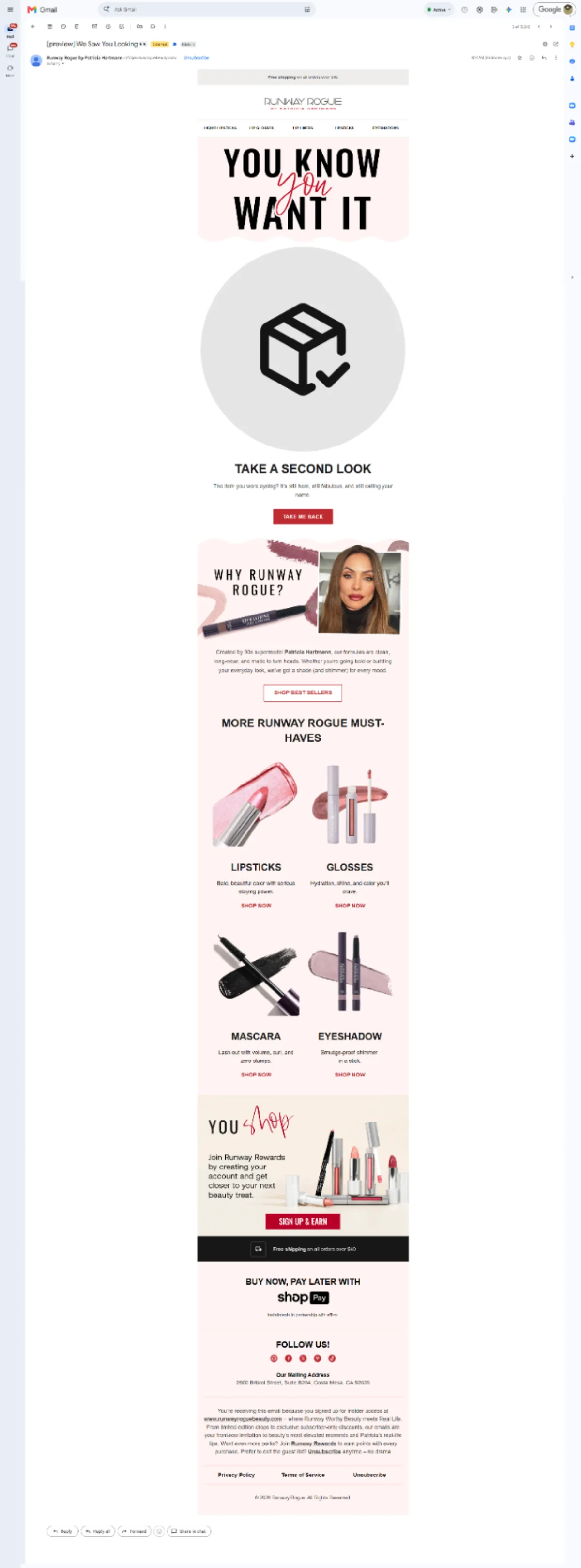
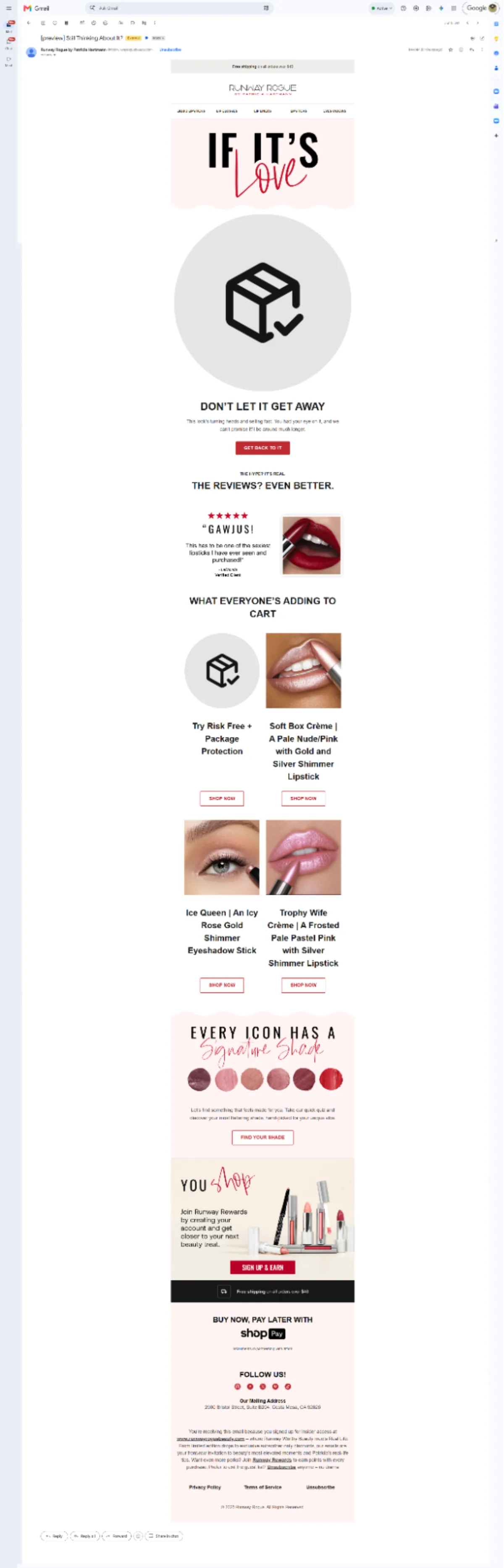
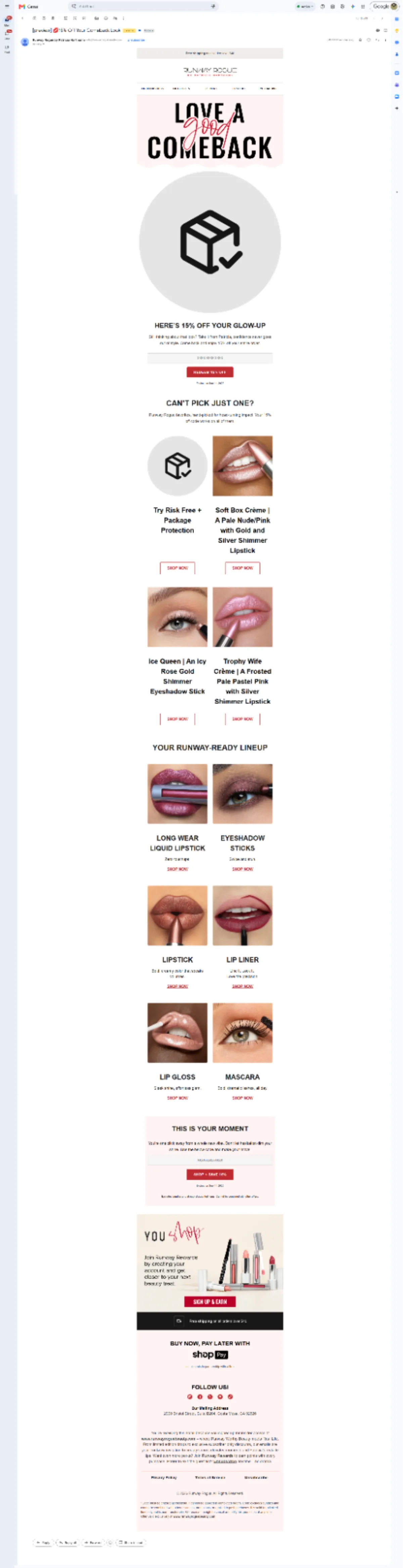
Open Rate: 51.8% Open Rate: 48.9% Open Rate: 49.44%
What works:
- The compelling subject lines we used clearly conveyed the email goal.
Email 1: We Saw You Looking
Email 2: Still Thinking About It?
Email 3: 15% Off Your Comeback Look
- Build trust by adding customer reviews and ratings.
- Encouraged the audience to create an account for Runway Rewards.
- Highlighted the “Buy Now Pay Later” option for a seamless shopping experience.
- Introduced a 15% discount in the final email to drive conversion.
- Incorporated best sellers and must-haves in every email to widen customer choices.
Purple Abandoned Cart Email Flow
InboxArmy built a 3-part abandoned cart email series for Purple to bring back potential customers.
Email 1 Open Rate: 70.9%
Email 2 Open Rate: 65.2%
Email 3 Open Rate: 63.0%
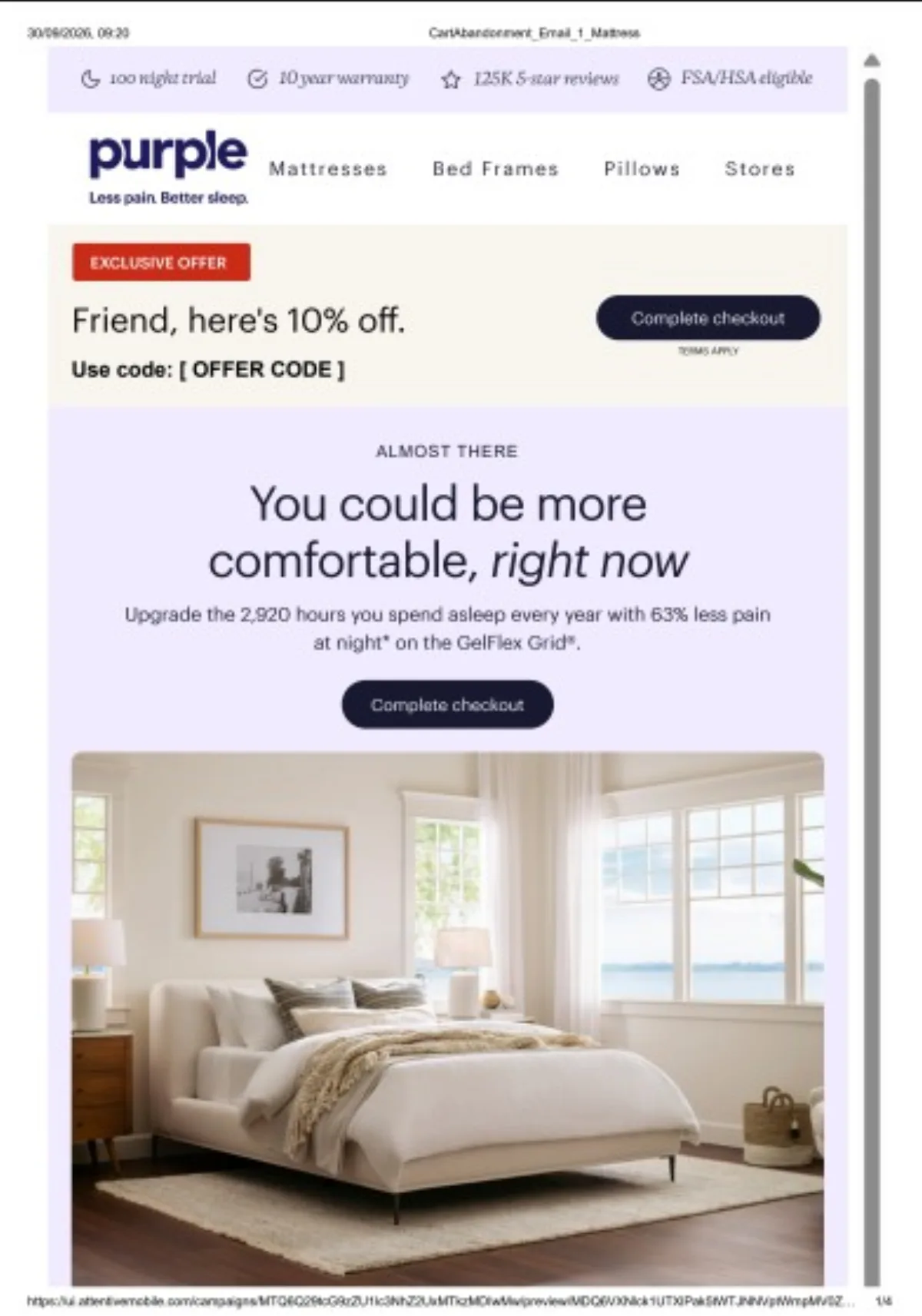
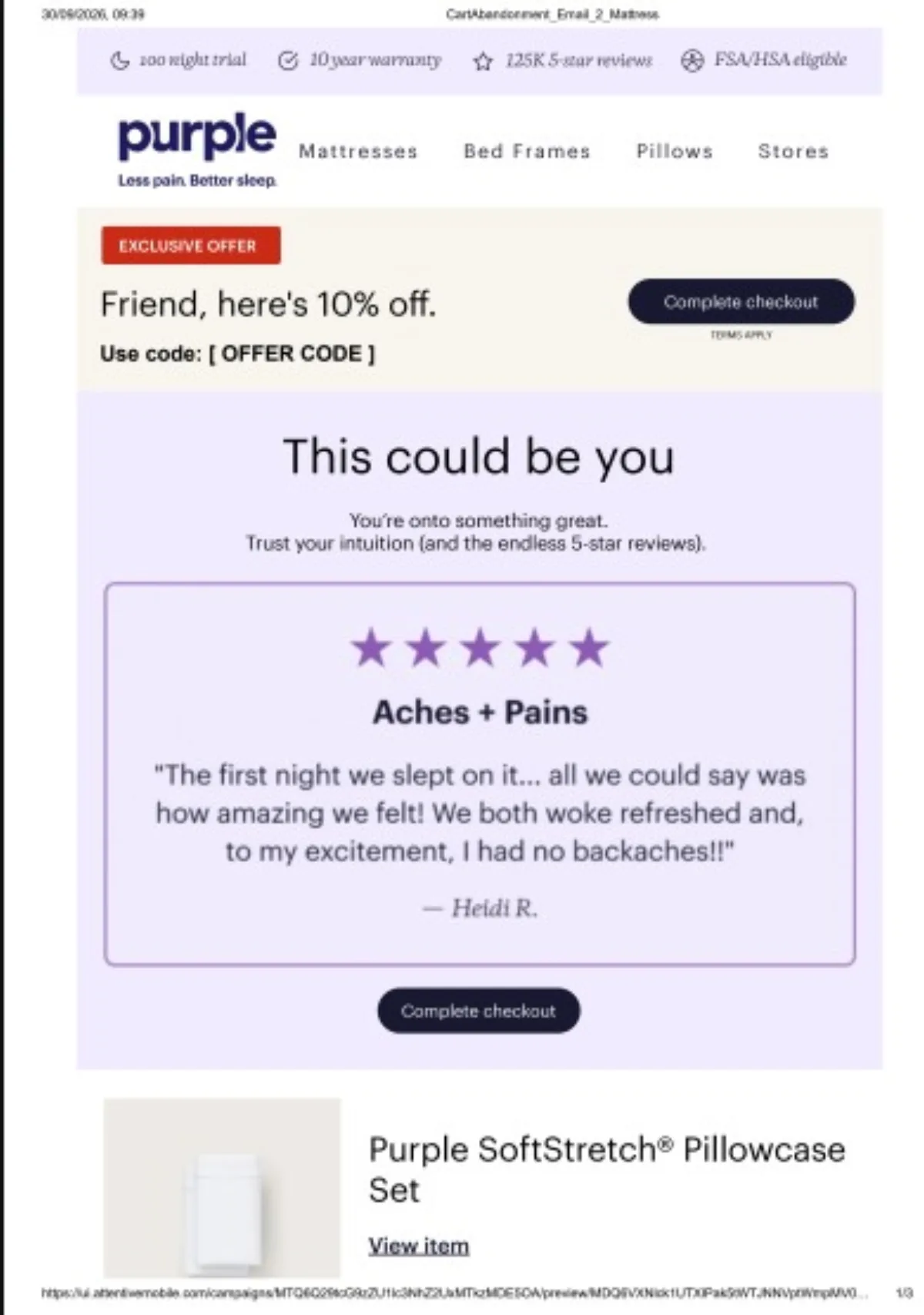
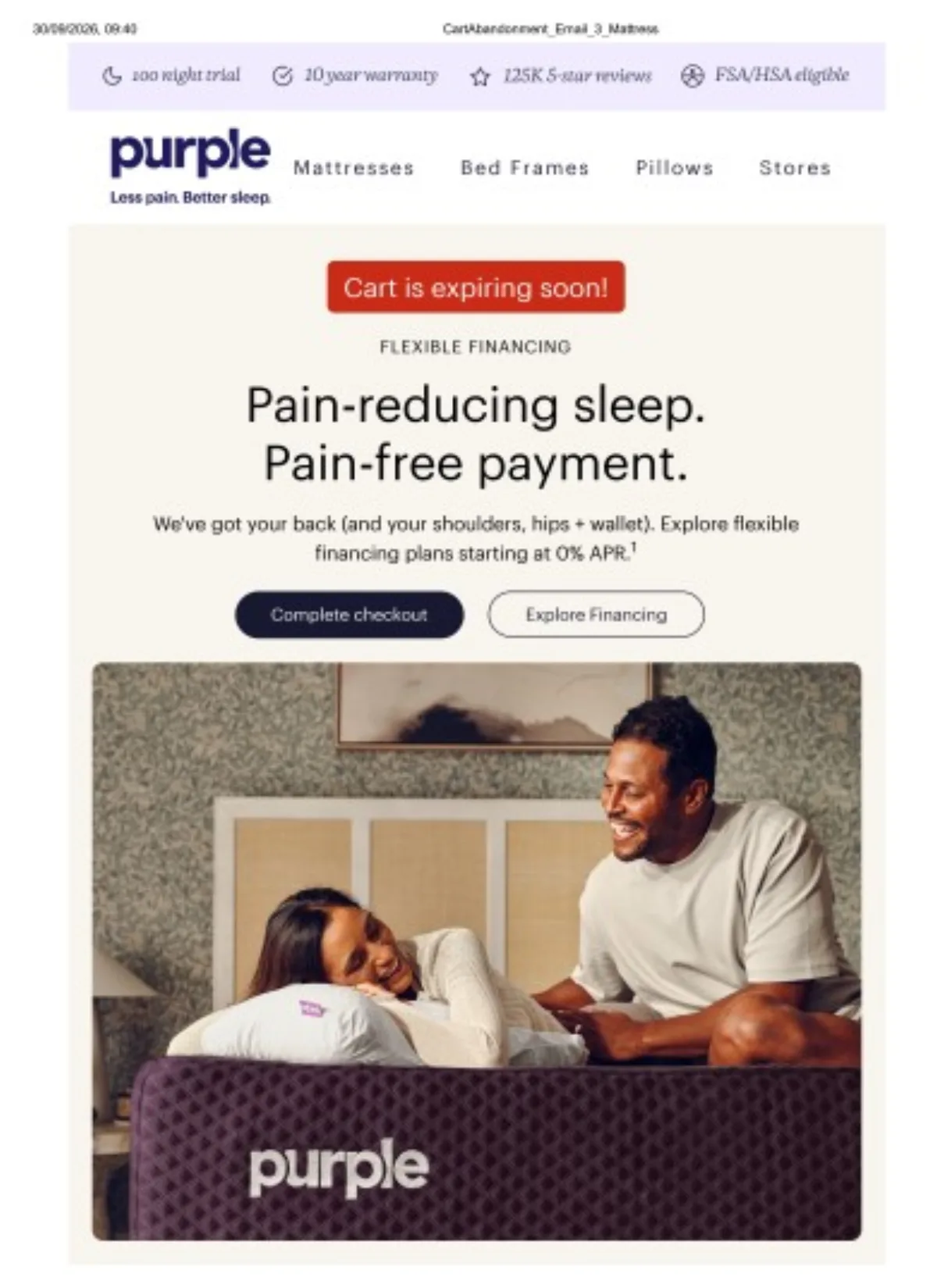
What works:
- We introduced a 10% off discount in the first email and Buy Now, Pay Over Time to urge conversion.
- Every email highlighted product features and exclusive Purple benefits.
- We included “Complete Checkout” and “Take Another Look” CTAs to ease pressure.
- The second email added customer reviews to the compelling argument.
- The last email was also about handling apprehensions with customer support and financing options. It emphasized the expiring cart and discount to create urgency.
How to Measure Abandoned Cart Email Performance
Ongoing tracking of abandoned cart email performance, including recovered revenue, revenue per recipient, and conversion rate, shows the financial results. Click-through rate, unsubscribe rate, and incentive cost show the flow health.
-
Cart abandonment rate:
This metric shows how many carts are abandoned.
-
Recovery rate:
We track the share of abandoned carts that convert after the flow starts.
-
Recovered revenue:
This KPI reveals the total sales the flow produces. We compare it against the cost of the discounts we gave.
-
Revenue per recipient:
Depicts the value of each email sent. Klaviyo’s analysis of more than 143,000 flows shows an average of $3.65, and the top 10% of brands reach $28.89.
-
Recovery or conversion rate:
Use to gauge the abandoned cart email flow’s efficiency. Klaviyo’s average is 3.33%.
-
Click-through rate:
It shows shopper interest. Klaviyo’s average is 6.25%, and the top 10% of brands reach 13.33%.
-
Incentive cost:
This metric indicates the margin you give away. We subtract it from recovered revenue to see the true profit.
-
Unsubscribe rate.
This metric shows how many recipients unsubscribe from the flow.
Note: Open rate adds a directional signal.
To understand the full strategy behind cart abandonment recovery, including how to structure multi-email sequences, optimize send frequency, and write conversion-focused copy, explore Chapter 4 of our Introduction to Email Marketing Course: Cart Abandonment. It explains the behavioral triggers and timing tactics that turn lost carts into recovered revenue.
Abandoned Cart Email FAQs
When should you send abandoned cart emails?
We send the first email within one hour for most products. We extend the delay for higher-priced items with longer buying cycles. Each brand should test its own timing against recovered revenue.
How do you write a good abandoned cart email?
A good abandoned cart email shows the exact products, answers the likely objection, and offers one clear button. We keep the copy short and personal. We add social proof and an incentive only when the segment needs them.
How many abandoned cart emails should you send?
We recommend 2 to 3 emails. The first email reminds the shopper, the second handles objections, and the third gives the final nudge. Each email adds a different reason to return.
Are abandoned cart emails legal?
Abandoned cart emails are legal when they follow privacy and marketing laws. In the US, the CAN-SPAM Act requires a truthful sender name, a clear unsubscribe option, and a valid physical address. GDPR requires a lawful basis and consent where it applies. Each client should confirm the details with legal counsel.
When should abandoned cart emails be sent?
The first email goes out soon after abandonment, and later emails follow at spaced intervals. We space the sequence across several days. Product type and buying cycle set the exact schedule.
Should you offer a discount in an abandoned cart email?
We hold the discount for later emails in the sequence. The first email goes out without one. Shoppers with price objections receive an offer in the second or third email.